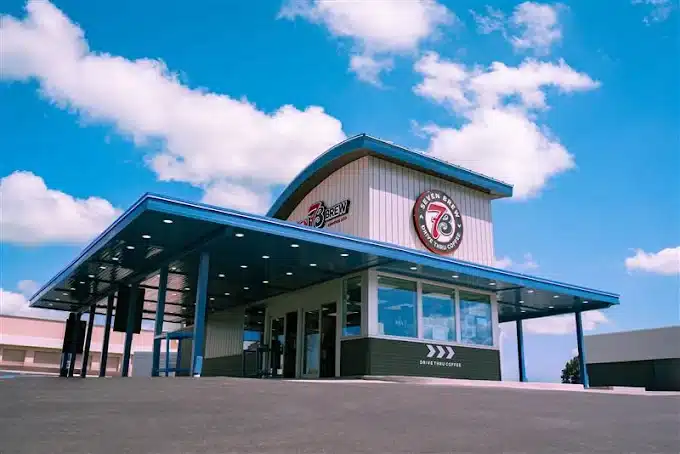
Canandaigua’s Zoning Board of Appeals unanimously approved two variances that could allow the Seven Brew Coffee property on Eastern Boulevard to be divided into separate commercial lots.
The July 15 decision applies to the former Denny’s property at 160 Eastern Blvd., where Brew Team NY LLC demolished the restaurant and opened a drive-through-only Seven Brew location this spring. The company wants to divide the 200-foot-wide parcel into two lots measuring 100 feet across, allowing it to sell or lease the unused portion for future development.
The approval included a condition tying the variances to Seven Brew’s existing site plan. Any future proposal that would remove the current building and replace it with a substantially different development would need to return for additional zoning review.
The board’s only other two scheduled cases, both involving a proposed patio at 228 North Main St., were withdrawn before the meeting.
Subdivision creates two zoning issues
The proposed subdivision required variances because Canandaigua’s zoning code requires a drive-through restaurant to occupy a lot at least 125 feet wide.
Seven Brew would remain on one of the proposed 100-foot lots, making the existing use noncompliant once the new property line is created.
The subdivision would also leave the business’s western drive-through canopy 17 feet from the new side property line. The city requires a minimum side setback of 25 feet.
Doug Beachel, speaking remotely for the applicant, said the company purchased the full former Denny’s site but does not need the entire property for its business model.
“We don’t really need the residual piece of the parcel,” Beachel told the board, explaining that the company hopes to sell or lease the remaining lot for another use.
City staff said the vacant lot would still comply with applicable dimensional requirements when created. Any future developer would need to submit a proposal for review, and another drive-through restaurant would require its own variance because of the 100-foot width.
The final subdivision must also go before the city Planning Commission.
Board weighs whether narrow lot works
Board members focused much of their review on whether the Seven Brew operation could function adequately on a 100-foot-wide parcel.
The coffee stand has been operating since early May, providing the board with a working example rather than a conceptual site plan. Members and staff noted that the building, drive-through lanes and canopy already occupy essentially the same 100-foot portion that would become the new parcel.
Planning staff said the business has operated for several months without apparent site-layout problems.
Board members acknowledged that the requested lot-width variance is mathematically significant, reducing the code requirement by 25 feet. However, they concluded that its practical impact is smaller because the existing drive-through configuration has already demonstrated that it can fit on the proposed lot.
The Seven Brew business model does not include indoor seating and is built almost entirely around drive-through service, reducing the space normally needed for customer parking.
One board member described the operating location as a “proof of concept” showing that the narrower parcel works for this particular use.
The board did not evaluate whether a future business could operate successfully on the second lot. Staff said that issue would be addressed by the Planning Commission during subdivision review and through later site plan or variance applications once a specific development is proposed.
Parking and future uses questioned
Board members questioned why vehicles had frequently been parked on the portion of the property that Seven Brew wants to separate.
Beachel said most of those vehicles belonged to employees and trainees during the location’s opening period. Seven Brew hired between 120 and 140 employees for its regional expansion, and the Canandaigua shop was being used to train workers for other locations.
He said the parking demand should decline as the local operation settles into its regular staffing pattern. The Canandaigua location also has more on-site parking than some other Seven Brew locations, he said.
Beachel noted that the company’s opening fundraiser in Canandaigua raised $25,000 for Happiness House, setting a record for one of its northeastern store openings.
City staff said Seven Brew would not need to rely on parking located on the proposed second parcel for its ordinary operation.
Members also raised concerns about whether the variance could automatically benefit a different business in the future, even if a replacement operation had a site plan that did not work as well.
Variances generally remain attached to the land rather than the business owner. To address that concern, the board conditioned its approval on the existing Seven Brew site plan.
That means a future owner could continue operating within the approved layout, but a proposal to demolish the building or establish a materially different site configuration would require a new review.
The restriction was intended to prevent the approval from becoming a blanket authorization for any future drive-through design on the narrower lot.
Board finds limited neighborhood impact
The board completed the five-part balancing test required for area variances, weighing the benefit to the applicant against possible impacts on the surrounding neighborhood and community.
Members found that the subdivision would not create an undesirable change in the character of Eastern Boulevard, which is already developed with commercial and drive-through businesses.
They also concluded that the applicant could not divide the property as proposed without zoning relief. Leaving an additional 25 feet with Seven Brew would create a second lot only 75 feet wide, making that parcel less practical for development.
The board found no significant environmental impact because the Seven Brew project had already undergone environmental review during the earlier site plan approval process. The proposed subdivision does not change the current operation or physical development of the site.
Members agreed that the difficulty was self-created because the company purchased a parcel larger than it needed and later sought to divide it. However, self-created hardship is only one factor in the variance test and does not automatically require denial.
The board determined that the limited effect on the surrounding commercial district outweighed that concern.
All six voting members supported the application.
The meeting also marked the first appearance of new board member John Auberger, a licensed real estate broker and property manager who said he moved to Canandaigua full time about a year ago after being connected to the community for roughly a decade.

FingerLakes1.com is the region’s leading all-digital news publication. The company was founded in 1998 and has been keeping residents informed for more than two decades. Have a lead? Send it to news@fingerlakes1.com.