


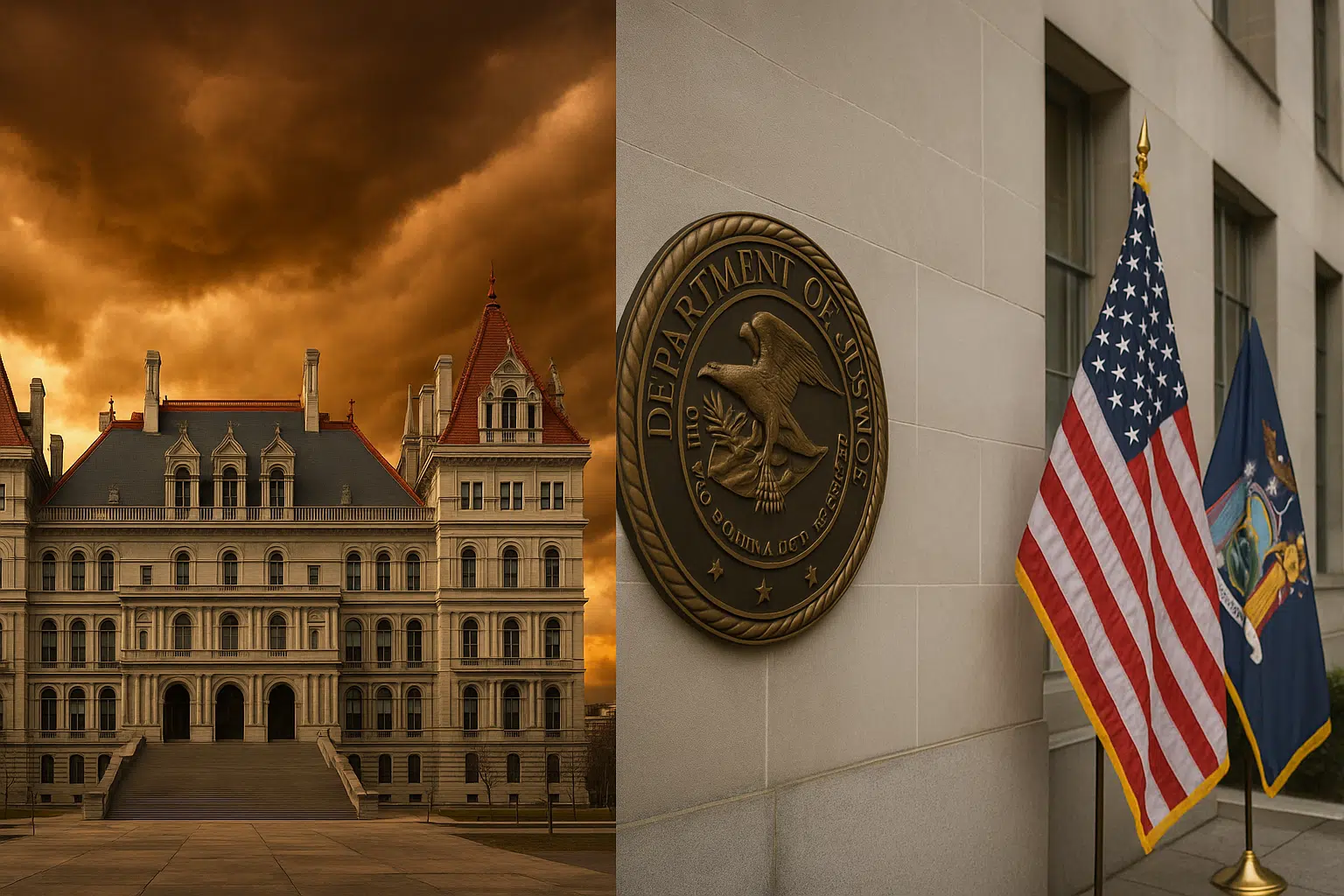
The Trump administration is preparing to repeal federal carbon pollution standards for coal- and natural gas-fired power plants, a move that would loosen federal requirements on the electric sector but leave New York’s own climate mandates and state-level power plant rules largely intact.
Bloomberg reported Sunday that the U.S. Environmental Protection Agency could formally repeal the standards as soon as Monday during the G20 energy ministers’ meeting in Houston. The EPA proposed eliminating the rules in June 2025, arguing the federal government should no longer regulate greenhouse gas emissions from fossil-fuel power plants under that section of the Clean Air Act.
For New York, the immediate effect would be complicated. The state remains heavily dependent on natural gas generation, particularly in New York City and other downstate areas, but it also operates under its own carbon regulations, the Regional Greenhouse Gas Initiative and a state law requiring the electric system to move toward zero emissions by 2040.
That means eliminating the federal standards wouldn’t erase New York’s restrictions on fossil generation or its statutory clean-energy targets. It would, however, remove a federal layer of regulation that was expected to push power plants nationally toward lower emissions, retirement or technologies such as carbon capture.
New York has its own power plant rules
The federal rules targeted by the Trump administration were adopted under former President Joe Biden in 2024. They established carbon dioxide requirements for certain existing coal plants and new natural gas plants, with compliance strategies varying based on plant type and how long facilities planned to operate.
EPA Administrator Lee Zeldin proposed repealing those requirements in June 2025. The agency said at the time that it was reconsidering whether emissions from fossil-fuel power plants should be regulated under Section 111 of the Clean Air Act.
New York has a separate regulatory structure.
The state Department of Environmental Conservation maintains carbon dioxide performance standards for major electric generating facilities under Part 251 of state regulations. New York also participates in the Regional Greenhouse Gas Initiative, or RGGI, which places a declining regional cap on carbon dioxide emissions from covered power plants and requires generators to obtain allowances for their emissions.
New York and other RGGI states have been working toward further reductions in that regional cap. A state regulatory proposal released in late 2025 described a regional plan that would reduce the cap by roughly 89% between the 2024 level and 2037.
Those rules don’t depend on the Biden-era EPA power plant standards remaining in place.
New York’s Climate Leadership and Community Protection Act creates another layer. State law calls for at least 70% of electricity consumed in New York to come from renewable sources by 2030 and for the statewide electric demand system to reach zero emissions by 2040.
The Public Service Commission reaffirmed those targets during its most recent Clean Energy Standard review in 2025, while adjusting programs intended to help the state continue moving toward them.
Natural gas remains critical to New York’s grid
The federal rollback could still matter in New York because natural gas remains the state’s largest source of electricity generation.
The U.S. Energy Information Administration listed natural gas as New York’s primary electricity source in 2024. The state’s power plants generated about 129 million megawatt-hours that year and emitted roughly 31.5 million metric tons of carbon dioxide, according to federal data.
Natural gas consumption by New York’s electric sector has remained substantial in 2026. EIA data show power generators in the state consumed about 38 billion cubic feet of natural gas in March alone, about 20% more than during March 2025.
That dependence is particularly important downstate.
The New York Independent System Operator has repeatedly warned that natural gas generation will remain necessary for reliability while renewable generation, transmission, storage and other zero-emission resources are built.
NYISO’s 2025 Power Trends report said natural gas plants are expected to continue playing an important reliability role during the transition toward the state’s 2040 goal. Many downstate plants can burn either natural gas or oil, giving grid operators another fuel option during extreme weather or natural gas supply constraints.
NYISO has also incorporated tighter gas-supply assumptions into its winter reliability planning. One recent assessment modeled conditions in which approximately 6,400 megawatts of gas-only generation could be unavailable during winter peaks because of fuel constraints.
Those reliability concerns exist independently of EPA’s carbon regulations.
Federal repeal could change the economics outside New York
One of the larger implications for New York may come from what happens beyond the state’s borders.
New York’s electric grid is interconnected with neighboring regions, and electricity regularly moves between New York, New England, Ontario, Quebec and the PJM system serving Pennsylvania and other states.
If coal and natural gas plants elsewhere face fewer federal carbon requirements, some could remain economically viable longer than previously expected. That could affect regional electricity prices, generation investment and the mix of power available for import into New York.
The magnitude of that effect is uncertain. Power plant decisions depend on fuel prices, wholesale electricity markets, state policies, plant age, environmental rules beyond carbon dioxide and the cost of maintaining older generating units.
The repeal also wouldn’t remove other federal pollution requirements covering contaminants such as nitrogen oxides, sulfur dioxide and particulate pollution, although the Trump administration has separately moved to reconsider or repeal several environmental regulations affecting fossil-fuel plants.
Coal itself is a much smaller issue inside New York than natural gas. New York’s generation system has moved substantially away from coal, meaning the most direct in-state questions surrounding the EPA action involve gas-fired facilities rather than large coal plants.
New York’s 2040 target remains the bigger constraint
For owners of New York gas plants, federal deregulation could reduce one potential compliance obligation, but it doesn’t resolve the much larger question created by state law: what role, if any, can fossil-fuel generators play as New York approaches 2040?
The state’s zero-emission electricity requirement has forced regulators and grid planners to examine resources capable of supplying electricity when wind and solar output is low and demand is high.
New York regulators opened a proceeding specifically focused on technologies that could fill that reliability gap. The state has also been studying expanded transmission, storage, virtual power plants and other flexible grid resources.
At the same time, the state’s ability to meet its interim renewable targets has faced practical pressure from project cancellations, rising costs, permitting timelines, supply-chain problems and transmission needs.
That creates a tension the federal rollback doesn’t solve. New York can continue imposing tougher climate requirements than Washington, but maintaining reliability while reducing the role of gas generation requires enough replacement capacity and supporting infrastructure to be built.
Another potential state-federal legal fight
The EPA action could also become part of a broader legal fight over federal climate authority.
New York Attorney General Letitia James has repeatedly challenged environmental rollbacks by the Trump administration. In July, New York joined a multistate lawsuit seeking to block an EPA rule weakening federal restrictions on hydrofluorocarbons, another category of greenhouse gases.
New York has also participated historically in litigation over federal efforts to regulate — or stop regulating — greenhouse gas emissions from power plants.
No New York lawsuit over the reported final repeal had been announced as of early Monday morning.
Any challenge would likely focus heavily on the Clean Air Act and the EPA’s legal justification for abandoning the standards. The administration has argued the federal statute doesn’t require the power-sector carbon regulations adopted under Biden and that their climate benefits don’t justify the regulatory burden.
Environmental groups and states supporting federal carbon regulation have taken the opposite position, arguing the Clean Air Act gives EPA both the authority and responsibility to control greenhouse gas pollution from major sources.
Federal and New York policy moving in opposite directions
The practical result is an increasingly sharp split between Washington and Albany over the future of fossil-fuel electricity.
The Trump administration is moving to reduce federal restrictions and encourage continued fossil-fuel production and generation. New York law is still directing regulators toward a power system that eventually eliminates greenhouse gas emissions from electricity consumption.
For the foreseeable future, New York gas plants could therefore operate in a regulatory environment where federal carbon requirements are weaker while state carbon requirements continue tightening.
The next immediate step is the EPA’s expected final action. Bloomberg reported that the administration could formally announce the repeal Monday, Sept. 14.

FingerLakes1.com is the region’s leading all-digital news publication. The company was founded in 1998 and has been keeping residents informed for more than two decades. Have a lead? Send it to news@fingerlakes1.com.