

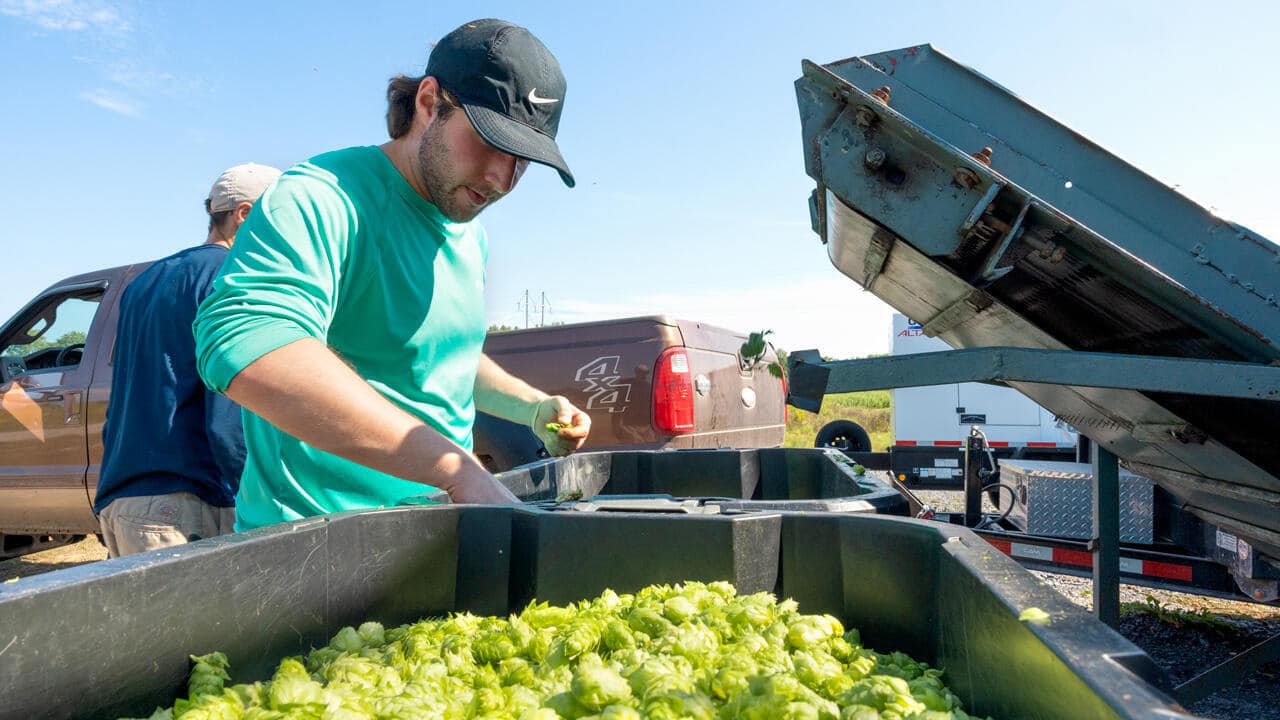
Cornell researchers are testing dozens of commercial, experimental and heritage hop varieties in Geneva in an effort to determine which plants can succeed in New York fields and produce flavors brewers actually want to use.
The work at Cornell AgriTech is intended to reduce some of the financial risk growers face when deciding whether to plant a new hop variety. Researchers are measuring yield, disease resistance and cone quality, then moving promising varieties into brewing trials with breweries across the region.

“It’s very expensive to establish a new variety in their hop yard,” said Larry Smart, a professor in Cornell’s School of Integrative Plant Science. “To put in 1,000 plants not knowing if any brewer will buy them is a huge risk.”
Smart said the program’s goal is to give growers more reliable information before they make those investments.
61 varieties under evaluation
At Cornell AgriTech’s Gates East Farm, researchers are working with 61 hop varieties that mature at different times and under different conditions.
The team began harvesting Aug. 10 and expects work to continue through about Sept. 25.
The current research includes 38 commercial varieties, seven experimental lines and 16 heritage varieties.
Nathan Lewis, a third-year doctoral student in Smart’s lab, is among those evaluating when individual hop varieties are ready for harvest. Researchers examine factors including flowering time, cone maturity and moisture levels.
The team is also experimenting with taller trellis systems.
Cornell’s conventional hop trellis is about 18 feet high, but Smart said some varieties grow beyond that height, reach the top wire and then flop over, potentially reducing harvestable material.
Researchers are installing six rows of 21-foot trellis using concrete posts donated by Jensen Precast. Smart said the donated materials represent a savings of roughly $18,000.
The taller system could increase yield, though it also creates practical challenges, including finding longer string and determining whether existing spraying equipment can reach the additional height.
From research plot to brewery
Cornell’s work does not stop with field performance.
Smart said beer quality ultimately determines whether a hop variety has commercial potential, so researchers are placing promising varieties in the hands of brewers.
Nine varieties are currently involved in brewing trials, including seven heritage lines recovered from old New York farms and homesteads.
Among them is USDA 032, an experimental hop described as having herbal, spicy and stone-fruit notes. It has been used by breweries including Big aLICe, Druthers, Fifth Hammer, Swiftwater and Watershed.
Reality, a heritage Cluster hop, has been used in cream ales and pale ales produced by Gem Creek, Seneca Lake Brewing, Steuben and Watershed.
Barryville, another heritage variety found near the community of the same name, has been featured in a Genesee Brew House pilsner and a Belgian pale ale produced by Brewery Ardennes and Scale House.
Dwyer 2 was used in a pilsner brewed by Strong Rope.
Smart’s lab has narrowed its focus to eight varieties — a combination of new USDA material and heritage hops — that have performed well enough in yield and production and appear to offer qualities likely to interest brewers.
Looking for a distinctly New York hop
The research comes as the national craft beer industry has contracted in both overall consumption and the number of breweries, though Smart said New York has been slower to experience those declines.
He pointed to the state’s strong local-food culture and its network of roughly 525 craft breweries.
Cornell recently held a Craft Brewer Open House to give brewers a closer look at the varieties being tested.
The program is also offering freshly harvested hops to brewers on a first-come, first-served basis on harvest days.
Several breweries associated with the Seneca Lake Order of Brewers are expected to request wet hops for an Oct. 17 competition.
The larger goal, Smart said, is to identify a signature New York hop that works not only agronomically for growers, but also commercially for breweries and ultimately for consumers.
At the center of that equation are the lupulin glands inside each hop cone. Those glands produce the oils and bitter compounds that shape beer’s aroma, flavor and bitterness.
For Cornell researchers, the question is whether a hop can perform from the field all the way to the pint glass.

FingerLakes1.com is the region’s leading all-digital news publication. The company was founded in 1998 and has been keeping residents informed for more than two decades. Have a lead? Send it to news@fingerlakes1.com.