

Wayne County supervisors will face a wide-ranging agenda Tuesday that includes resolutions involving the name of Lake Ontario, opposition to a state food-procurement bill, a major change in how towns receive sales tax revenue and acceptance of up to $1 million to address a blighted property in Savannah.
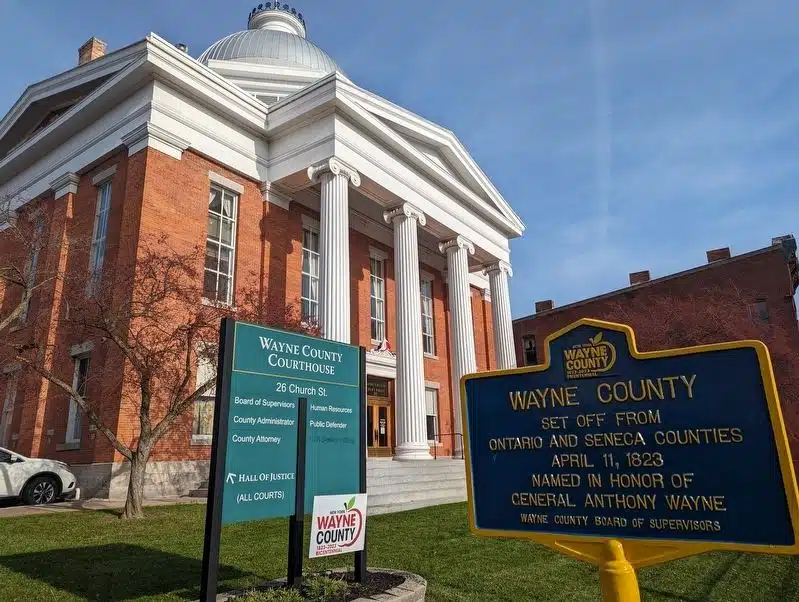
The Board of Supervisors is scheduled to meet at 9 a.m. Sept. 15 at the Wayne County Historic Court House in Lyons. More than 40 resolutions are on the agenda spanning public safety, health care, EMS, county staffing, economic development, youth programs and financial administration.

County could formally reject Lake Ontario name change
One of the more unusual items is a Rule 14 resolution stating Wayne County’s preference to continue calling Lake Ontario by its longstanding name in county communications and documents.
The resolution cites the lake’s historical and regional significance, its importance to communities on both sides of the U.S.-Canada border and concerns about the costs to taxpayers and businesses from changing documents, publications and branding. It says the county recognizes federal naming authority but wants to preserve the Lake Ontario name locally.
The issue follows President Donald Trump’s federal action renaming Lake Ontario as “Lake America” in U.S. geographic naming systems, a change that has also appeared for U.S. users on major digital mapping platforms. (Reuters)
If adopted, Wayne County’s resolution would be forwarded to state and federal representatives and other officials.
Supervisors to consider urging Hochul to veto ‘Good Food’ bill
The board will also consider a resolution urging Gov. Kathy Hochul to veto state legislation known as the “Good Food” bill.
The legislation would allow municipalities and other public entities to give procurement preference to food products meeting certain standards involving local economies, environmental resilience, workforce conditions, agriculture, animal welfare, nutrition and other factors, provided the bid is not more than 10% higher than the lowest responsible bidder.
Supporters of the legislation have argued it would give public institutions more flexibility to consider local sourcing, working conditions, public health and other factors instead of relying primarily on price. (New York City Council)
Wayne County’s proposed resolution takes the opposite position, arguing the criteria would create uncertainty for farmers and local governments and could discourage some producers from bidding. It calls for Hochul to veto the legislation, as she did with an earlier version in 2024.
Sales tax distribution could change for all 15 towns
Supervisors will also consider formalizing a significant change in how Wayne County distributes sales tax revenue to its towns.
Historically, the towns’ share of sales tax revenue has been applied to reduce county property taxes levied within each town. All 15 Wayne County towns have now passed resolutions seeking direct payment of that money instead.
The resolution before supervisors would recognize those local actions and allow the county treasurer to make direct sales tax payments to towns for use for town purposes. The change would continue in subsequent years.
The Finance Committee is also bringing forward proposed 2026 equalization rates that will affect 2027 county taxes, along with a new deputy director position in Real Property Tax Services intended to improve succession planning.
$1 million Savannah blight project on agenda
The county could accept up to $1 million through the Community Development Block Grant Imminent Threat Program for a deteriorated property on North Main Street in Savannah.
The county previously authorized an application seeking funding to clear the property, which is owned by the Wayne County Land Bank and is described in the resolution as deteriorated, blighted and a threat to public health and safety.
The proposed action would accept the grant, establish the necessary budget accounts and authorize a subrecipient arrangement to implement the project.
Wayne County is separately considering an application for as much as $1.5 million through the federal EPA Brownfield Assessment Grant Program and adding $500,000 in previously accepted federal funding to its brownfield revolving loan fund.
Another proposal would seek $150,000 from the Genesee Transportation Council to develop a countywide active transportation corridor plan, with a $15,000 county match.
Public Health seeks approval to add dental services
Wayne County Public Health will ask supervisors for permission to pursue state approval to add dental care to its existing Article 28 certification.
County officials say the goal is to increase access to dental services for lower-income children and families and people eligible for Medicaid. Tuesday’s resolution would authorize submission of the required limited-review application to the state Department of Health; it would not itself establish the service.
Public Health is also seeking authority to expand its Early Intervention provider agreement so the county can directly provide speech, special instruction, occupational therapy and physical therapy to qualifying children from birth through age 3.
Officials say the change is intended to address children currently waiting for services.
Another resolution would continue a five-year childhood lead poisoning prevention agreement worth $39,900 annually, or $199,500 over the contract period.
EMS billing, staffing changes under consideration
Wayne County EMS is seeking several operational changes.
Supervisors will consider replacing two authorized substitute paramedic positions with two additional substitute EMT positions. County officials say the adjustment would improve coverage and reduce costs without harming operations.
The county is also considering bringing ambulance billing work in-house using ImageTrend’s Billing Bridge software.
County staff compared outsourcing billing with purchasing software and determined that handling the work internally offered what the resolution describes as a “clear and decisive” financial advantage. The proposed contract would cost $24,840 in the first year and $56,782 over three years.
Nursing home would add six resident attendants
The Wayne County Nursing Home is asking supervisors to create six additional full-time resident attendant positions through the 2027 budget.
Five would work in nursing services and one would be assigned to rehabilitation services.
Resident attendants perform non-medical care duties, allowing certified nursing assistants to concentrate more heavily on clinical work. The positions can also serve as a pathway into the county’s in-house CNA training program.
The nursing home is also proposing to replace an account clerk position with a senior account clerk position and shift money within its 2026 budget, including $60,000 toward help-wanted advertising.
Youth programs compete for state funding
Supervisors are also scheduled to award state-supported youth program funding.
Under the Youth Sports and Education Opportunities program, an evaluation committee recommends giving the Town of Huron $10,000 for a weeklong sports camp and the Lyons Community Center $24,500 for sports and educational programming. Six organizations applied for the available money.
A separate Youth Development award would provide $39,700 to the Town of Marion for a six-week summer recreation program serving 70 children and up to $5,300 to Scarlet Thread for after-school programs across eight Wayne County communities.
Public safety grants and staffing also on agenda
The board will consider accepting $325,645 in state Aid to Defense funding, with 75% designated for the Public Defender’s Office and 25% for the Assigned Counsel Program.
Another $114,471 would continue the county’s Victim/Witness Services program for the upcoming year.
Wayne Pre-Trial Services could also receive an additional $250,000 through an amended county contract tied to a larger $1 million state grant for the Wayne County Intervention Program. The additional spending is expected to be reimbursed by the state.
Supervisors will also consider filling a full-time assistant district attorney position after the District Attorney’s Office reported a substantial felony caseload and growing discovery obligations, including review of body-camera footage.
The board is scheduled to return for its next regular meeting Oct. 20.

FingerLakes1.com is the region’s leading all-digital news publication. The company was founded in 1998 and has been keeping residents informed for more than two decades. Have a lead? Send it to news@fingerlakes1.com.