
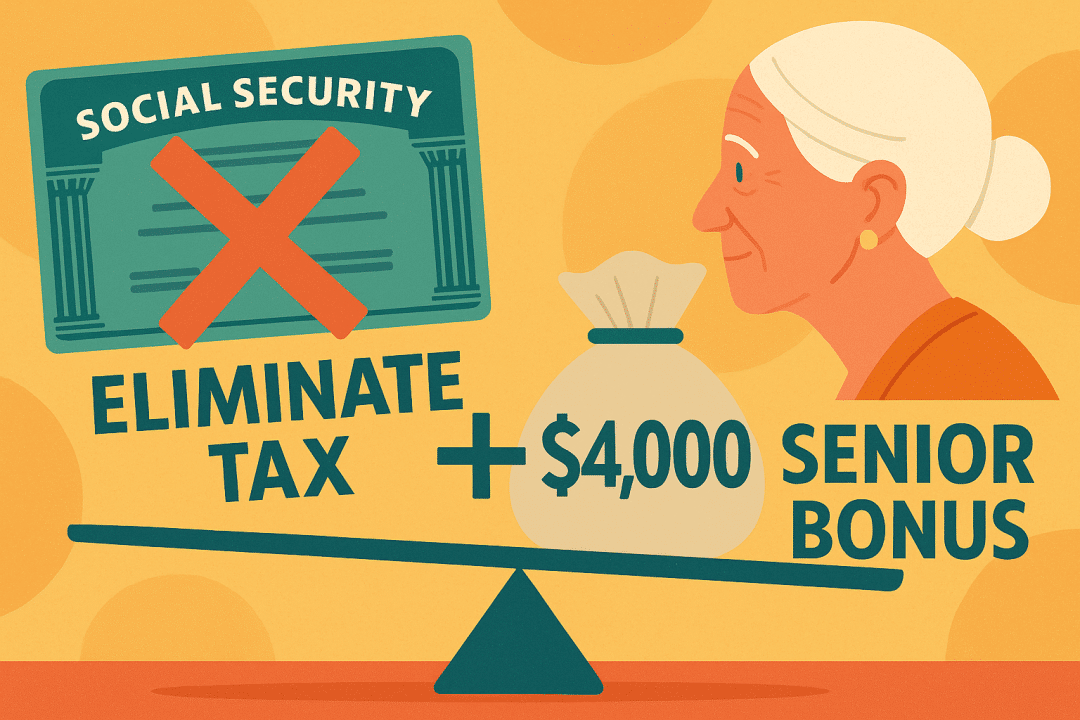
House Republicans’ latest tax proposal offers retirees a temporary $4,000 “senior bonus” deduction instead of fully exempting Social Security benefits from taxation. Here’s how the two options stack up.
What is the $4,000 senior bonus?
- Temporary deduction: Applies for tax years 2025–2028.
- Eligible taxpayers: Individuals age 65+ who claim either the standard deduction or itemize.
- Phase‑out thresholds: Begins at $75,000 MAGI for singles and $150,000 for joint filers.
- Estimated benefit: A retiree with $50,000 income could save roughly $500 annually .
How Social Security benefits are taxed
- Combined income: AGI + nontaxable interest + half of Social Security.
- Tax brackets: Up to 50% of benefits taxed for combined income of $25,000–$34,000 (single) or $32,000–$44,000 (joint). Up to 85% taxed above $34,000 (single) or $44,000 (joint) .
Comparing costs and impacts
| Feature | $4,000 deduction | Exempting benefits |
|---|---|---|
| Cost over 10 years | ~$200 billion | > $1 trillion |
| Benefit type | Deduction (lowers taxable income) | Exemption (eliminates tax liability) |
| Who benefits most | Lower‑ to middle‑income older people (phase‑out limits) | Higher‑income retirees (paying 85% tax rate) |
| Effect on Social Security trust | No direct impact | Directly reduces trust fund revenue |
Why policymakers prefer the senior bonus
- Budget rules: Reconciliation bans changes to Social Security taxes in this bill.
- Cost control: The deduction is less than 20% the cost of full exemption and spares trust funds.
- Targeting: Focuses relief on older people who still owe income tax, without over‑rewarding high earners.
What it means for retirees
- Modest relief: Most will see a few hundred dollars saved, not a full elimination of tax bills.
- Not life‑changing: Experts note it’s helpful but far from the windfall that full exemption would provide.
- Phase‑out effects: Well‑off retirees may receive little to no benefit once income limits are exceeded.
Key takeaway: The $4,000 senior bonus is a targeted, budget‑friendly way to ease tax burdens on retirees. It costs far less than removing taxes on Social Security benefits altogether but delivers only modest savings to most beneficiaries.


This content is brought to you by the FingerLakes1.com Team. Support our mission by visiting www.patreon.com/fl1 or learn how you send us your local content here.


