

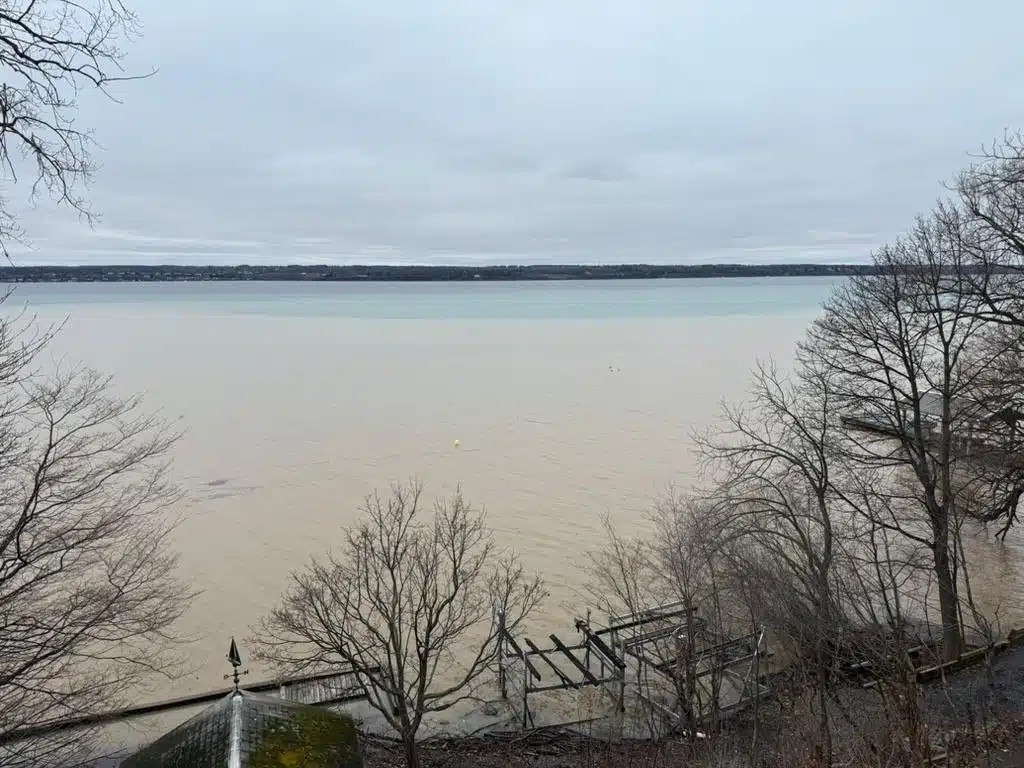
Federal regulators have declined to order immediate action to address a malfunctioning gate at the Seneca Falls Development that is leaking an estimated 164 cubic feet of water per second from the Seneca Lake system.
The Federal Energy Regulatory Commission determined the temporary measures sought by the Seneca Lake Pure Waters Association weren’t warranted after reviewing the organization’s complaint and a July deviation report from the project’s licensee. The agency said the current plan remains to repair low-level Gate #4 following a full reservoir drawdown after the canal navigation season.
Pure Waters filed a formal complaint with FERC on Aug. 13, asking regulators to address the leaking gate and consider temporary measures that could reduce or stop the loss of water before permanent repairs are made.

The organization estimates the leak could account for roughly two additional inches of lake-level loss per month beyond other seasonal factors.
FERC initially responded Sept. 2, referring the complaint to its Office of Energy Projects’ Division of Hydropower Administration and Compliance. The agency said it would treat the filing as a noncompliance allegation and review the matter.
A second response came Sept. 9, when FERC said lake-level deviations reported in July wouldn’t be considered violations of Article 405 of the project’s federal license.
According to Pure Waters, FERC attributed those deviations to low precipitation and the need to maintain required minimum flows at the project.
The agency also found that previous efforts to temporarily seal Gate #4 had failed and additional attempts could potentially cause more damage. Sending a diver to inspect or repair the gate without a full reservoir drawdown was also determined to be unsafe.
As a result, regulators didn’t require additional action in response to the complaint.
The issue has drawn attention around Seneca Lake following a year in which both high and low water conditions have caused problems for homeowners, boaters and other lake users.
Pure Waters acknowledged that precipitation and weather are major factors affecting lake levels but said the Gate #4 malfunction creates an additional source of water loss.
Seneca Lake is part of a larger interconnected water system that includes the Cayuga-Seneca Canal, Van Cleef Lake and the Oswego River basin. Water levels are affected not only by weather but by operational and regulatory requirements across that system.
Pure Waters said its Lake Level Committee will continue monitoring conditions, tracking the Gate #4 repair and communicating with FERC and other agencies. The committee is also examining the broader system used to manage Seneca Lake levels and potential opportunities for longer-term improvements.
The two FERC responses are public records associated with Project No. P-2438.

FingerLakes1.com is the region’s leading all-digital news publication. The company was founded in 1998 and has been keeping residents informed for more than two decades. Have a lead? Send it to news@fingerlakes1.com.