New York has hit pause on some of the largest proposed data centers as state officials confront a surge in electricity demand that could reshape the power grid, increase water use and leave utility customers paying for costly infrastructure.
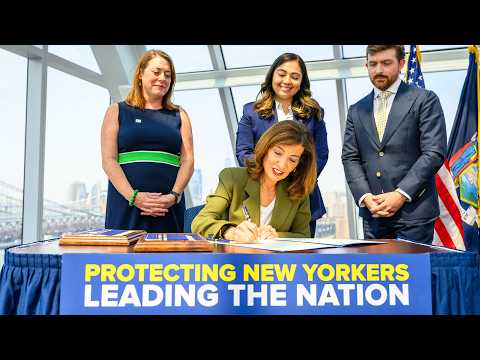
Gov. Kathy Hochul signed Executive Order 62 on Tuesday, establishing a temporary moratorium while the state develops new environmental standards, ratepayer protections and community-benefit requirements for large-scale data center projects. The pause could last up to one year, but it does not amount to a blanket ban on every data center proposal in New York.

The order comes as artificial intelligence, cloud computing and other digital services drive demand for facilities containing thousands of computer servers. As of May, nearly 12 gigawatts — or 12,000 megawatts — of proposed data center demand was waiting in the New York Independent System Operator’s interconnection queue, including more than 8 gigawatts added during 2025 alone.
Here are five things New Yorkers should know about the new policy.
1. The moratorium targets the largest data centers
The executive order applies to data centers that consume, or could consume, at least 50 megawatts of electricity.
That threshold is significant. A 50-megawatt facility can place sustained demand on the power system comparable to that of a small city or tens of thousands of homes, depending on usage patterns. The largest hyperscale campuses can require several hundred megawatts.
Under the order, a data center generally includes facilities used to house servers and related equipment for data storage, cloud computing, content delivery, internal business operations and other computing services. Covered facilities often operate continuously and rely on backup power, cooling systems and cybersecurity infrastructure.
The order excludes certain facilities primarily used for manufacturing, academic research, quantum computing research, biomedical research, education or medical care.
That means the policy is aimed primarily at large commercial projects built to support intensive computing operations rather than ordinary server rooms, hospital systems, university research facilities or smaller technology operations.
2. The state is pausing certain environmental permits, not all local reviews
The moratorium works through the state’s environmental permitting process.
Until the Department of Public Service completes a statewide Generic Environmental Impact Statement, the Department of Environmental Conservation will hold certain discretionary permit applications for covered data centers in abeyance.
The pause applies to projects that still require DEC permits, approvals or licenses and were not considered complete before the executive order took effect. Projects with completed applications may be treated differently, depending on their status and the permits involved.
The order does not stop local governments from reviewing zoning applications, site plans, subdivisions, building permits or other municipal approvals. It also does not automatically cancel projects already underway.
Local planning boards, zoning boards, town boards and industrial development agencies may continue reviewing proposals. However, a project unable to obtain a required state environmental permit could not move into construction or operation until the moratorium ends or the state determines it is exempt.
The practical impact will therefore vary by project. Proposals requiring major water withdrawals, air permits, wetland approvals or other DEC action could face significant delays, while projects farther along in the approval process may have more flexibility.
3. New York will study energy, water and environmental impacts
The Department of Public Service must develop a Generic Environmental Impact Statement examining the cumulative effects of data center development across New York.
The review will look at electricity demand, grid reliability, water consumption, water quality, air quality, noise, lighting and the effects on disadvantaged communities. It is also expected to establish consistent standards that state agencies and project developers can use after the pause ends.
Water use is emerging as a major issue because many data centers rely on cooling systems that can consume large quantities of water. The executive order directs DEC to review whether its existing water withdrawal regulations, reporting requirements and guidance adequately account for large industrial users such as data centers.
DEC must submit a report within 12 months identifying potential regulatory or policy changes needed to address water demand and other environmental concerns.
The state is also reviewing how utilities study large electricity customers. Transmission owners will be asked to examine whether their current methods properly estimate the grid upgrades and new power supplies needed to serve data centers.
Once the environmental review and related standards are finalized, the moratorium can be lifted. Future projects would then be allowed to proceed if they comply with state requirements and obtain necessary local approvals.
4. Hochul wants developers, not ratepayers, to cover grid costs
Protecting utility customers is one of the central goals of the order.
State officials are concerned that utilities could spend billions of dollars building substations, transmission lines and other equipment for proposed data centers, only for some projects to be delayed, downsized or abandoned. Those costs could eventually be spread across the broader customer base.
The Department of Public Service is already conducting an “Energize NY” proceeding intended to determine how large energy users should connect to the grid. Hochul has said data centers should pay more of the costs they create or provide their own power.
The executive order directs state regulators to consider creating a New York Grid Acceleration Fund. Data center developers could be required to contribute money for transmission upgrades, new clean energy supplies and other system investments.
The state may also consider an insurance pool designed to protect customers when utilities build infrastructure for speculative projects that do not materialize.
Other options include requiring data centers to develop or fund new electricity generation dedicated to their operations. That could include on-site energy resources, battery storage or other power supplies that reduce pressure on the public grid.
Hochul is also pursuing legislation to repeal state sales tax exemptions for the largest data centers. That proposal would require approval from the state Legislature and is separate from the executive order.
5. Host communities could seek millions in direct investment
The state is developing a Community Investment Framework to help municipalities negotiate with data center developers.
Empire State Development must publish the framework within 60 days. It is intended to provide local governments, industrial development agencies and developers with a standard starting point for community-benefit agreements.
The preliminary policy recommends that communities begin negotiations at $1 million in developer contributions for every megawatt of anticipated electricity demand.
Under that formula, a 50-megawatt project could be expected to contribute $50 million, while a 200-megawatt development could begin negotiations at $200 million. A 400-megawatt campus could face a recommended community investment of $400 million.
Those figures are not automatic taxes or mandatory payments under the executive order. They are proposed baselines that communities could use when negotiating project agreements, tax incentives or other approvals.
Eligible investments could include water and sewer upgrades, roads, public transit, parks, housing, child care, schools, libraries, hospitals, emergency services, workforce training, broadband expansion and energy affordability programs.
The framework also calls for prevailing wages, project labor agreements, apprenticeships, local hiring and workforce-development commitments. Developers could be asked to address noise, lighting, landscaping and other neighborhood impacts through enforceable “good neighbor” provisions.
Transparency would be another major component. Data center operators could be expected to publicly report their electricity and water use, employment levels, average salaries, tax payments, construction workforce, environmental impacts and community investments.
The policy reflects a basic challenge surrounding data center development: The projects can bring enormous private investment and tax revenue, but they often create relatively few permanent jobs compared with traditional manufacturing facilities.
New York’s moratorium gives the state one year to decide how those trade-offs should be handled. The outcome could determine not only where large data centers are built, but also who pays for the infrastructure they require and what host communities receive in return.

FingerLakes1.com is the region’s leading all-digital news publication. The company was founded in 1998 and has been keeping residents informed for more than two decades. Have a lead? Send it to news@fingerlakes1.com.