

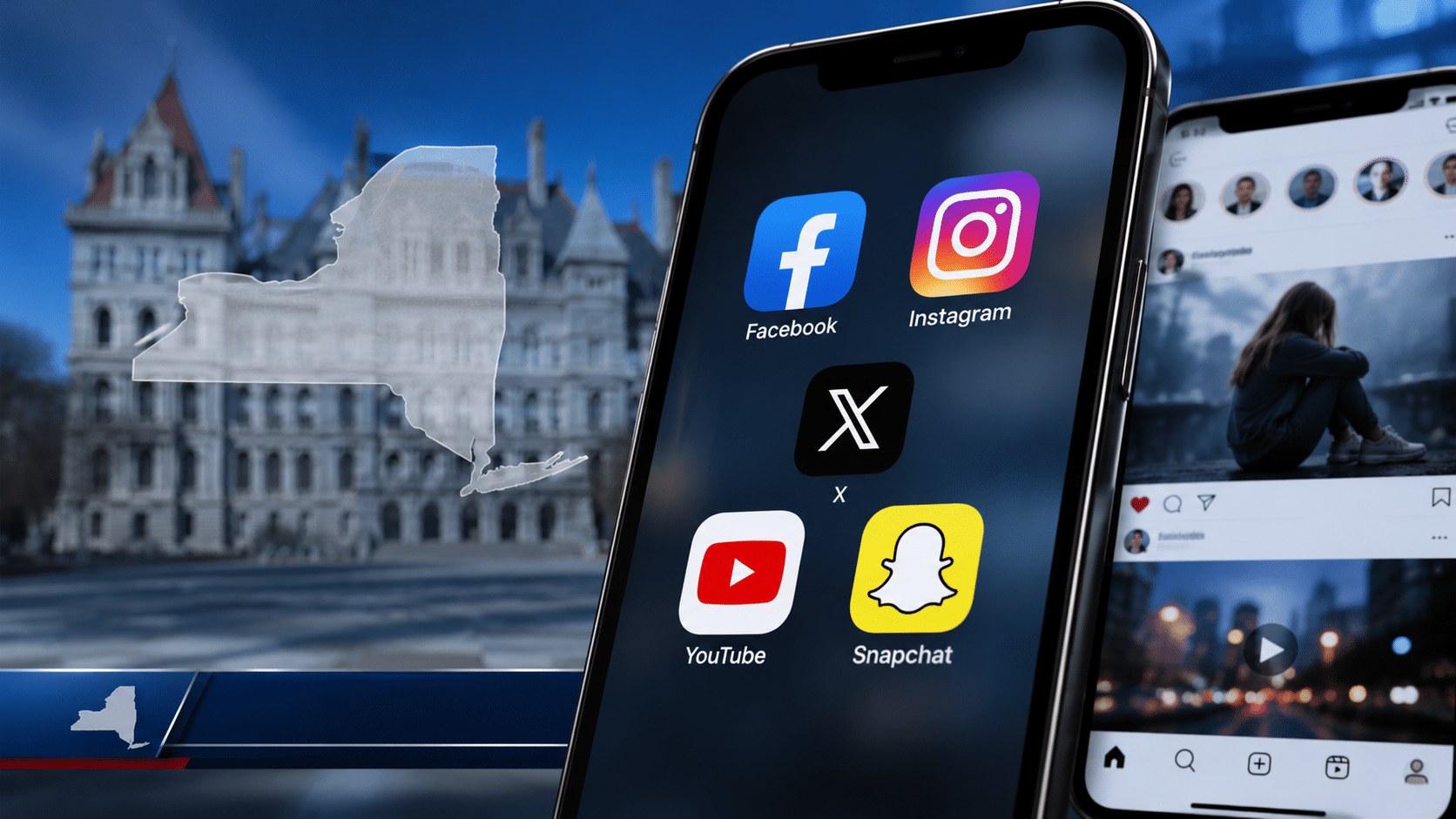
A majority of Americans now support banning children under 16 from using social media, a new Pew Research Center survey shows, adding momentum to a fast-moving debate that has already pushed New York into the center of the national fight over kids, phones and addictive online platforms.
The survey, conducted May 26 to June 1, found that 56% of U.S. adults support a ban that would prevent anyone under 16 from using social media sites. Another 21% oppose the idea, while 23% said they were not sure.

The findings come months after Gov. Kathy Hochul signed legislation requiring warning labels on certain social media platforms, making New York one of the states most aggressively trying to regulate the way social media companies design products used by young people.
New York’s law does not ban children from social media. Instead, it targets the features state lawmakers say keep users — especially teens — scrolling, watching, checking and returning to platforms for longer stretches of time.
Those features include addictive feeds, autoplay, infinite scroll, like counts and push notifications. Under the law, platforms that offer those features must display warning labels to users in New York.
The new Pew survey suggests the public conversation has moved beyond whether social media should be regulated. The sharper question now is how far government should go.
Support cuts across age, party and parent status
The Pew findings show broad public support for stronger limits on minors’ social media use, even though Americans remain divided over the most aggressive option: a full ban for users under 16.
Support was highest among adults ages 30 to 49, with 63% backing an under-16 ban. That age group includes many parents currently raising school-age children and teens.
Parents of children under 18 were also more likely to support a ban than adults without minor children. Pew found that 65% of parents backed the idea, compared with 52% of adults who do not have a child under 18.
The issue also cuts across party lines. Among Republicans and Republican-leaning independents, 59% supported banning social media for children under 16. Among Democrats and Democratic-leaning independents, 54% supported it.
That matters politically. Social media regulation has often been framed as a culture-war issue, especially when debates touch on content moderation, censorship, privacy and parental rights. But the Pew data shows a different pattern on youth access: many Americans across the political spectrum see social media as a child safety issue.
The survey also found broader support for less sweeping restrictions. Eighty-five percent of adults said they support requiring parental consent before minors can create social media accounts. Seventy-eight percent support age verification before using social media sites. The same share supports limits on how much time minors can spend on social media.
All three figures increased from 2023, when 81% supported parental consent, 71% supported age verification and 69% supported time limits.
New York chose warnings over an outright ban
New York’s warning label law takes a different approach than the under-16 ban backed by many adults in the Pew survey.
Rather than blocking young users from social media altogether, the law requires platforms with certain addictive design features to display warnings. The state’s goal is to force platforms to confront users with information about potential mental health risks tied to prolonged or compulsive social media use.
The legislation, Senate Bill S4505, applies to addictive social media platforms that provide features such as addictive feeds, autoplay, infinite scroll, like counts or push notifications as a significant part of their service.
The warning label must be designed by the state commissioner of mental health, in consultation with the state health commissioner and education commissioner. The label must be based on medical and sociological research, including government publications and peer-reviewed studies.
The law also gives the state Office of Mental Health authority to update the warning label annually as research changes. The agency must also issue an annual report to the governor, attorney general and legislative leaders explaining how research shaped the warning label and whether the law should be updated.
Enforcement falls to the state attorney general, who can seek court orders, restitution, damages, disgorgement and civil penalties of up to $5,000 per violation.
The law is built around the same basic theory as tobacco or alcohol warnings: consumers should see the health risk before or during use, not buried inside a terms-of-service agreement no one reads.
The law targets design, not just content
The core of New York’s approach is that the problem is not only what young people see online. It is how platforms are built to keep them there.
The bill’s legislative findings cite concerns about algorithmic feeds, endless scroll, autoplay, notifications and likes. Lawmakers described those features as part of a design system that rewards frequent checking and prolonged use.
That framing is important because it avoids a narrower fight over specific posts, accounts or types of speech. Instead, New York is targeting platform architecture — the mechanics that determine how users are nudged, retained and pulled back in.
For parents, the distinction is familiar. A teen may open an app to respond to one message, then get pushed into an endless stream of videos, recommended posts and alerts. The issue is no longer a single app session. It is the cumulative effect of repeated, frictionless use.
Supporters of regulation argue that families cannot solve that alone. They say parents are being asked to police products designed by some of the world’s most sophisticated technology companies.
Opponents of aggressive regulation have raised different concerns. Age verification can create privacy risks. A ban can be difficult to enforce. Warning labels may face legal challenges if companies argue the state is compelling speech or overstating disputed research.
That tension is why New York’s law matters. It is a middle-ground policy, at least compared with an under-16 ban. It does not remove children from social media. It does not require every user to prove age before opening an account. It instead tries to make addictive design features more visible and legally accountable.
A national debate is accelerating
The Pew survey shows the political ground is shifting quickly.
Many major social media platforms already require users to be at least 13 to create an account. But the new polling suggests many adults no longer see 13 as a meaningful safety threshold.
Internationally, some governments have gone further or are considering tougher rules. Pew noted that Australia, Canada and the United Kingdom are among the countries that have set or are considering a minimum age of 16 for social media use. In the United States, lawmakers in California have considered similar legislation.
New York has already taken multiple steps in this space. The warning label law builds on earlier state efforts to regulate addictive feeds and strengthen protections for minors online.
The practical question now is implementation. State regulators must determine what the warnings say, when they appear, how long they remain visible and how platforms must comply. Those details will decide whether the law becomes a meaningful intervention or another notice users learn to ignore.
For families across New York, the broader message is clear: social media is no longer being treated as a private household issue alone. It is becoming a public health, consumer protection and education issue.
The new Pew survey shows most Americans are open to stronger guardrails. New York’s law shows one version of what those guardrails can look like.
The debate is no longer about whether kids are spending too much time online. It is about who has the responsibility to change that — parents, platforms, schools, lawmakers or all of them at once.

FingerLakes1.com is the region’s leading all-digital news publication. The company was founded in 1998 and has been keeping residents informed for more than two decades. Have a lead? Send it to news@fingerlakes1.com.