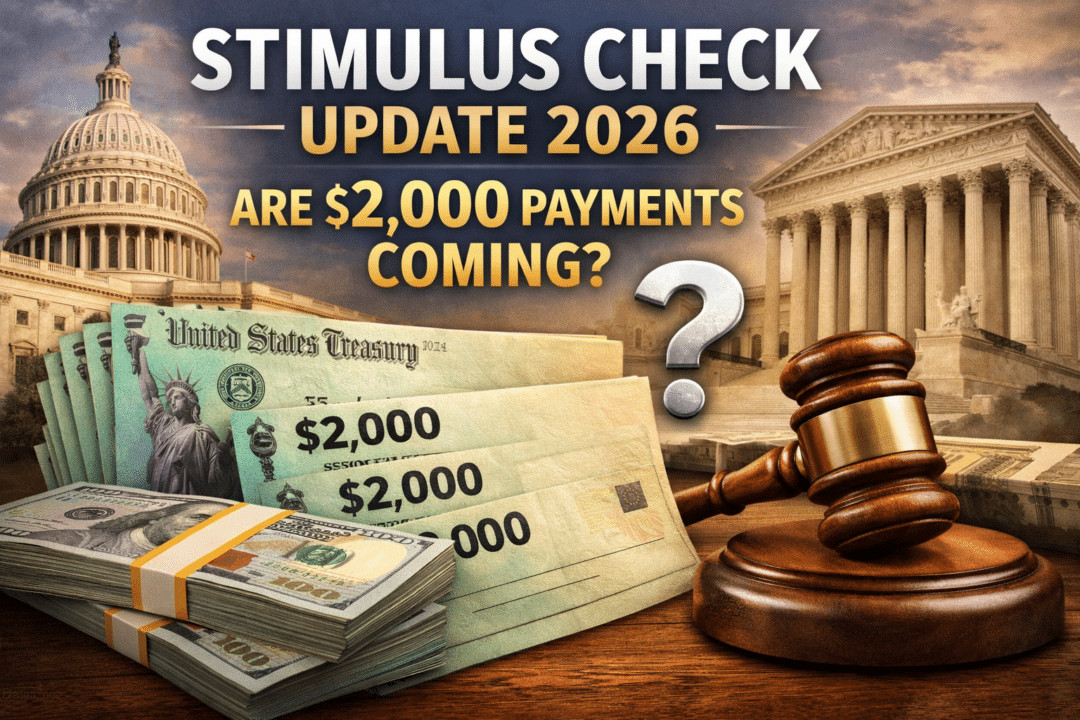
Americans are once again searching for answers about stimulus checks, fueled by renewed talk of a possible $2,000 payment tied to tariff revenue under President Donald Trump. While the idea has been widely discussed, no stimulus check has been approved or scheduled as of January 2026.
Here’s what we know right now, what’s uncertain, and what would need to happen before any money is sent out.
Is There a New Stimulus Check Coming?
Short answer: Not yet.
The White House has floated the idea of a $2,000 “tariff dividend” payment, but it is not an approved stimulus program and does not currently exist in law. No checks have been authorized, no payment dates have been set, and no eligibility rules have been finalized.
Despite public statements suggesting checks could be sent later in 2026, multiple legal and political hurdles remain unresolved.
What Is the $2,000 Tariff Dividend?

The proposed payment would come from tariff revenue collected on imported goods, rather than from deficit spending like the COVID-era stimulus checks.
President Trump has described it as a “dividend” for Americans, arguing that tariffs have generated hundreds of billions of dollars in federal revenue. Administration officials, however, have offered conflicting explanations about how the payments would work and whether Congress must approve them.
That uncertainty matters—because without legislation, the checks cannot legally be issued.
Does Congress Have to Approve a Stimulus Check?
Most likely, yes.
White House economic advisers and Treasury officials have repeatedly stated that Congress would need to appropriate the funds before any payments could go out. While the president has suggested alternative funding mechanisms, no legal pathway has been publicly detailed.
Until Congress passes a bill, the proposal remains theoretical.

Who Would Qualify for a $2,000 Stimulus Check?
There are no official eligibility rules, but early discussions suggest the payments would be income-restricted, similar to past stimulus programs.
Analysts modeling the plan often assume it would follow the COVID-era framework:
- Full payments for individuals earning up to $75,000
- Reduced payments above that level
- Phase-outs for higher earners
- Possible adjustments for households with children
The president has explicitly said high-income earners would be excluded, but no thresholds have been confirmed.
When Could Stimulus Checks Be Sent?
Even optimistic estimates point to late 2026 at the earliest—and that assumes:
- Congress passes authorizing legislation
- Courts uphold the tariffs funding the payments
- Federal agencies are directed to distribute funds
As of now, none of those steps have occurred.
The Supreme Court Factor
A major wildcard is an ongoing Supreme Court case that could determine whether certain tariffs are constitutional. If the court rules against the administration, the government could be forced to refund tariff revenue, eliminating the funding source entirely.
That ruling alone could kill the stimulus check proposal.
How Much Would the Checks Cost?
Independent estimates suggest the program could cost $450 billion to over $600 billion, depending on eligibility rules.
That’s more than most projections of annual tariff revenue, raising serious questions about:
- Sustainability
- Deficit impact
- Whether the payments would be one-time or recurring
Several nonpartisan budget groups have warned the math does not currently add up.
Bottom Line: Should You Expect a Stimulus Check?
Right now, no.
There is:
- No approved stimulus bill
- No guaranteed funding source
- No payment date
- No confirmed eligibility
The $2,000 stimulus check remains a proposal, not a program. Until Congress acts and legal challenges are resolved, Americans should treat claims of “checks coming soon” with skepticism.
What to Watch Next
If a stimulus check becomes real, it will require:
- A formal proposal introduced in Congress
- Committee action and floor votes
- A signed law with clear eligibility rules
Until then, this remains a political talking point—not money in your mailbox.

This content is brought to you by the FingerLakes1.com Team. Support our mission by visiting www.patreon.com/fl1 or learn how you send us your local content here.