


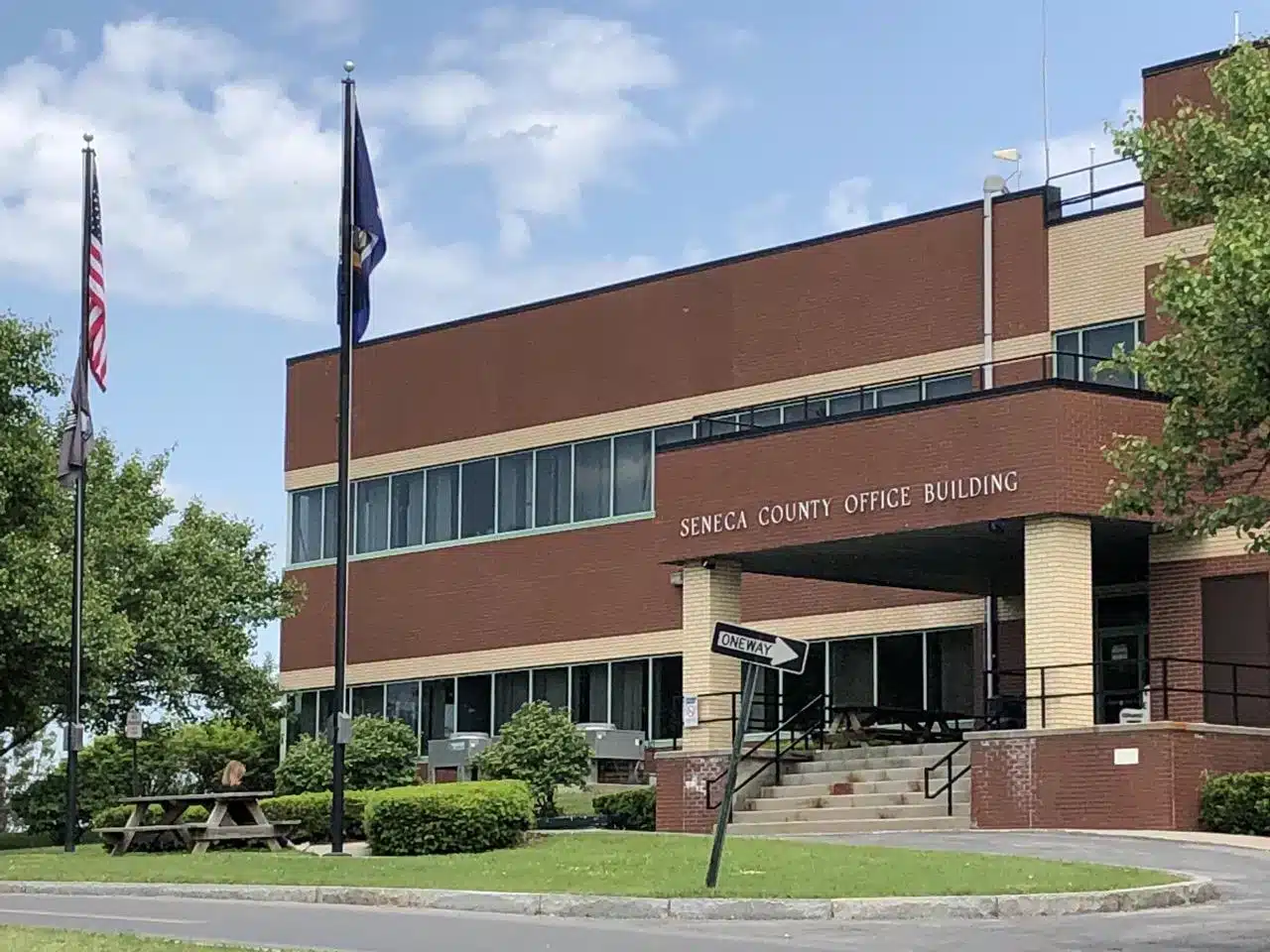
The Seneca County Board of Supervisors met for it’s regularly scheduled November meeting Thursday night, with most discussion focused on changes to Beverly’s Animal Shelter’s dog control services and a proposed hike to the 2026 tax levy.
Shelter leaders defend reduced coverage under new state law

Representatives from Beverly’s Animal Shelter addressed the board during a scheduled presentation and were questioned by several supervisors about the shelter’s recent decision to reduce its dog control service area to only three towns: Seneca Falls, Waterloo, and Fayette. The change is a response to new state requirements under the Companion Animal Care Standards Act, which takes effect Dec. 15 and imposes stricter staffing, space, and recordkeeping rules.
Shelter President Pat Morin and Vice President Nima Kaiser said the facility is scrambling to comply with the regulations, which require one staff member per five to six dogs, segregated spaces for different types of animals, and extensive documentation. They said the shelter no longer has the capacity to manage the entire county’s dog control needs and would focus only on the three nearby towns going forward.
“We’re kind of hard put to get this straightened out,” Morin said. “We just don’t have the facilities.”
Supervisor Joe Borst (Ovid) asked whether residents from other towns would be turned away. Morin responded that owner surrenders might be accepted if space allows, but there is no guarantee. Shelter leaders emphasized that they cannot safely accept aggressive animals and may have to euthanize dogs if there is no alternative placement.
Supervisor Michael Reynolds asked if the shelter would resume broader countywide coverage once renovations were complete. Kaiser said it was unlikely. “I honestly don’t see it expanding beyond those three areas. No, probably not.”
The shelter is currently undergoing renovations funded in part by a Golisano Foundation grant and expects state inspections to occur between mid-December and early January. Leaders expressed uncertainty about their long-term capacity, and several supervisors voiced concerns about the sustainability of shelter services.
Supervisor Jeffrey Trout (Fayette) questioned how the new regulations and reduced service area would affect contracts with towns like Fayette. “At what point, if any, will there be a point where you can’t meet them for the three towns as well?” Trout asked.
Shelter leaders acknowledged the concern and said they are still assessing the financial and operational impact of the changes.

Board honors sheriff’s office for reaccreditation
The board also recognized the Seneca County Sheriff’s Office for achieving reaccreditation in both its Jail Division and Court Security Division. Peter Kehoe, Executive Director of the New York State Sheriffs’ Association, presented plaques and praised the department’s professionalism and compliance with rigorous standards.
“These are not easy accomplishments,” Kehoe said, noting that only 11 counties in New York have attained court security accreditation. He recognized several individuals involved in the reaccreditation process, including Sergeant Dan Dressing and Lieutenant Joshua Kurtz.
Sheriff Tim Thompson thanked the board for its continued support and noted that law enforcement division reaccreditation is expected in December.
Supervisors debate tax rate in proposed 2026 budget
The board received a presentation on the proposed 2026 budget, which includes a tax levy increase of $6.5 million and a rise in the countywide tax rate from $3.64 to $4.85 per $1,000 of equalized assessed value. Deputy County Manager Melissa Taylor said the increase is driven by capital project planning, rising operational costs, and investments in public health, safety, and infrastructure.
Supervisor Trout noted that if the 2014 tax rate of $5.41 had simply been adjusted for inflation, the current rate would be equivalent to $10.43. He used that figure to argue that the county’s financial burdens have outpaced tax revenue growth.
Supervisor David Hayes (Romulus) countered that increased property values have helped generate revenue without significantly raising tax rates. “That’s why it doesn’t keep going up, because we get more assessed valuation,” he said.
The board will hold a public hearing on the proposed budget on Dec. 9.
Other actions
- The board held and closed a public hearing on Local Law 6 of 2025, which sets the salaries of county public officers. No public comments were recorded during the hearing.
- Resolutions were passed to purchase new network switches, adopt equalization rates for tax apportionment, and authorize a public hearing on the 2026 county budget.

FingerLakes1.com is the region’s leading all-digital news publication. The company was founded in 1998 and has been keeping residents informed for more than two decades. Have a lead? Send it to news@fingerlakes1.com.