

The truck outside a hardware store at 6 a.m. is part of a system most people never think about, until the day it fails to show up. And that’s where real consequences reach people around us.
Despite economic forecasts focusing on ports, railroads, and warehouses, the real bottleneck in local commerce usually sits somewhere more mundane: whether the truck scheduled to arrive Tuesday actually arrives Tuesday.
That reliability is built into decisions made months or years earlier, like:
- Which fleet a company runs
- How well it maintains those trucks
- Where it turns when something breaks
A regional carrier with a standing relationship at a Michigan Kenworth dealer, for instance, can get a truck back on the road in days instead of weeks, and that kind of uptime is exactly what determines whether a delivery window means anything.
Every business owner has learned this lesson the hard way at some point, and this article will keep you from making the same mistake.

The Supply Chain Nobody Notices Until It Breaks
Freight logistics only becomes visible when something goes wrong, which means most people underestimate how much coordination sits behind a fully stocked shelf or an on-time service call.
What Happens to a Small Business When a Delivery Doesn’t Show
Independent grocers, hardware stores, and contractors typically operate without the supplier redundancy that larger chains build into their contracts, so a single missed delivery can mean days of lost sales, canceled jobs, or customers who simply go elsewhere.
Why National Chains and Local Shops Feel Disruptions Differently
Large retailers negotiate multiple carrier relationships and regional distribution centers specifically to absorb disruptions, while local businesses often depend on one carrier and one route, which makes them far more exposed when something breaks down upstream.
What “Reliable” Actually Means in Trucking Right Now
Trucks move over 72% of the nation’s freight tonnage and nearly 77% of freight revenue, a dominance that means any internal disruption in the industry ripples outward into nearly every other sector almost immediately.
Fleet Maintenance and Driver Shortages Behind the Scenes
The industry is currently short an estimated 82,000 qualified drivers, a gap driven by an aging workforce, tightening licensing regulations, and a labor pool that hasn’t kept pace with freight demand, which forces companies to treat driver retention as seriously as equipment upkeep.
When Routes Are Still Run on Memory Instead of Data
A lot of carriers, especially smaller regional ones, still dispatch routes based on a driver’s experience or an old default schedule rather than current conditions.
That works fine, really. But a road closure, a weather event, or a construction detour throws the whole plan off. So, it’s best to combine local knowledge with real-time visibility into the fleet for the most optimal results. Experience is fine, but technology translates experience into smoothness.
Where Tracking Tech and Route Software Actually Help
Predictive maintenance software now flags mechanical issues before they cause breakdowns, and route optimization tools account for real-time traffic and weather, which together explain why some carriers can promise a delivery window and consistently hit it while others can’t.
The Community Side of the Job
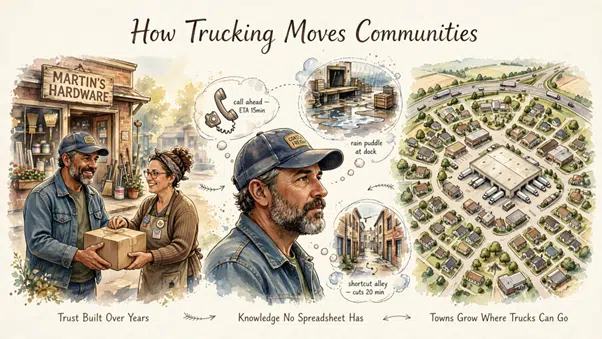
Unlike most modern logistics, trucking still runs on personal relationships built over years, and that familiarity often matters more to a local economy than any efficiency metric.
Local Drivers, Local Knowledge
A driver who has worked the same regional route for a decade tends to know which loading docks flood after rain, which business owners need a call ahead, and which shortcuts save twenty minutes, knowledge that never shows up in a logistics spreadsheet.
How Trucking Intersects With Real Estate and New Development
Developers increasingly site new warehouses and distribution centers based on freight access, which in turn shapes where residential and commercial growth follows, tying real estate value directly to logistics infrastructure most residents never think about.
Trucking’s Overlooked Role in Moving and Relocation
As remote work decouples income from location, freight and moving logistics have become one of the deciding factors in where freelancers and remote employees choose to settle.
What to Ask a Moving or Freight Company Before You Sign
- Ask for a firm delivery window rather than an estimate
- Ask whether the final leg is subcontracted
- Ask what compensation applies if something is delayed or damaged
The answers to these three questions reveal more about a company’s reliability than any online review or local tribune story coverage.
The Rise of Remote Work and Smaller-Market Relocation
As freelancers and remote workers relocate to smaller, more affordable cities, freight and moving companies in those markets are absorbing demand volumes they weren’t built for a decade ago, which is reshaping regional logistics capacity in real time.
Where Is the Industry Actually Headed?
Electrification and Automation
Electric trucks currently make the most sense on short regional routes with predictable charging infrastructure, not long-haul freight, and automation is following a similarly incremental path, assisting drivers rather than replacing them for the foreseeable future.
What This Means for Local Economies and Investors
Regional logistics infrastructure has become an attractive asset class precisely because it’s unglamorous and essential, generating steady returns regardless of shifts in consumer retail trends.
Reshoring
One trend hasn’t come up yet: reshoring. As manufacturing shifts back toward domestic and near-border production, freight lanes are reorganizing around new regional hubs rather than coastal ports, and that shift will determine which small towns suddenly find themselves on a major route and which local businesses gain access they never had before.

This content is brought to you by the FingerLakes1.com Team. Support our mission by visiting www.patreon.com/fl1 or learn how you send us your local content here.