

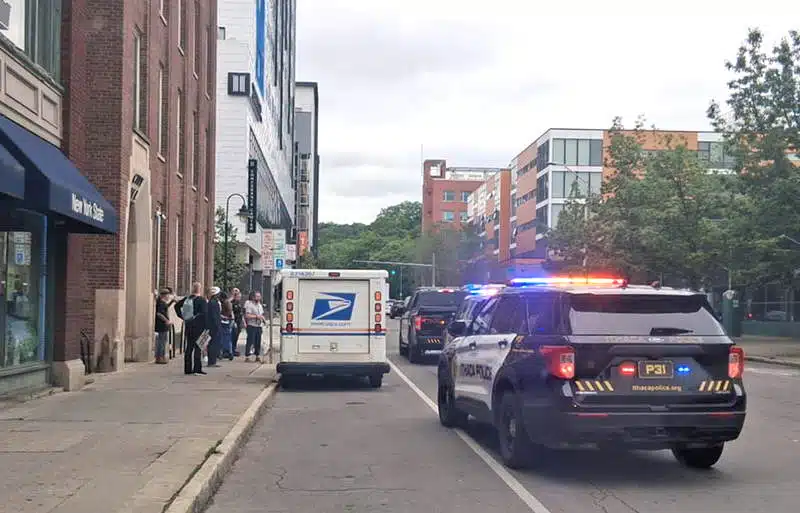
Conditions inside Ithaca’s troubled Asteri apartment building remain a serious concern despite months of enforcement efforts, according to updates presented to the Tompkins County Legislature this month.
City and county officials told legislators during the May 19 meeting that health, safety, and management problems continue at the downtown Ithaca property, with local leaders warning that meaningful long-term improvements may depend on stronger ownership involvement and additional state support services.

Ithaca Mayor Robert Cantelmo said conditions inside the building had not “materially improved” during a recent walkthrough. He described broken doors, overflowing garbage, damaged apartment units, unsanitary stairwells, and elevators without working lights. Cantelmo also criticized building management for failing to cooperate with inspection requests and said the city plans to continue aggressively enforcing code violations.
Tompkins County Whole Health Commissioner Jennie Sutcliffe said county officials have spent nearly two years addressing sanitary code violations at the property, primarily involving garbage, biohazards, and unsafe common areas. The county has already issued a $40,000 penalty related to violations of commissioner’s orders and conducted multiple inspections throughout May.
Environmental Health Director Skip Parr said inspectors have seen some improvement compared to earlier visits, though several violations remain unresolved. He also noted the county’s authority is limited to public health concerns and does not extend to broader building management or structural code enforcement.
Legislators raised questions about whether stronger penalties or additional legal action may be necessary if conditions continue deteriorating. Others focused on the need for expanded supportive services and case management for residents living in the building.
Discussion also centered on the balance between tenant responsibility and property management accountability. County officials stressed that stable housing, mental health services, and ongoing support programs are critical to helping residents maintain safe living conditions.
The legislature also received a broader sustainability and energy update from Chief Sustainability Officer Terry Carroll, who reported county energy spending rose 8.3% from 2024 to 2025 due largely to higher utility rates and weather-related demand.
Carroll highlighted the county’s hydroelectric partnership in Waterloo as one of its most successful long-term investments, generating roughly $242,000 in savings in 2025 despite lower production caused by drought conditions. He said the facility now offsets about 40% of county electricity use and may have saved taxpayers nearly $1 million since the partnership began.
Lawmakers also approved several resolutions during the meeting, including the creation of a temporary senior motor vehicle examiner position at the DMV and the disbursement of $80,000 in county industrial development funds to support a Habitat for Humanity housing project on West Court Street in Ithaca.
The legislature additionally approved a resolution urging federal investment in economic development, housing, and infrastructure by a 12-2 vote.

FingerLakes1.com is the region’s leading all-digital news publication. The company was founded in 1998 and has been keeping residents informed for more than two decades. Have a lead? Send it to news@fingerlakes1.com.