

For most Finger Lakes residents, the University of Rochester Medical Center is mostly a place you go when you’re sick or when someone you love is sick. What fewer people realize is that URMC and the surrounding research hospitals run a quiet, steady program that pays healthy local adults to take part in clinical studies. It is not a get-rich scheme, but for some Rochester-area residents, it adds up to a few thousand dollars a year and pays for a stack of medical screenings they would otherwise cover out of pocket.
The model is straightforward. Pharmaceutical sponsors, federal agencies like the NIH, and the universities themselves need participants for studies on everything from sleep and metabolism to heart disease, depression, vaccines, and recovery from common surgeries. They cannot run those studies without people willing to volunteer. In return, they offer compensation that depends on the study’s demands: a few hundred dollars for a short outpatient study, several thousand for a longer trial that involves overnight stays or repeated lab visits.
Rochester sits in a relatively unusual position for a midsize American metro. Between URMC, the affiliated Strong Memorial Hospital, the Wilmot Cancer Institute, and the smaller specialty research outfits nearby, there is constant recruitment for new studies. Most of these never get advertised in the kind of newspaper or radio ad a typical resident would notice. They get listed on internal registries and on national databases. Online directories pull these listings into one place: Hipa.ai, for example, maintains a searchable index of paid medical studies currently recruiting in the Rochester area, with compensation amounts when the sponsor has disclosed them.
How big the recruiting pool actually is
The scale is bigger than most residents would guess. As of May 2026, New York state alone has 4,418 clinical trials actively recruiting participants. Rochester ranks third among New York cities for active research, with 459 trials currently recruiting, behind only New York City and the Bronx. The University of Rochester sits among the top sponsors in the state, running 83 active trials of its own, putting it in the same recruiting tier as much larger institutions like AstraZeneca and Eli Lilly.
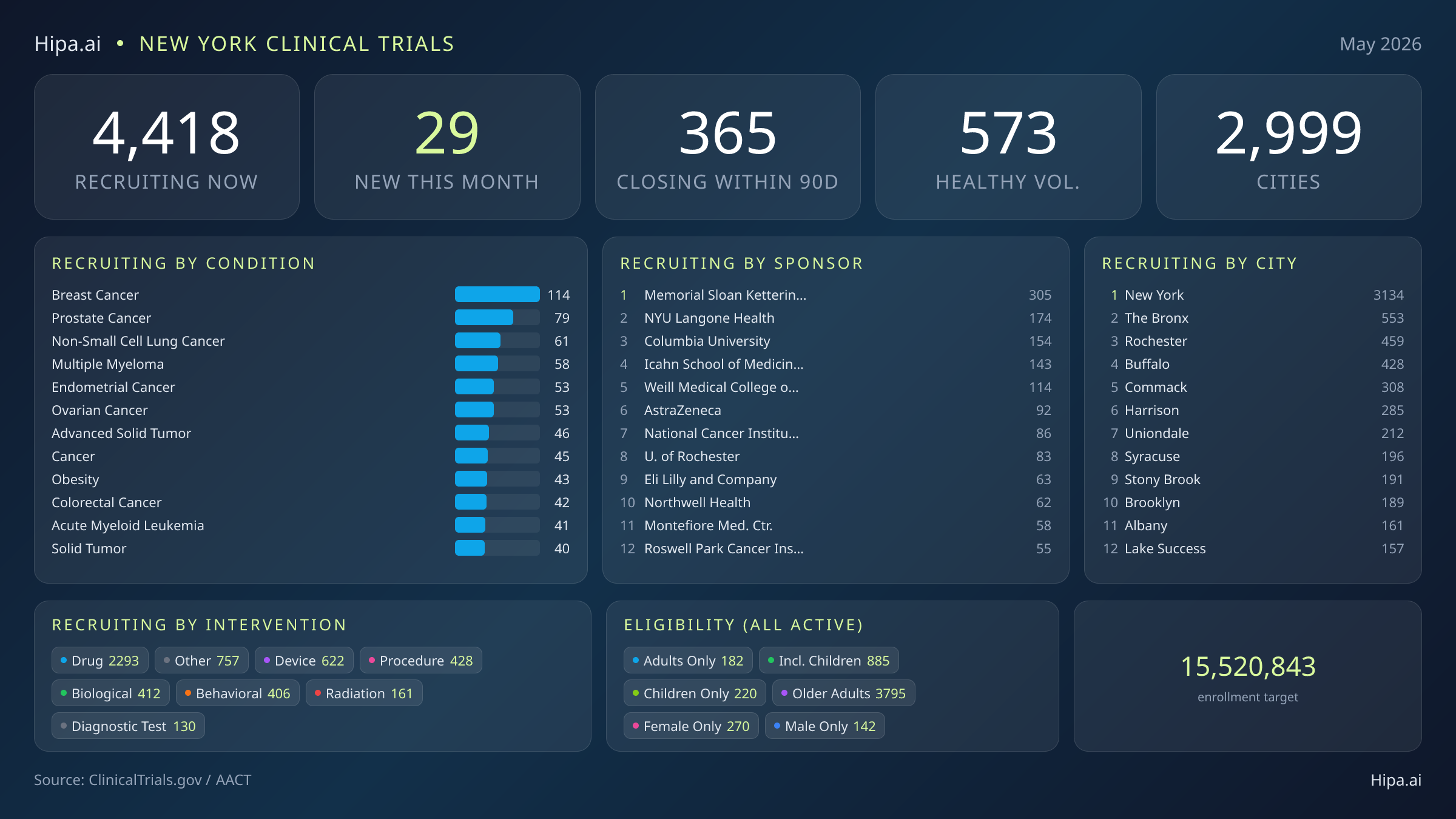
New York clinical trials snapshot, May 2026. Source: Hipa.ai / ClinicalTrials.gov
Across the state, 573 of those active trials are open to healthy volunteers, meaning people without a specific diagnosis or condition. That number tends to surprise people. Most assume clinical research only needs sick patients. The opposite is true for a large slice of studies, which is the part that matters for the average healthy Rochester adult considering whether to participate.
What participation actually looks like
Joining a study typically goes in three stages. The first is a brief eligibility screening, sometimes done online and sometimes by phone, where the research coordinator asks about your basic health history, age, location, current medications, and any conditions relevant to the study. If you pass the initial screen, the second stage is an in-person screening visit. This is where most of the medical value sits: you get a physical exam, vital signs, fasting bloodwork, and, depending on the study, an ECG, imaging, or specialty tests. The bloodwork alone, if you walked into a private clinic and paid cash, would run several hundred dollars.
The third stage is the study itself. This is where time commitment varies. A vaccine trial might involve four or five visits spread over a year, each lasting an hour or so. A Phase 1 drug study might involve a three-day inpatient stay where staff monitor how a new medication behaves in healthy bodies. A behavioral or nutrition study might involve weekly check-ins for two months. The compensation scales roughly with the time and the level of intrusion you accept.
Who actually qualifies
A common misconception is that you need to be sick to participate in clinical research. As the May 2026 data shows, more than 12 percent of currently recruiting New York trials are specifically for healthy volunteers. Pharmaceutical companies need healthy adults as control groups for nearly every drug trial they run. Universities run dozens of studies on sleep, exercise response, nutrition, immune function, and stress that specifically recruit healthy participants. Vaccine programs need a steady stream of healthy adults across age brackets.
What often disqualifies people: certain prescription medications, recent participation in another drug study, and specific medical conditions that the study protocol screens out. Body mass index requirements vary by study and are sometimes restrictive. Smoking and alcohol use can disqualify some studies and be irrelevant for others. The only way to know for any given study is to read the eligibility criteria or talk to the coordinator.
Why it has stayed below the public radar
If the system is real and the compensation is real, why is it not better known? Several reasons.
Studies are not allowed to advertise the way ordinary consumer products advertise. The FDA regulates what recruitment ads can say, and the result is generally bland flyers and clinic-website notices rather than memorable campaigns.
Most people associate clinical research with the most dramatic kinds of trials, the ones that get newspaper coverage when something goes wrong or when a new cancer drug shows promise. The everyday reality of clinical recruitment is much more mundane: a healthy 45-year-old taking part in a sleep study at URMC for $800, a retired teacher contributing to a memory study for $1,200, a college student in a metabolism study for $500.
And the bureaucratic apparatus of recruitment has historically been built for medical professionals to find studies, not for the public to find them. Online directories like hipa.ai aggregate trials and translate the eligibility criteria into plain English, but they are a relatively recent addition to the landscape.
Practical points for Finger Lakes residents
A few things worth knowing for anyone in the region thinking about it.
Start by filtering for studies within driving distance. URMC’s research campus in central Rochester is the largest concentration, but smaller research sites operate in Henrietta, Brighton, and the surrounding Finger Lakes communities. Some studies allow remote check-ins for parts of the protocol, which helps if you are outside the immediate Rochester commute.
Read the informed consent document carefully. It explains what they will do, what the known risks are, how they will pay you, and what happens if you want to drop out. A well-run study will have this document available before you commit to anything.
Keep records of any test results they share with you. Many studies send participants their bloodwork and imaging. Over time these accumulate into a useful personal health record at no cost to you.
Do not stack drug studies. Most pharmaceutical trials require a washout period before you can join another, and you are not supposed to be in more than one active drug study at a time. This is a rule that protects you, but it also means treating studies as occasional rather than continuous.
The bigger picture
For Rochester specifically, the recruitment economy is not a small thing. Local hospitals run hundreds of active studies in any given year. The compensation distributed across those studies adds up to a meaningful amount of local economic activity, mostly invisible because it goes to thousands of individual participants in small amounts rather than to a single big entity.
For an individual resident, the question is simpler. Is the time worth the money and the medical data? For some people, particularly retirees with flexible schedules, freelancers between contracts, and graduate students, the answer is often yes. For others with rigid work schedules and no medical curiosity, probably not. But it is a quiet option that more people in the Finger Lakes region could reasonably consider, and almost none of them currently do.

This content is brought to you by the FingerLakes1.com Team. Support our mission by visiting www.patreon.com/fl1 or learn how you send us your local content here.