Two independent analyses — one commissioned by the city and another conducted by firefighters’ union leadership — are pointing to the same conclusion: Canandaigua’s fire response system is operating below national safety benchmarks.
A newly highlighted GIS-based study from the International Association of Fire Fighters, combined with a comprehensive 2025 assessment by the Center for Public Safety Management, found that staffing levels and response capabilities fall short of standards outlined in NFPA 1710, the national benchmark for fire department deployment.

The IAFF study, completed in December, used geographic mapping and response modeling to evaluate how well the Canandaigua Fire Department can meet critical response targets. It found that current staffing levels leave the department unable to meet minimum staffing thresholds on frontline apparatus, limiting its ability to safely and effectively respond to structure fires.
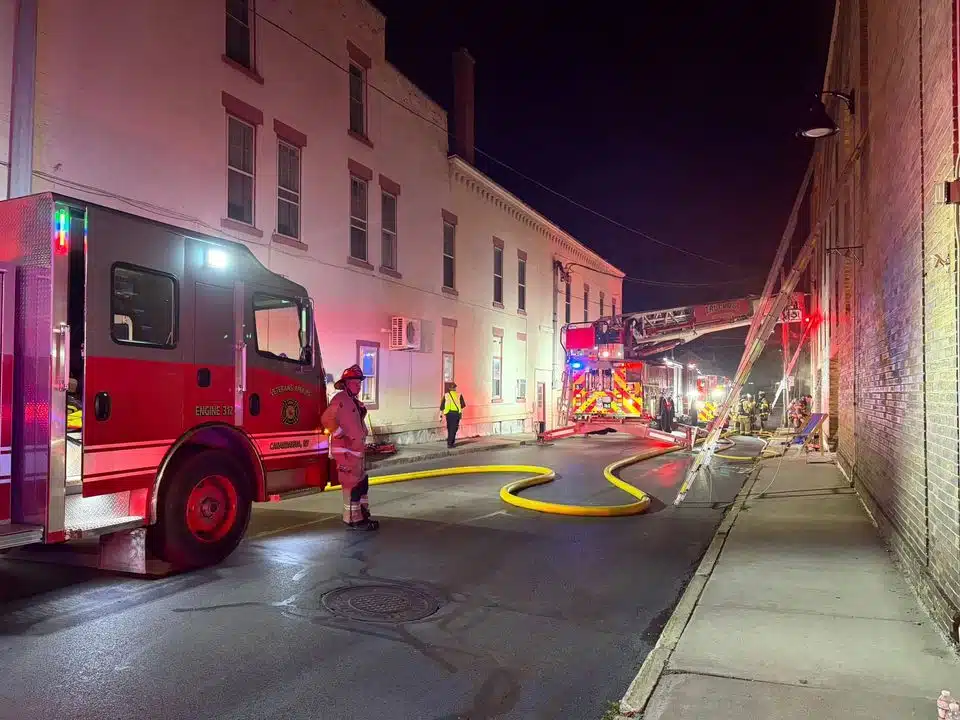
The department operates with two stations, typically staffing one engine and one quint with as few as two firefighters per unit — below the four-person minimum recommended by national standards. That shortfall, the report found, forces crews to split responsibilities on scene, delaying fire suppression and rescue operations.
The consequences of that gap can be significant. According to the IAFF analysis, only 1.4% of the department’s coverage area meets the minimum staffing needed to safely begin interior firefighting operations under current conditions. With recommended staffing levels, that coverage would rise to more than 50%.
The study also found that the department can reach just over half of its coverage area within four minutes — the benchmark for first-arriving units — and about 55% within six minutes for a second-arriving unit. Neither metric meets the 90% coverage standard outlined in NFPA guidelines.
The city-commissioned report reached similar conclusions. It found the fire department cannot assemble the minimum number of personnel needed to manage most structure fires without relying heavily on mutual aid from surrounding departments.
Response times are also a concern. Turnout times — the period between dispatch and units leaving the station — are more than double national recommendations in many cases, further delaying arrival at emergency scenes.
Both studies highlight structural challenges within the system. Canandaigua’s fire department covers roughly 24 square miles and serves more than 15,000 residents across the city and portions of the surrounding town. Over the past decade, its service area has shrunk due to staffing reductions, while demand for service has remained steady.
Mutual aid plays a critical role in filling those gaps, but surrounding departments are largely volunteer-based and face their own staffing challenges. That creates added uncertainty when additional personnel are needed for larger incidents.
Emergency medical services face similar pressures. The city relies on a third-party provider for transport, while fire crews provide initial response. The CPSM report found that overlapping calls and long transport times can reduce system availability, particularly during peak hours.
Despite those constraints, both reports note that personnel continue to deliver professional service. But they warn that without changes, performance will likely deteriorate as demand increases.
Recommendations from both analyses center on staffing increases and structural changes. Those include adding personnel to meet minimum four-person staffing on apparatus, introducing a dedicated command officer, and exploring long-term regional or shared service models.
The findings underscore a broader point emphasized in both reports: response time and staffing levels are directly tied to outcomes.
If crews arrive too late or without enough personnel, emergencies escalate — increasing the risk to both residents and first responders, and raising the likelihood of significant property loss.

FingerLakes1.com is the region’s leading all-digital news publication. The company was founded in 1998 and has been keeping residents informed for more than two decades. Have a lead? Send it to news@fingerlakes1.com.