

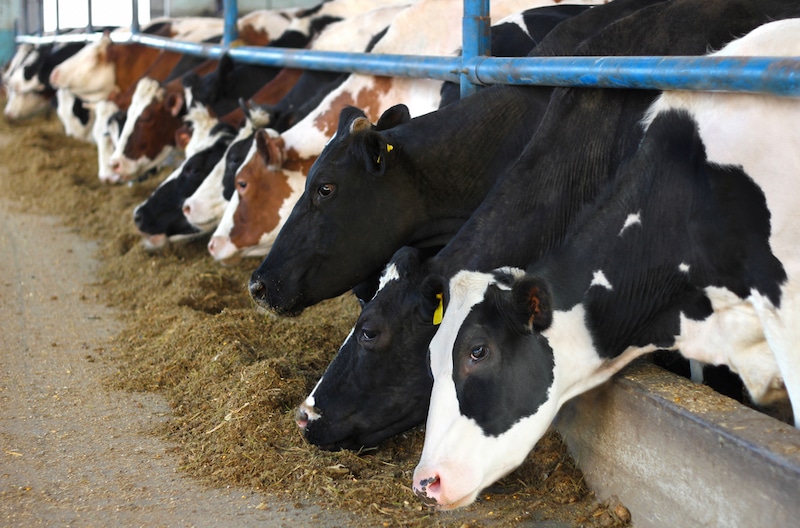
A new analysis of beef production in the Northeast suggests grass-fed operations remain significantly more expensive than conventional systems—but could become competitive if producers scale up and coordinate across the supply chain.
Researchers examining farms across New York and New England found that small-scale grass-fed operations struggle with high per-animal costs, driven by labor, land use, and longer production timelines. But when operations expand or collaborate to achieve economies of scale, those costs drop sharply—potentially narrowing the gap with grain-fed beef.

The study, conducted by Houtian Ge and Miguel I. Gómez of Cornell University’s Charles H. Dyson School of Applied Economics and Management, and Christian J. Peters of the U.S. Department of Agriculture’s Agricultural Research Service, draws on surveys of 31 farms and a full supply chain cost model to assess economic viability across the region.
Their findings show grass-fed production costs average about $15.58 per kilogram without scale efficiencies, compared to $8.44 per kilogram for conventional grain-fed beef. With scaling, however, grass-fed costs fall to roughly $11.72 per kilogram—a reduction of about 24%, and a much closer range to conventional production.
That cost gap carries through to retail pricing. Grass-fed beef produced at smaller scales would require prices averaging more than $24 per kilogram to remain profitable, while scaled operations could bring that down to about $18 per kilogram. Grain-fed beef, by comparison, averages just over $13 per kilogram at retail.
The difference is largely structural. Grass-fed cattle take longer to reach market weight—about 24 months compared to 17 months for grain-fed—and yield less meat per animal. That increases feed, land, and labor costs, especially for smaller farms that lack efficiencies in purchasing and operations.
Scale, the study found, changes that dynamic. Larger farms—or coordinated networks of smaller producers—can spread fixed costs, reduce feed expenses, and improve logistics. Feed costs, for example, dropped from an average of $153 per head on small farms to $57 on larger ones. Unpaid labor costs showed an even sharper decline.
Even with those gains, grass-fed beef still requires a price premium to remain viable. Without scale, that premium ranges from 65% to 125% above conventional beef prices. With scale efficiencies, it drops to between 23% and 67%, averaging about 39%.
That matters because consumers are already paying premiums for grass-fed products—often exceeding 100% depending on the cut. The study suggests that if producers can reduce costs through scale, they may be able to compete more effectively without pushing prices beyond what consumers are willing to pay.
Geography also plays a role. New York consistently showed the lowest production costs in the region, driven by higher cattle density, better infrastructure, and more efficient transportation networks. Costs were higher in states like Connecticut and Vermont, where production is more dispersed and land productivity varies.
Still, infrastructure remains a major constraint. The region lacks sufficient slaughter and processing capacity to handle a large-scale shift toward grass-fed production. Without expansion—or alternatives like mobile slaughter units—bottlenecks could limit growth regardless of farm-level efficiencies.
The analysis also highlights a broader opportunity: the Northeast has significant unused pastureland and underperforming forage yields. Researchers estimate the region could support hundreds of thousands of additional grass-fed cattle without expanding agricultural land, potentially capturing a larger share of the regional beef market.
But that expansion hinges on coordination. The study points to cooperative models or larger integrated operations as key pathways to achieving the scale needed to reduce costs and stabilize supply.
Without that shift, grass-fed beef is likely to remain a niche product—popular with consumers willing to pay a premium, but constrained by high production costs and limited scalability.
With it, the economics begin to look more competitive, opening the door for broader adoption across the region’s agricultural landscape.

FingerLakes1.com is the region’s leading all-digital news publication. The company was founded in 1998 and has been keeping residents informed for more than two decades. Have a lead? Send it to news@fingerlakes1.com.