


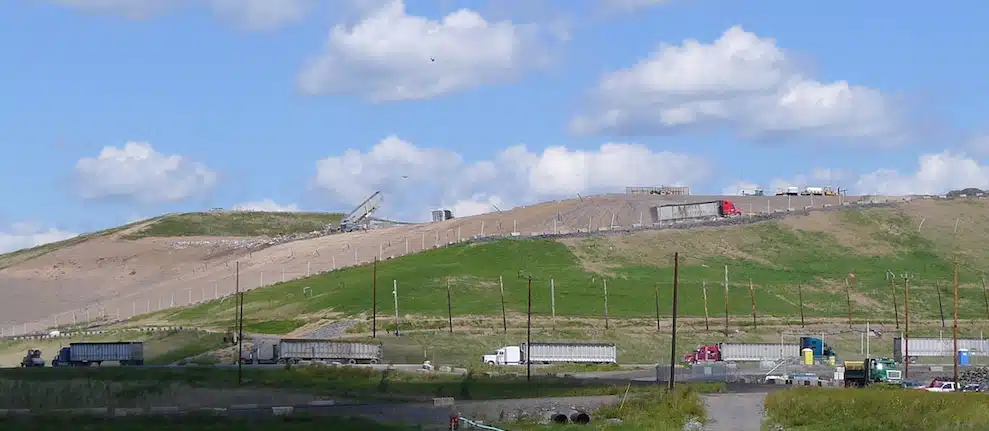
A New York State Court of Appeals decision issued Tuesday has reopened a key legal challenge to Seneca Falls’ landfill closure law, adding another layer of uncertainty as the Seneca Meadows landfill approaches a Dec. 31 permit deadline.
In a unanimous ruling, the state’s highest court held that Seneca Meadows Inc. has legal standing to challenge the town’s Local Law 3 under the State Environmental Quality Review Act, or SEQRA, reversing a prior Appellate Division decision that had dismissed the claim on procedural grounds 125opn25-Decision.
The ruling does not order the landfill to close or remain open, nor does it invalidate Local Law 3. Instead, it sends the case back to the Appellate Division, Fourth Department, for consideration of the merits of Seneca Meadows’ SEQRA challenge.
What the court decided
Local Law 3, adopted by the Seneca Falls Town Board in 2016, requires the closure of solid waste disposal facilities in the town by Dec. 31, with a limited exception for existing facilities operating under a valid state permit. Seneca Meadows, the owner and operator of the state’s largest landfill, has long argued that the law was adopted without proper environmental review.
The Court of Appeals ruled that Seneca Meadows has standing to bring that challenge simply because it owns the property directly regulated by the law. The court relied on long-standing precedent holding that a property owner does not need to prove environmental harm to challenge a land-use decision under SEQRA when its property is the subject of the action.
In doing so, the court rejected a 2024 Appellate Division ruling that had concluded Seneca Meadows lacked standing because it failed to allege environmental injury. The high court found that conclusion inconsistent with prior Court of Appeals decisions.
The court also declined to revisit arguments that the SEQRA challenge was filed too late, noting that the statute-of-limitations issue had already been resolved earlier in the case and was not properly before the court at this stage.
What the ruling does not do
The decision does not resolve whether Local Law 3 is valid or enforceable, nor does it address whether the landfill must close on Dec. 31. Those questions remain unresolved.
The court did not rule on the merits of the SEQRA claim itself, including whether the Town Board took the required “hard look” at potential environmental impacts when adopting the law. That analysis will now be considered by the Appellate Division on remittal.
How it fits into the broader landfill debate
The ruling comes amid a convergence of deadlines and decisions involving the Seneca Meadows landfill. The facility’s current state operating permit expires at the end of the year, though the Department of Environmental Conservation has indicated that permit conditions remain in effect while a renewal application is under review. Seneca Meadows has also applied for approval of a proposed expansion that would extend the landfill’s life.
At the local level, enforcement of Local Law 3 rests with the Seneca Falls Town Board, which has not taken steps to shut down the landfill. Town officials have previously indicated that any enforcement action would likely prompt additional litigation and requests for a court-ordered stay.
The Court of Appeals ruling strengthens Seneca Meadows’ legal position by reviving its SEQRA claim, which could ultimately result in Local Law 3 being invalidated if the courts find the town failed to comply with state environmental review requirements. At the same time, the law remains on the books unless and until a court strikes it down or the town rescinds it.
What happens next
The case now returns to the Appellate Division, Fourth Department, where judges will review the substance of Seneca Meadows’ SEQRA challenge. That process could take months and may ultimately return to the Court of Appeals, depending on the outcome.
In the meantime, the ruling does not change day-to-day operations at the landfill. Any closure, extension, or enforcement action will continue to depend on a combination of state permitting decisions, town board actions, and ongoing litigation.
As Dec. 31 approaches, the court’s decision underscores that the future of the Seneca Meadows landfill remains unsettled — shaped as much by the courts and regulatory process as by the calendar.

FingerLakes1.com is the region’s leading all-digital news publication. The company was founded in 1998 and has been keeping residents informed for more than two decades. Have a lead? Send it to news@fingerlakes1.com.