


Moving stirs up practical worries: weather delays, elevator outages, storage stops, fragile items that need special handling. Insurance should be the safety net that makes those unknowns feel manageable, yet it’s often bolted on at the very end. We’re evaluating a different path: bringing coverage into the planning flow so it’s easy to understand, easy to choose, and easy to use when it matters.
As part of this assessment, Simplified Moving Solutions is mapping where insurance can genuinely improve the journey — before the first box is packed, while goods are in transit, and if a claim is needed after delivery. The idea is a single, well-lit experience where comparing movers, selecting protections, and keeping documents organized all live in one place.
About Simplified Moving Solutions
Simplified Moving Solutions is a marketplace that helps people and businesses compare vetted moving providers, pricing, and service options in one place. By unifying data, standards, and clear terms, the platform aims to make planning a move more transparent and less stressful, an ideal foundation for thoughtfully integrated coverage.
A Potential Pilot with Baker International Insurance Agency
Simplified Moving Solutions is in negotiations with Baker International Insurance Agency regarding a prospective pilot program. Current discussions focus on presenting clear coverage tiers alongside mover quotes, calibrating premiums to route and inventory details, and reusing packing checklists and condition photos to accelerate decisions if an issue arises. While terms are still being negotiated and subject to further diligence, the shared intent is to emphasize clarity at booking and predictability at claim time — two moments that matter most for customers in the middle of a move.
What a Joined-up Journey Could Look Like
In the envisioned flow, customers would build an estimate and see coverage reflecting distance, season, access constraints, storage needs, and high-value items. The same steps that keep a move on track: photographing conditions, following packing protocols, confirming delivery access, would also supply the evidence insurers need for quick, fair outcomes. Movers benefit from consistent documentation; insurers gain standardized context; customers gain confidence and fewer surprises.
Short term, the approach promises fewer escalations and faster resolutions. Long term, it creates a feedback loop where preparation and outcomes steadily improve. For example, if delay claims spike on ferry-dependent routes during spring thaw, prompts can shift earlier in the journey to set expectations, recommend buffer days, or suggest optional delay protection for those routes.
Anticipated Benefits for Key Stakeholders
- Customers: clear tiers from basic to high-value, guidance that prevents issues, and claims that reuse existing documentation rather than demanding a scavenger hunt.
- Insurers: standardized data on routes, seasonality, and item types for better underwriting; options like delay protection; and prevention at scale via packing and storage standards.
- Moving companies: higher trust at booking from transparent terms and fewer disputes thanks to shared templates, photo logs, and consistent evidence.
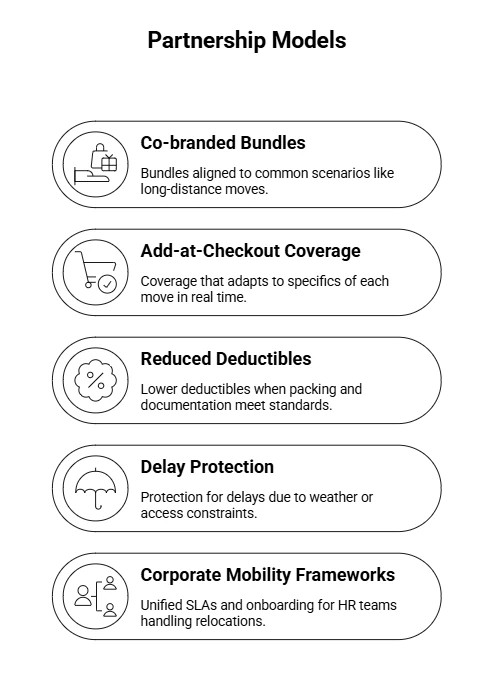
Partnership Models under Consideration
While details will be validated through user testing, several models are on the table:
- Co-branded bundles aligned to common scenarios (long-distance with storage, small offices, high-value items).
- Add-at-checkout coverage that adapts to specifics of each move in real time.
- Reduced or zero deductibles when packing and documentation meet agreed standards.
- Delay protection for weather, ferry schedules, or access constraints that shift delivery windows.
- Corporate mobility frameworks with unified SLAs and onboarding for HR teams handling multiple relocations.
Designed to Feel Natural — Not Technical
The planned approach favors light-touch prompts at the right moments (photograph finishes, log pre-existing scuffs, confirm storage conditions) and a claims path measured in days, not weeks. Language should be everyday, not legalistic. Evidence capture should happen inside normal steps, take photos as you wrap, verify serial numbers as your inventory, so the customer never feels like they’re doing extra work “for the insurer.”
Under the hood, the team is scoping secure APIs, role-based permissions, encrypted media storage, and auditable logs. Service levels and dispute paths are expected to be published in plain English, not hidden in dense PDFs. Where regulations require specific disclosures or timing, those would be surfaced contextually during checkout and in follow-up emails, so customers see what matters exactly when it matters.
Measuring What Matters
Success metrics are being defined around outcomes rather than volume:
- Attach rate for moves including coverage, segmented by route type and season.
- Post-claim satisfaction (CSAT/NPS) and complaint rate, with verbatim analysis to spot friction.
- Average resolution time, especially for straightforward cases targeted for automation.
- Dispute reduction via prevention and consistent documentation.
- Seasonal loss-ratio stability driven by better data and preparation on higher-risk corridors.
Beyond the numbers, the team will track a simple qualitative test: can a customer explain their coverage to a friend without looking anything up? If yes, the design is doing its job.
Risk, Compliance, and Data Stewardship
Because relocation involves sensitive information: addresses, contact details, photos of belongings, the planning includes privacy reviews and data-retention policies tuned to the shortest practical window. Access is scoped to need-to-know roles, and every action (uploads, edits, approvals) is logged. The intent is to make good behavior the default: clear authority, minimal exposure, predictable retention, and an easy process for customers to request deletion where appropriate.
Near-term Focus Areas
The plan calls for stakeholder interviews, prototype user journeys, and economic modeling across peak seasons and remote routes. Usability testing will examine whether prompts feel helpful or heavy, whether customers recognize value in optional coverages, and where explanations need to be simpler. In parallel, the company is preparing best-practice guides — packing standards, condition checklists, and incident templates, so operational habits reinforce the digital experience.
Conclusion
Simplified Moving Solutions is moving deliberately toward insurer partnerships that make relocations more predictable without adding friction. By embedding plain-English coverage options into the comparison and booking flow, and by reusing the same packing checklists and condition photos customers already complete, the company aims to replace guesswork with clarity at the two moments that matter most: booking and claims. The team remains in negotiations with Baker International Insurance Agency on a prospective pilot and is validating details through user testing, operational dry runs, and compliance reviews. The intended outcome is a joined-up experience that benefits everyone involved.

This content is brought to you by the FingerLakes1.com Team. Support our mission by visiting www.patreon.com/fl1 or learn how you send us your local content here.