

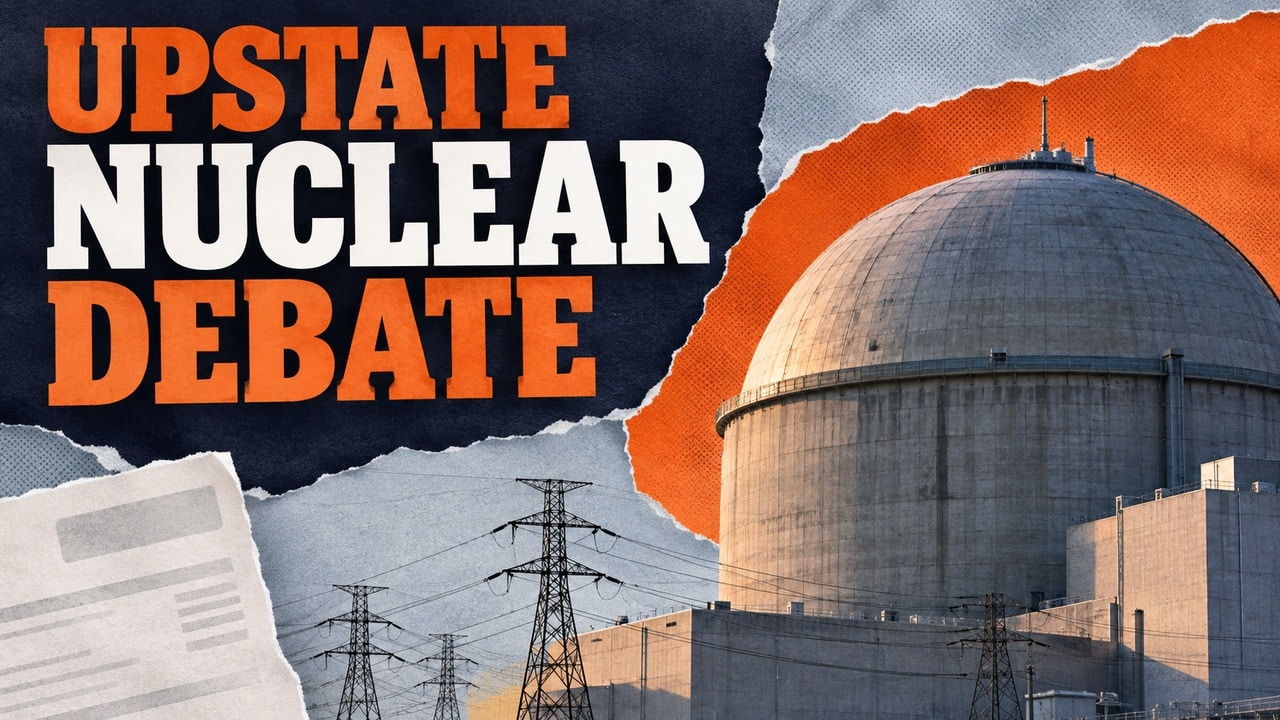
Rochester and Wayne County remain in the discussion over where New York could build new nuclear power facilities as a state-organized summit brings the debate over electricity supply, development and consumer costs closer to the Finger Lakes.
RED Rochester at Eastman Business Park and Wayne County have expressed interest in hosting nuclear development, WROC reported Tuesday. The Rochester gathering continues Wednesday as New York evaluates technologies and potential partners for an expansion of its nuclear generating capacity.
At the summit Wednesday, Gov. Kathy Hochul announced the completed state nuclear master plan, a 30-point roadmap for adding 5 gigawatts of nuclear capacity. The state Department of Public Service also issued policy recommendations for New York utility regulators to consider as they weigh how to make future projects financially viable and reduce costs.
Assemblyman Scott Gray, the ranking Republican on the Assembly’s energy committee, told WROC that transmission infrastructure, electricity customers and an available workforce would be important to a successful proposal. He said Rochester remains a contender.
Developer qualifications advance while siting remains open
The New York Power Authority qualified 10 nuclear developers on Nov. 12 for potential partnerships in its effort to deliver at least 1 gigawatt of new advanced nuclear generation in Upstate New York.
The authority received 21 responses to its request for qualifications. Earlier solicitations attracted interest from 23 developers and eight potential host communities.
Six companies qualified for both large-reactor and small-modular-reactor pathways: Avangrid, Elementl Power, NextEra Energy, Oppenheimer Energy, The Nuclear Company and Turquoise Power. Blue Energy, Holtec International, TerraPower and X-energy qualified for the small-modular-reactor pathway.
Qualification allows firms to participate in subsequent solicitations. NYPA said it aims to select a host community, technology and development partner in the coming months.
What the completed master plan calls for
New York’s larger goal includes 5 gigawatts of additional advanced nuclear capacity. NYPA’s project would be an early component, alongside a state process examining another 4 gigawatts.
The New York State Energy Research and Development Authority and the Department of Public Service wrote the plan following Hochul’s 2025 directive to develop a framework for advanced nuclear projects. Hochul set the five-gigawatt expansion goal in her 2026 State of the State agenda. The governor’s office said that would bring combined nuclear capacity to 8.4 gigawatts, including the 3.4 gigawatts already in place.
The governor’s office said 12 studies and more than 1,000 pages of research and analysis support the plan. For potential host communities, it calls for a process to identify interested localities, assess possible sites, including brownfields, and help with early site evaluations. It also calls for reviewing how state regulatory requirements fit together and giving local governments tools to prepare for potential projects while maintaining safety standards.
The plan also proposes a supplier-readiness program to connect New York businesses with project opportunities and calls for a longer-term strategy for the state’s nuclear supply chain. On workforce development, it recommends drawing on existing training funds, helping experienced workers move into nuclear jobs and timing specialized training to match project needs. It identifies Project Janus at Fort Drum as an opportunity to build on federal investment.
Regulators will weigh project costs and financing
The Department of Public Service issued its white paper for the Public Service Commission’s Nuclear Reliability Backbone proceeding. It recommends a set of policies intended to improve the financial prospects for new projects and reduce costs. The paper follows a June policy options paper from state energy officials and incorporates public comments and feedback from an October technical conference. The recommendations are now before the commission for consideration.
State officials argue that nuclear power can supply reliable electricity without the carbon emissions associated with fossil-fuel generation, supporting the grid as electricity demand grows.
Hochul presses for faster federal reviews
In remarks at the Rochester summit, Hochul said she had asked President Donald Trump to halve the time spent on federal review and pledged to cut the time New York takes on its own part of the process by half. She said she had been told a reactor takes about 10 years to develop, with about seven years spent in federal review. She expressed uncertainty about whether a project could be completed during Trump’s term.
- Josh Riley pushes $100 household credits when electric utilities fail state standards
- NYSEG, RG&E to offer utility-bill help Nov. 18 in Auburn
- Schumer backs permitting debate, seeks changes to protect water and communities
- Energy crisis: blackouts, extreme temperatures, and drought expected this summer
Hochul said she plans to continue talks in Washington and hopes New York will be selected for a low-interest loan. She gave no loan amount or award date and said the state would continue its work while awaiting a decision.
Hochul pointed to New York’s four existing reactors at three sites near Lake Ontario and described new nuclear generation as part of an energy strategy that also includes wind, solar and geothermal power. She said dependable electricity could help attract energy-intensive employers to upstate communities, and she emphasized the need to train workers for construction and specialized plant maintenance.
Opponents question who would pay
Environmental and climate advocates are organizing a noon press conference Wednesday outside the summit at 155 E. Main St. in Rochester, followed by a 1 p.m. community teach-in at the Central Library, 115 South Ave.
The Climate Solutions Accelerator and participating organizations argue that public investment should prioritize renewable projects they say can deliver electricity sooner. Their objections focus on potential taxpayer and utility-customer costs and the time needed to bring reactors into service.
Gray offered a long-term outlook in his WROC interview, estimating that a small modular reactor could require about five years for approvals and another five years to build.
NYSERDA will hold a public webinar at noon Eastern on Jan. 13, 2027, to explain the master plan.
Make FL1 part of your day.
Local reporting. Useful updates. More ways to stay close to your community.
Go ad-free
Support independent local reporting and enjoy FL1 without display ads.
$4.99 / month
Become a member →Cancel anytime. Third-party media players may contain ads.Get the daily briefing
Start your morning with the headlines that matter across the Finger Lakes.
Find more FL1 on Google
Choose FingerLakes1.com as a preferred source to see more of our reporting in your Google news results.

FingerLakes1.com is the region’s leading all-digital news publication. The company was founded in 1998 and has been keeping residents informed for more than two decades. Have a lead? Send it to news@fingerlakes1.com.