

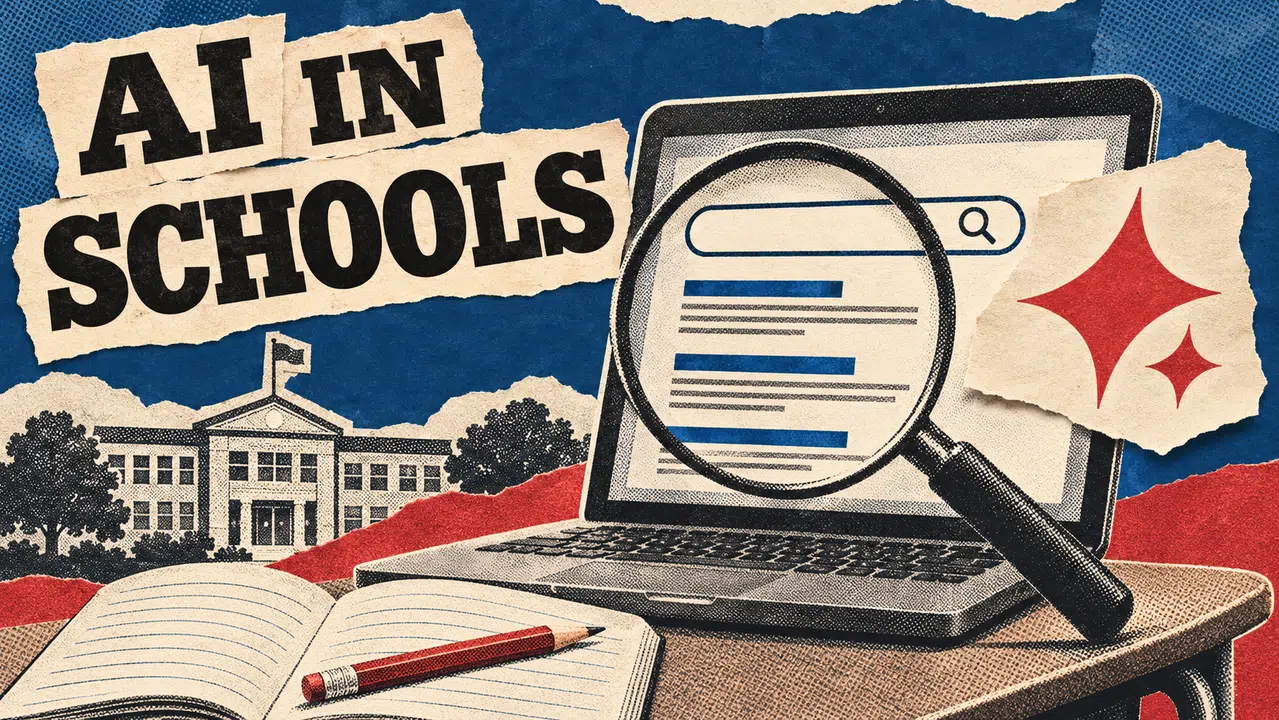
Schools will be able to turn off Google’s Gemini chatbot without losing Google Search, the company says. But districts seeking to keep generative artificial intelligence out of student searches still face an unresolved choice: Google’s announced changes do not offer an AI-free version of its search engine.
That distinction sits at the center of a dispute that has drawn criticism from New York educators and national child advocates, generated conflicting headlines and raised questions about who controls the technology students encounter at school.
Google describes its changes as giving administrators more authority. Critics argue that separating the Gemini chatbot from Search does not resolve their concern about AI-generated answers appearing inside the search engine itself.
For New York families trying to catch up, the dispute involves several different Google products, changes that have not yet fully rolled out and school policies that vary by district.
What Google announced and why it caused an uproar
The controversy grew after Google expanded student access to Gemini features in Google Classroom in August, prompting objections from educators and parents concerned about children using AI to complete assignments.
On Nov. 3, Google announced a different approach to student account controls.
In its announcement of the changes, Google said Gemini, Gemini Notebook, Gemini in Classroom and Google Search would be off for school-managed K-12 student accounts until administrators explicitly enabled them.
The company said it would provide more details before the controls rolled out.
Initial coverage focused on a consequential condition: Schools rejecting AI altogether would also have to forgo student access to Google Search under the proposed system, The Associated Press reported.
That prompted criticism that Google was using a familiar research tool to pressure districts into accepting AI.
“Google doesn’t get to hold school districts hostage just to force its AI products into our classrooms,” New York State United Teachers President Melinda Person wrote on social media, the Times Union reported.
Later that day, Google clarified its position: Administrators could enable Gemini, Gemini Notebook and Search independently.
Schools could therefore keep Search while leaving the standalone AI services disabled.
Turning off Gemini does not remove AI from Search
The distinction between products explains why the controversy has continued.
Gemini is an AI chatbot. Google Classroom is the platform schools use to organize assignments and class materials. Google Search is a separate service that now includes generative AI features of its own.
Those search features include AI Overviews, which summarize information, and AI Mode, which provides a conversational search experience.
Disabling the standalone Gemini service does not automatically remove those features from Search.
Google told Ars Technica that its clarification did not represent a policy change. The company’s planned controls allow schools to choose Search separately, but do not provide a conventional, AI-free Search option.

That makes the description of a complete retreat too broad. Google clarified that schools do not have to enable Gemini to retain Search. The dispute over AI built into Search remains.
Child advocacy organization Fairplay made that point in its Nov. 3 response to Google’s clarification.
Executive Director Josh Golin argued that the announcement still left students exposed to Google’s AI through Search. The organization urged schools to leave the services disabled, saying it believes the tools undermine learning and critical thinking.
Those are the advocacy group’s conclusions. Google maintains that appropriately designed AI can support learning.
New York schools are making different choices
The debate has immediate relevance in New York, where districts have taken different approaches to student AI access.
New York City’s 2026-27 guidance on artificial intelligence establishes a one-year moratorium on student-facing generative AI from 2-K through eighth grade, with limited use in high schools.
That is a city school system policy, rather than a statewide prohibition applying to every Finger Lakes district.
The city’s guidance also distinguishes between students using AI and educators using technology for their work. Its approach includes restrictions intended to preserve human responsibility for consequential educational decisions.
Elsewhere, district responses illustrate why a single Google announcement can have different consequences.
- Google receives lawsuit after Republican committee says they used email filters to suppress them
- Lawsuit filed in 2016 against Google is making $400 payments to those impacted
- Google accused of tracking users data
- DEBRIEF: Is Amazon, Facebook, or Google tracking you around the internet? Could it be stopped? (podcast)
Albany schools spokesman Ron Lesko told the Times Union that the district had disabled Gemini and AI Mode but could not disable the AI Overview summaries generated in searches.
Mohonasen Superintendent Shannon Shine described a different approach. His district already permitted Gemini, and he said usage data showed very little activity, which he believed was largely teacher-supervised.
Shine said he would have kept Gemini available if doing so had been necessary to preserve Search access.
The contrasting responses show that districts are weighing both instructional concerns and the practical consequences of changing tools teachers and students already use.
Google’s answer is guided learning; critics want an off switch
Google is also changing how some school-related AI interactions work.
Its Guided Learning approach is designed to lead students through questions and problem-solving steps rather than immediately supplying a finished answer. The company announced Guided Learning in Classroom and a pilot bringing similar capabilities to Search in selected U.S. schools during November.
Google says that design can help students work through difficult material. Whether that satisfies a district’s policy is a separate question: Guided AI assistance still involves generative AI.
For critics, the central request is the ability to keep familiar web searches while excluding generated answers. Google’s announced controls do not provide that option.
For parents, the practical questions are which services their district permits, what students can access through school-managed accounts and whether classroom rules match the technology settings.
Google has promised further implementation details. Until then, the company’s clarification resolves one question—schools can separate Gemini access from Search—but leaves the larger disagreement over AI in student searches intact.

FingerLakes1.com is the region’s leading all-digital news publication. The company was founded in 1998 and has been keeping residents informed for more than two decades. Have a lead? Send it to news@fingerlakes1.com.