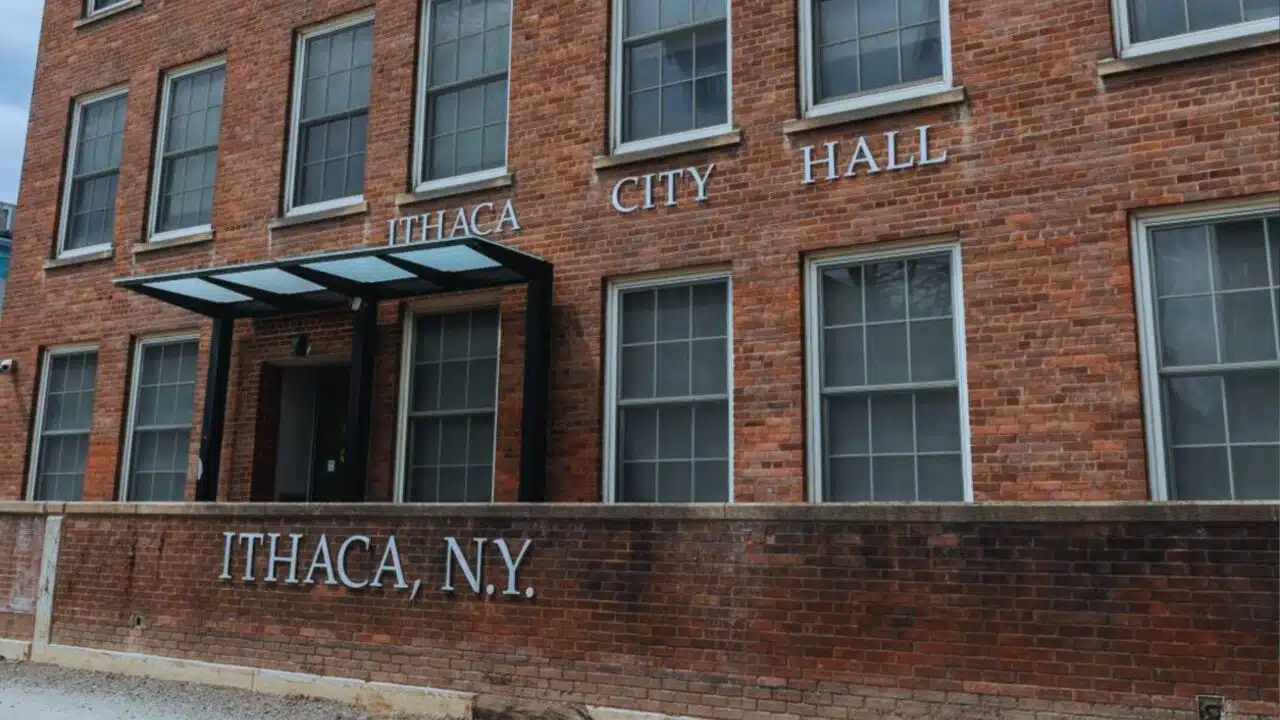
Ithaca is moving ahead with redevelopment planning for the former Seneca Street Garage while reconsidering whether the city can afford a new public safety facility, two major decisions that came as officials warned Common Council that next year’s budget could begin with a $5 million to $6 million gap.
During its Sept. 2 meeting, Common Council authorized the Ithaca Urban Renewal Agency to begin seeking redevelopment proposals for the closed downtown garage property and expanded the city’s existing public safety capital project so remaining funds can be used to study less expensive alternatives to constructing an entirely new facility. Council also approved additional transportation funding, expanded paid family leave benefits and adopted a 2026-27 work plan that will guide city operations through next year. The Sept. 2 Common Council meeting was listed by the city as a regular voting meeting. (City of Ithaca)
The decisions come as Ithaca prepares for a difficult 2027 budget process. Acting City Manager Dominick Recckio told council that departments have submitted operating and capital requests and have been asked to identify spending reductions or new revenue equal to 5% of their budgets.
City officials are trying to close the projected gap while remaining within New York’s property tax cap. Formal budget presentations and deliberations are expected during October and November.
Seneca Street Garage site moves toward redevelopment
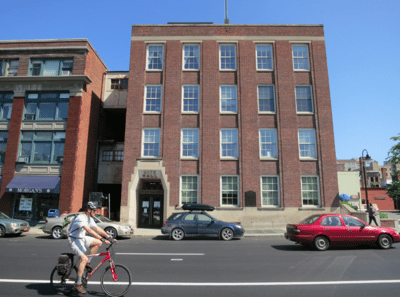
One of the meeting’s most consequential actions involved the former Seneca Street Garage at 202 E. Seneca St., which has been closed since April because of structural deterioration.
The city previously determined that repairing and reopening the aging garage was not financially or operationally practical. Protective scaffolding has since allowed sidewalks around the property to reopen while long-term redevelopment planning continues. (City of Ithaca)
Council first declared itself lead agency for the environmental review associated with transferring the property to the Ithaca Urban Renewal Agency, then issued a negative declaration finding that the transfer itself would not create significant adverse environmental impacts.
That environmental determination applies only to the transfer. Any eventual redevelopment would still be subject to its own environmental and site plan reviews.
Council then authorized an option agreement that allows the IURA to begin the formal redevelopment process.
Under the framework approved Wednesday, the property would be treated as surplus municipal land and the IURA would solicit development proposals. Any final sale or transfer would still require a future Disposition and Development Agreement and another approval from Common Council.
The city is looking for a financially viable, taxable residential project that could include market-rate or mixed-income housing, owner-occupied units and climate-resilient design. Other objectives include restoring a TCAT bus shelter along East Seneca Street and maintaining active ground-floor uses consistent with downtown planning requirements.
City officials have described redevelopment of the garage property as a major opportunity to add housing and economic activity downtown. (City of Ithaca)
New public safety building no longer the only option
Council also changed course on a long-running plan to replace Ithaca’s aging public safety facilities.
The city previously established a $4 million capital project to pursue a replacement facility intended to accommodate police operations, future staffing needs and expansion of Ithaca’s unarmed responder program.
About $2.48 million remains in that capital project.
With construction costs and inflation making a new building at the city’s 401 Third St. property increasingly expensive, council authorized those remaining funds to be used to evaluate alternatives.
One concept under consideration would expand public safety operations into space now used by City Court next to the existing police facility, with the court relocated elsewhere.
The authorization allows the city manager and controller to hire consultants, conduct feasibility and fit studies, assess deferred maintenance, study possible relocations and compare long-term costs.
No final facility option was selected Wednesday. The goal is to give council a clearer financial comparison before committing to major new construction.
More money added to bike and pedestrian planning
Common Council accepted another $252,437 for Ithaca’s Active Transportation Network Plan.
The funding includes $201,950 in additional federal money administered through the state Department of Transportation and a required local contribution of $50,487.
The city had already approved a $587,000 planning effort to develop a detailed, block-by-block bicycle and multimodal transportation network.
The additional money will allow engineers to conduct more surveying, incorporate traffic-calming concepts and develop more detailed conceptual designs.
The plan builds on earlier work by Bike Walk Tompkins and is intended to create a connected citywide network for bicycling, walking and other forms of transportation while advancing Ithaca’s climate goals.
Paid family leave expanded to more city employees
Council also authorized New York State Paid Family Leave coverage for employees in Ithaca’s Administrative Unit and Executive Unit, along with unrepresented city employees.
The decision follows discussions with employees and bargaining units that began after council directed the administration in 2025 to explore participation.
The Administrative and Executive units voted to participate and negotiated agreements with the city, while a majority of responding unrepresented employees also supported joining the program.
Paid Family Leave is primarily funded through employee payroll deductions and provides eligible workers paid time away from work for qualifying family-care situations.
The Acting City Manager was authorized to execute the necessary agreements and complete implementation.
Council adopts 36-part executive work plan
Ithaca also formally adopted its 2026-27 Executive Work Plan, setting out 36 major deliverables supported by 109 individual action items.
The plan covers housing, economic development, public works, finance, sustainability, human services, public safety and intergovernmental relations.
Among the initiatives are housing-density analysis, zoning updates, infrastructure planning, flood mitigation, stronger financial controls, implementation of the Climate Action Plan, public safety staffing and changes to community engagement.
City departments will use the plan to guide work and budget decisions through 2027.
Quarterly progress reports are expected to be presented to council, with the first anticipated in December.
City considers more flood mitigation resources
Recckio also told council that flood mitigation remains Ithaca’s highest public works priority.
The city continues working with FEMA and engineering consultants on flood mitigation planning and flood map revisions.
Ithaca received a 24-week extension on a related state grant, giving the city until Feb. 1, 2029, to complete construction covered by the funding.
Additional engineering resources could be proposed as part of the 2027 budget.
Building complaint system draws 69 reports in five weeks
The city’s recently launched Building Division complaint system received 69 complaints during its first five weeks.
Officials said 94% were assigned to inspectors within two business days, and some complaints have already resulted in code violations.
The city plans to continue tracking response times, enforcement results and other data as the system develops.
ROOTS hiring begins
Hiring has also begun for Ithaca’s ROOTS Community Responder Program, with interviews underway and onboarding expected this fall.
The Community Justice Center, CARE Team, Ithaca Police Department, city staff and community organizations are participating in the selection process.
The program is part of Ithaca’s effort to expand alternatives to traditional police response.
Council separately accepted a $9,700 Community Foundation of Tompkins County grant to support Community Justice Center activities and programming.
City carries nearly $148 million in debt
The meeting also included a detailed financial update showing Ithaca continues to face significant debt and audit challenges.
The city currently carries approximately $147.7 million in combined short- and long-term debt across all funds, including bonds and bond anticipation notes.
Officials said Ithaca has relied more heavily on short-term borrowing while working through overdue audits and repairing its credit position. Reimbursement-based capital projects have also contributed because the city often must spend money before receiving grant reimbursements.
A more detailed debt-reduction and conversion strategy is expected to come before council later this month.
Through July, General Fund revenue totaled about $51.9 million, roughly 60% of the annual budget. Property taxes were at about 93% of budgeted collections, while sales tax continued to show growth.
General Fund spending stood at approximately $44 million, or about 49% of annual appropriations.
Officials noted that some major expenses, including retirement system payments, occur later in the year.
Audit backlog continues to shrink
The city has completed draft 2022 financial statements and submitted them to its outside auditors.
Formal audit fieldwork is expected to begin in October.
Clearing the backlog is considered important for establishing reliable fund balances, strengthening internal controls and improving Ithaca’s ability to borrow at favorable rates.
GIAC project coming to council next
Council was also told it will get an informational presentation Sept. 9 on a proposed Planned Unit Development for a new GIAC Red and White Café facility on Court Street.
The project requires additional review because portions of the proposal do not comply with existing zoning.
Separately, applications remain open through Sept. 11 for Ithaca’s next director of planning and development as the city prepares for the current director’s retirement.
Council also approved appointments for Christine O’Malley to the Sustainability and Climate Justice Commission, Kristen Brennan as an alternate on the Ithaca Landmarks Preservation Commission and Karen Johnson Feltham to the Planning and Development Board.
With the 2027 budget approaching, much of the work approved Wednesday now shifts to staff: developing lower-cost public safety options, soliciting redevelopment proposals for the Seneca Street Garage property, advancing the transportation plan and determining how Ithaca can balance its priorities against a multimillion-dollar operating gap.

FingerLakes1.com is the region’s leading all-digital news publication. The company was founded in 1998 and has been keeping residents informed for more than two decades. Have a lead? Send it to news@fingerlakes1.com.