

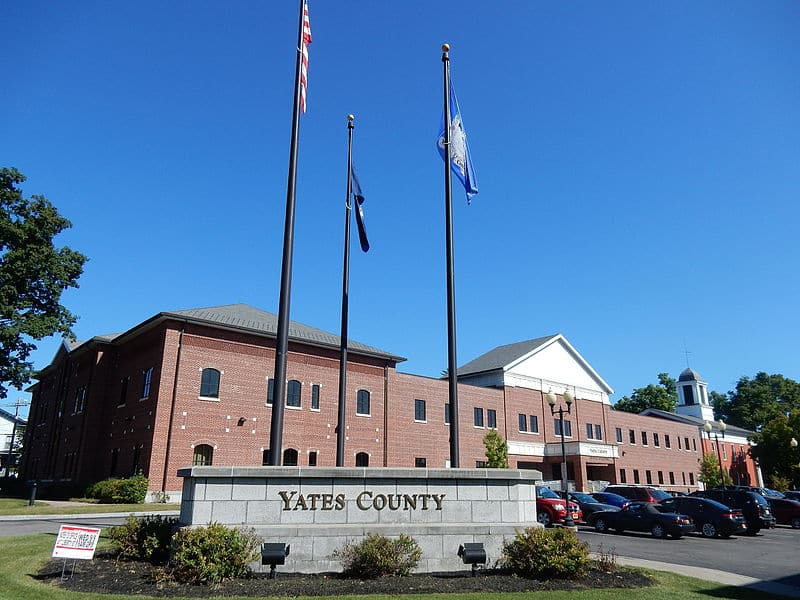
Questions about a proposed new jail and an increasingly contentious debate over the Ferguson Corners Bridge project dominated Yates County government meetings over the last two weeks, as residents repeatedly pressed lawmakers for more transparency while legislators approved a series of public safety, health and infrastructure initiatives.
Public opposition to the county’s proposed public safety facility emerged as the central issue during committee meetings and the June 8 meeting of the Yates County Legislature, where residents challenged lawmakers on everything from project costs and public involvement to the size and necessity of a replacement jail.
Residents push for more transparency on jail project
Several residents used public comment periods to urge county leaders to slow down the public safety facility process and provide more information to taxpayers.
Barbara Craig called for a public hearing, creation of a citizen advisory committee and public meetings of the Legislature’s ad hoc public safety facility committee. She argued that residents have struggled to get answers about a project that could ultimately cost tens of millions of dollars.
Others echoed those concerns, questioning why discussions surrounding the jail have not included more direct public engagement.
Former deputy sheriff Gene Mitchell urged lawmakers to reconsider plans for a new facility, arguing that the county should instead renovate the existing jail. Mitchell said the current facility, which opened in the late 1970s, remains functional and could be upgraded for a fraction of the estimated cost of replacement.
“I would much rather see a 49-year-old building have whatever it takes, $5 million, $10 million, to upgrade it,” Mitchell told legislators.
Resident Denise Hopkins said public skepticism could be reduced if county officials more clearly explained why renovation is not a viable option and publicly shared any analysis comparing rehabilitation costs against construction of a new facility.
But support for a new facility also surfaced during the meeting.
Milo Town Justice Michael Christensen, who previously worked in the jail, said design problems existed almost immediately after the facility opened. He argued that the county risks significantly higher costs in the future if it waits for intervention from the state Commission of Corrections before acting.
Public Safety Facility Committee Chairman Doug Paddock reported that 47 residents participated in recent tours of the existing facility and said additional tours could be scheduled if interest continues.
Paddock also reiterated that the ad hoc committee serves only in an advisory capacity and does not make final decisions regarding the project. Legislature Chair Leslie Church echoed that point during committee discussions, noting that all final decisions remain with the Legislature.
Bridge replacement becomes a battle between cost and convenience
If the jail debate generated the most public concern, the Ferguson Corners Bridge project produced the most significant legislative action.
Farmers, agricultural businesses and residents packed committee and legislative meetings to urge lawmakers to maintain access across the bridge during its planned rehabilitation.
Representatives from several large farming operations warned that closure of the bridge without a temporary crossing would force farm equipment, fuel trucks and delivery vehicles onto lengthy detours through neighboring communities. They argued the additional mileage would increase costs, create safety concerns and complicate access to thousands of acres of farmland during critical growing and harvest seasons.
Rushco owner Mark Spoor said fuel trucks use the bridge multiple times each day, while representatives of Tomion Farms, Vaughan Farms and other agricultural operations described the bridge as essential to their daily operations.
Highway Superintendent Doug Rapalee told legislators the state Department of Transportation recently informed the county that construction of a temporary bridge would not qualify for anticipated state reimbursement. The DOT also warned that adding a temporary bridge could delay the project until 2028 and potentially jeopardize future state funding.
Still, legislators remained divided.
Several lawmakers argued that the county should absorb additional costs if necessary to avoid major disruptions to farmers and businesses. Others warned that delaying the project could ultimately create even greater financial and logistical problems.
After extensive debate, legislators adopted a compromise.
The Legislature approved an amended resolution authorizing a double-lane temporary bridge only if engineers determine that alternative construction methods or scheduling options cannot be economically incorporated to complete the project during a less disruptive period, such as late fall through early spring.
The amendment, proposed by Paddock, directs county officials to first explore construction alternatives before committing to the temporary bridge option.
Emergency services expansion moves forward
While the bridge and jail discussions attracted the most attention, lawmakers also approved several significant public safety initiatives.
The Legislature unanimously authorized the creation of four new specialty emergency response teams: a surface, flood and swift-water rescue team; a hazardous materials decontamination team; a fire investigation team; and deputy fire coordinator positions.
Officials said the new teams will improve emergency response capabilities and provide faster specialized assistance during incidents throughout the county.
Lawmakers also approved the purchase of a new Crestline ambulance for the Office of Emergency Services at a cost of nearly $170,000.
Emergency Services Director David Dowdle previously reported that county EMS crews continue to respond to a growing number of serious incidents, including major vehicle crashes, water rescues and structure fires.
Public health officials highlight emerging concerns
Public Health Director Alyssa Broome-Quissimisse reported a growing number of tick-borne illness cases in Yates County and warned legislators that anaplasmosis infections are already exceeding last year’s pace.
Four cases have been confirmed so far this year, compared with eight reported during all of 2025.
The department is also monitoring an Ebola outbreak in Central Africa. While officials stressed the risk to local residents remains very low, public health agencies continue tracking developments because of international travel patterns.
Broome-Quissimisse also reported that Yates County maintains some of the lowest vaccination rates in New York and announced efforts to better understand vaccine hesitancy through community outreach and focus groups.
Lawmakers later approved several public health-related initiatives, including participation in a lead hazard reduction partnership with Ontario County and acceptance of state funding to support immunization outreach efforts.
Social services preparing for federal benefit changes
The Department of Social Services warned that new federal work requirements could result in dozens of local residents losing Supplemental Nutrition Assistance Program benefits.
Commissioner Amy Miller said officials expect between 50 and 80 SNAP cases could close because recipients failed to meet participation requirements.
At the same time, the county is preparing for distribution of Summer EBT benefits for eligible children and continuing workforce development programs funded through the Finger Lakes Workforce Investment Board.
The Legislature approved workforce funding agreements, authorized a new caseworker hire and approved a departmental reclassification intended to address findings from a recent audit of the county’s support collection operations.
Tourism, broadband and county operations continue moving forward
Outside the headline-grabbing debates, county officials reported progress on several ongoing initiatives.
County planners said the federally funded ReConnect broadband expansion project continues advancing, with dozens of new customers already connected and additional construction phases expected later this year.
The Tourism Advisory Council also recommended funding two projects during the latest grant round, supporting initiatives in Dresden and along the Keuka Lake Wine Trail.
Lawmakers additionally approved upgrades to the county’s website and public records systems through an expanded CivicPlus contract that includes new software designed to streamline Freedom of Information Law requests.
The Legislature also authorized multiple personnel actions, including efforts to fill vacant EMT, paramedic, correction officer, dispatcher and assistant public defender positions as county departments continue facing recruitment challenges.
Debate likely to continue
Although lawmakers approved dozens of routine resolutions during committee and legislative meetings, it was clear that the county’s proposed public safety facility and Ferguson Corners Bridge project remain the issues generating the strongest public reaction.
With jail planning still underway and bridge engineers now tasked with evaluating additional alternatives, both issues appear likely to remain at the forefront of county discussions throughout the summer.

FingerLakes1.com is the region’s leading all-digital news publication. The company was founded in 1998 and has been keeping residents informed for more than two decades. Have a lead? Send it to news@fingerlakes1.com.