

Editor’s Note: This article is the fifth in a multi-part series exploring the hidden science behind the decline of American lakes and reservoirs. Adapted from an educational video series it aims to equip local communities, lake associations, and municipal leaders with the scientific knowledge needed to demand effective, long-term restoration strategies.
In our previous articles, we explored how the loss of deep-water oxygen – hypoxia – creates a dead zone at the bottom of our lakes. But hypoxia is only the trigger. The real engine driving the toxic algae blooms across the Finger Lakes is what lies beneath that dead zone: the sediment.
For decades, researchers at institutions like the New York State Water Resources Institute (WRI) at Cornell University have studied the complex nutrient dynamics of the Finger Lakes. Their findings point to a critical, often overlooked reality: while we spend millions trying to stop phosphorus from washing into our lakes from farms and lawns, many of our lakes are now independently fertilizing themselves from the inside out.
This process is called internal nutrient loading, or sediment nutrient recycling. It is the reason why, even after a community successfully reduces watershed runoff, the toxic cyanobacteria blooms keep coming back. The lake has built up its own internal stockpile of fuel, and our current management practices are actively making it worse.
The sludge hydra: A monster fed by symptoms

To understand what is happening at the bottom of the lake, it helps to think of the sediment not just as muck, but as a living entity. One lake resident aptly compared it to the Hydra – the multi-headed monster from Greek mythology.
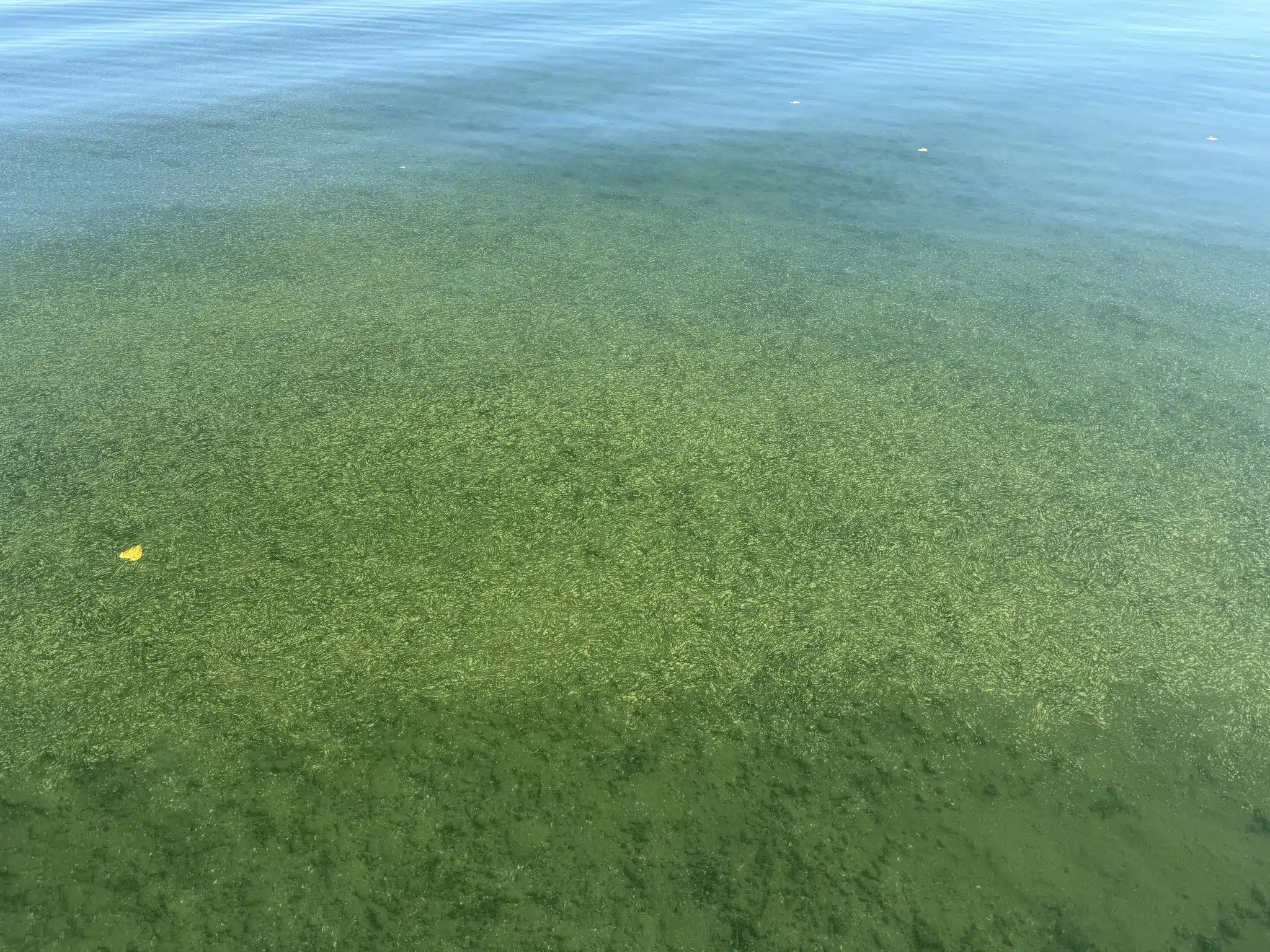
Each head of the Hydra represents a visible symptom on the surface: a toxic algae bloom, a dense mat of invasive weeds, or a sudden fish kill. But these are just the masks the monster wears. The true body of the beast is the thick, slimy layer of organic muck at the bottom of the lake. This muck is composed of decades of dead, rotting plant matter, packed with phosphorus and nitrogen.
When a lake committee hires a contractor to spray algaecides or herbicides, they are trying to cut off the Hydra’s heads. The chemicals kill the weeds and the algae, and the surface temporarily clears. But as the legend warns, every time you cut off a head, two grow back and the monster grows stronger.
The chemically killed biomass sinks to the bottom, where it rots, consumes more oxygen, and adds to the toxic muck layer. The beast feeds on the very corpses produced by our futile attempts to control it. We are paying to feed the monster.
How to defeat the Hydra: Starve it from within
You cannot kill this beast by attacking it at the surface and cutting of its heads. To defeat it, you must starve it from within. This requires a fundamental shift in strategy, moving away from chemical symptom management and toward biological restoration.

First, we must restore oxygen to the deep water, ending the hypoxic conditions where the muck thrives. When the bottom is oxygenated, phosphorus remains locked in the sediment rather than dissolving into the water.
Second, we must rebuild the lake’s natural digestive system. By supporting beneficial microbes and zooplankton, the lake can begin to naturally consume and break down the organic sediment. This process, known as enzymatic bio-dredging, digests the muck away without the need for destructive heavy machinery. As the muck disappears, the internal nutrient stockpile is eliminated, and the Hydra starves.
Measuring the muck: Why poking poles fail
If reducing the sediment stockpile is the key to long-term recovery, how do we know if a management plan is actually working? We have to measure it.
Shockingly, many lake management consultants still rely on an archaic, unscientific method: poking a pole into the soft muck in a few shallow spots to guess its depth. This is entirely inadequate. Muck is fluid; it slowly moves with water currents and settles in the deepest parts of the lake where a pole cannot reach. A few random pokes tell you nothing about the total volume of sediment in the lake.
To truly measure sediment reduction, communities must demand comparative bathymetric sonar scanning. This technology takes millions of accurate, acoustic measurements across the entire lakebed, creating a highly detailed 3D contour map. By comparing these scans year over year, we can calculate the exact volume of sediment gained or lost, down to the cubic yard.
The proof is in the data
When you use accurate bathymetric data, the truth about chemical treatments becomes undeniable. In one documented case study at a lake in New Jersey, a dense weed bed was treated with herbicides. A bathymetric scan was conducted before the treatment, and again two months later.
The results were staggering. In just 60 days, the average depth of the entire lake had decreased by six inches. The dead, rotting weeds had added the equivalent of nearly 5,500 cubic meters of new, nutrient-rich sediment to the lake bottom. The treatment had actively accelerated the lake’s decline.
Conversely, bathymetric data proves the effectiveness of biological restoration. In a separate reservoir project, five years of oxygenation and bio-dredging digested away 138,000 cubic yards of organic sediment. The water volume increased by over 50%, and the lake grew significantly deeper – all without a single barge, bulldozer or dump truck.
Demand better data
The Finger Lakes are facing a critical turning point. We can continue to feed the Sludge Hydra with expensive chemical treatments, or we can demand a smarter, science-based approach.
If your lake association or municipality is paying for a management plan, you have the right to know what is happening at the bottom of your lake. Demand comparative bathymetric scanning. If your contractor cannot provide accurate, mapped data proving that the sediment stockpile is shrinking, they are not solving the problem – they are just managing the symptoms.
