

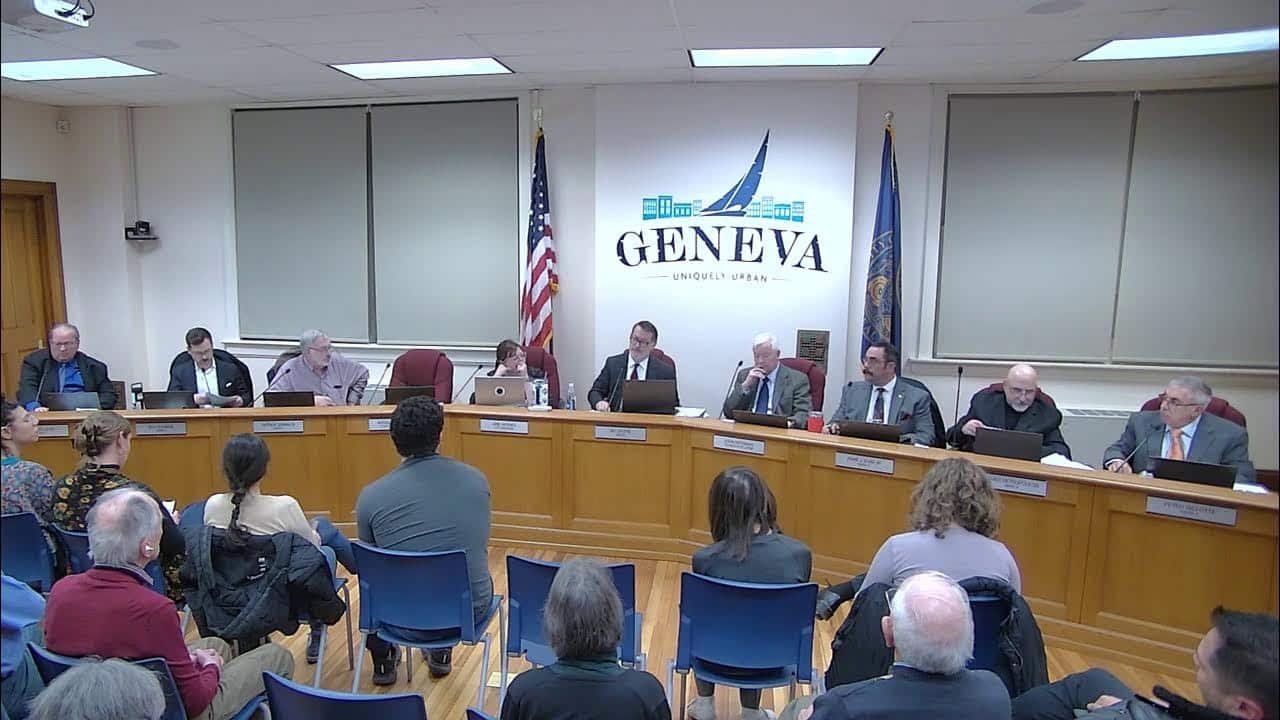
City Council formally moved forward with its 2026–2027 strategic plan process this week, approving a resolution to hold two public hearings before potential adoption in early April.
The hearings are scheduled for March 28 at the Geneva YMCA and April 1 at City Hall, with council expected to consider adoption following public input.
The strategic plan is designed to establish a structured, results-oriented framework to guide council priorities, policy direction, and oversight over the next two years. It was developed through council input sessions, prioritization exercises, and the creation of a month-by-month action framework.
Council discussion at the meeting emphasized that the plan is intended to improve transparency, coordination, and accountability while shifting away from reactive decision-making.
Strategic plan centers on housing, finances, economic development, and infrastructure

The proposed plan organizes city priorities into tiers, with four “Tier 1” focus areas receiving the most attention in 2026:
- Housing and development
- Budget and finance processes
- Downtown and economic development
- Infrastructure planning
Housing was identified as the top priority, with goals including increasing homeownership, addressing vacant properties, and improving zoning clarity. Financial priorities include improving transparency, developing a capital improvement plan, and aligning spending with council priorities.
Downtown revitalization efforts will focus on reducing vacancy, improving coordination among economic development entities, and strengthening the visitor economy. Infrastructure planning includes long-term strategies for water, sewer, and stormwater systems, as well as aligning capital projects with growth and environmental goals.
The plan also outlines secondary priorities such as recreation, public safety, governance reforms, and shared services, along with longer-term efforts like a comprehensive plan update and charter review.
City manager outlines reorganization and operational priorities
City Manager Amie Hendrix provided a detailed overview of the city manager’s office, highlighting a recent restructuring that consolidates recreation, economic development, planning, zoning, code enforcement, and facilities under the assistant city manager.
The reorganization was implemented without adding staff, instead aligning related functions to improve coordination and efficiency.
Hendrix described the office as the “bridge” between council policy and day-to-day operations, responsible for translating priorities into services delivered to residents.
Key operational goals for 2026 include:
- Developing the 2027 city budget
- Expanding shared services and regional coordination
- Strengthening internal operations and communications
- Advancing infrastructure and sustainability initiatives
- Managing and increasing grant funding
The city has set a target of securing between $3 million and $5 million in grant funding annually and is already exceeding that benchmark, according to Hendrix.
She also noted the city is managing roughly 30 active grants and faces capacity limits without additional administrative support.
Grant capacity and staffing needs emerge as concern
Council members questioned whether the city should invest in a dedicated grant writer to pursue additional funding opportunities.
Administrators said current staffing allows the city to maintain its existing grant volume but limits expansion beyond the current funding range.
Officials indicated that hiring or contracting additional grant-writing support could increase revenue but would require balancing administrative capacity to manage those awards.
Comprehensive plan update introduced as long-term policy guide
Assistant City Manager Nicole Youngs presented an overview of the city’s comprehensive plan update, describing it as a long-term framework guiding land use, housing, infrastructure, and economic development decisions.
The update process is expected to take approximately 24 months and will include data analysis, community engagement, scenario development, and eventual council adoption.
Youngs emphasized that the comprehensive plan is not a zoning law or capital plan, but rather a guiding document for future decision-making.
“It’s really about how we make decisions as a city, not just today, but 10 to 20 years from now,” Youngs said.
The effort will build on the city’s 2016 comprehensive plan and integrate other planning efforts, including economic development strategies and regional initiatives.
Council raises concerns about state influence and community input
Discussion of the comprehensive plan revealed some concern among council members about potential influence from state funding requirements and whether the process would reflect local priorities.
Officials clarified that while the plan update is tied to state funding and includes required deliverables — such as public engagement and outreach to disadvantaged communities — the content of the plan itself will be locally driven.
City leadership stressed that community input will be central to the process, with multiple engagement methods planned, including public meetings, outreach efforts, and ongoing feedback opportunities.
Council members also highlighted the need to ensure broader representation in the process, noting that some communities have historically been underrepresented in city decision-making.
Strategic plan and comprehensive plan expected to align
Mayor Jim Cecere and city staff framed the strategic plan and comprehensive plan as complementary efforts.
The strategic plan focuses on near-term priorities and execution, while the comprehensive plan provides a longer-term vision and policy framework.
Officials said the strategic plan reflects elements of the existing comprehensive plan but narrows them into actionable priorities for council over the next two years.
The comprehensive plan update, in turn, is expected to incorporate those priorities while expanding community input and long-range planning.
Next steps set for late March and early April
Council will now move into the public engagement phase for the strategic plan, with hearings scheduled for March 28 and April 1.
Following those sessions, council is expected to consider adoption of the plan, which will guide legislative priorities, budget decisions, and policy direction through 2027.
Meanwhile, work on the comprehensive plan update is expected to continue over the next two years, with ongoing council involvement and community participation shaping the final document.
FingerLakes1.com is the region’s leading all-digital news publication. The company was founded in 1998 and has been keeping residents informed for more than two decades. Have a lead? Send it to news@fingerlakes1.com.