

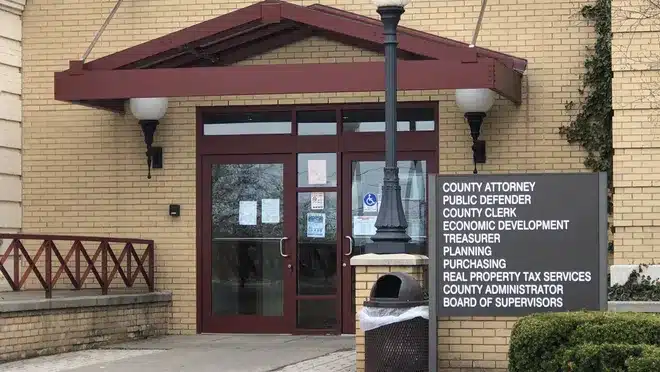
A sweeping forensic audit of the Ontario County Clerk’s office has uncovered a shocking embezzlement scheme involving more than $453,000, orchestrated by former County Clerk Matthew Hoose, who served in the position from 2012 until his unexpected death in February 2023. The findings have rattled county officials and left lingering questions about internal controls and oversight.
The audit, commissioned by the Ontario County Board of Supervisors (BOS) and conducted by The Bonadio Group, was initiated in response to mounting concerns over delayed state filings and payments, which initially surfaced in mid-2022. These delays raised red flags within both county and state offices, prompting the Board to investigate further. What began as a routine inquiry into tardy reports quickly unraveled into a decade-long embezzlement operation.
Delayed reports sparked investigation
Concerns were first raised in July 2022 when the New York State Department of State notified Ontario County Administrator Chris DeBolt about reports and payments from the Clerk’s office that were significantly delayed. Despite multiple offers of assistance from county officials, including the BOS, Hoose resisted efforts to rectify the backlog. Several instances between July and November 2022 saw Hoose making sporadic progress, but each attempt was quickly followed by further delays.
By early 2023, frustrations reached a boiling point. The BOS adopted a “Resolution of No Confidence” (Resolution No. 117-2023) against Hoose in February, initiating a forensic audit led by The Bonadio Group. Just days before the audit was set to begin, Hoose unexpectedly passed away, leaving county officials to manage an office in disarray and address the growing concerns about its financial operations.
Thefts took place over span of years, showcasing clear pattern
After Hoose’s death, The Bonadio Group resumed its audit, which quickly revealed financial irregularities spanning more than a decade. The audit team uncovered 637 instances between 2012 and 2023 where the amount deposited by the Clerk’s office was less than the reported revenue. In total, $453,364 was found to be missing, much of it in cash.
“Nearly all of the missing cash was in multiples of $100,” the report states, indicating a deliberate and calculated approach to the theft. The audit found no discrepancies in the accounts of the Department of Motor Vehicles, which also fell under Hoose’s oversight, but records indicated that Hoose manipulated deposits, using checks received by the Clerk’s office to balance DMV accounts.
The scheme involved diverting cash from the daily deposit reports, which were processed through the County Fusion system, the software used by the Clerk’s office to record transactions. The audit documented that Hoose consistently took advantage of his sole control over cash-handling and banking activities, bypassing any internal oversight or standard financial controls.
Criminal investigation clears others from office
Following the audit, a criminal investigation was launched by the New York State Police (NYSP) in July 2023 to determine whether others were involved in the embezzlement. After a thorough, year-long investigation, the NYSP concluded that Hoose acted alone in the theft. No evidence was found to suggest that any other county employees or officials were aware of or complicit in his activities.
Investigators noted that when Hoose was absent from the office, there were no instances of missing funds, further solidifying that he operated independently in the embezzlement scheme. “Every time Hoose went on vacation, the deposit records were flawless,” the audit revealed, citing interviews with staff and reviews of the deposit records during these periods.

Pattern of deception identified in report
The audit outlined a clear pattern of theft that began shortly after Hoose took office in 2012. Initially, the theft involved only cash, but by 2018, checks were also being diverted. Hoose is believed to have deposited checks meant for the County Clerk’s office into the DMV’s accounts, offsetting the theft of cash in a way that balanced the books and avoided raising suspicion.
The final years of Hoose’s life were marked by increasing delays in payments and reports to state agencies, as the pressures of maintaining the scheme likely became too great. From June 2022 to February 2023, several offers of assistance were extended to Hoose by the County Administrator and the Chairman of the Board of Supervisors, but he resisted all attempts to impose standard oversight.
How quickly did Ontario County react
In light of the findings, Ontario County has moved swiftly to implement new internal controls to safeguard public funds. Recommendations from The Bonadio Group include strict segregation of duties within the Clerk’s office, the use of locked bank bags for deposits, and daily reconciliations of financial reports, all aimed at preventing any similar incidents in the future.
County officials are also working closely with New York State representatives to ensure that all overdue filings and payments are brought up to date. Jean Chrisman, elected as Ontario County Clerk in November 2023, has already overseen the implementation of these reforms since taking office in December of that year. Chrisman has worked alongside county officials to reinforce transparency and rebuild public trust in the Clerk’s office.
Despite these efforts, the stolen funds are unlikely to be recovered. “There are no viable legal options for the county to pursue at this time,” the report acknowledges, leaving Ontario County taxpayers to shoulder the financial loss.
County looks forward to implementing better oversights
While Hoose’s death may have brought an abrupt end to the investigation, the embezzlement case leaves a significant stain on the Clerk’s office and raises questions about the lack of oversight for independently elected officials. The case has sparked discussions about how county governments can better monitor financial practices in offices that traditionally operate with little direct supervision.
Moving forward, county leaders are determined to use this scandal as a catalyst for reform. Ontario County Administrator Chris DeBolt emphasized that the county is committed to ensuring such a breach of public trust never happens again. “The system failed, and we’re doing everything we can to make sure that failure doesn’t repeat itself,” DeBolt said in a recent statement.
The Ontario County Clerk’s office, now under new leadership, is set on a path to recovery, but the financial and reputational damage left in the wake of Hoose’s actions will likely reverberate for years to come.
What happens next?
Ontario County is focused on rectifying the damage done by Hoose’s decade-long deception. The recommendations from Bonadio have been fully implemented, including monthly bank reconciliations by the finance department, a new segregation of duties, and the removal of sole deposit control from any one individual. These measures, along with stricter oversight from county leadership, aim to restore trust in the office.
As Ontario County recovers from the financial blow, the story serves as a cautionary tale for other municipalities across New York. With a system that allows independently elected officials wide latitude over their offices, the case underscores the importance of oversight and robust internal controls to prevent abuse of power.
The full forensic audit report and additional recommendations are expected to be released to the public in the coming months, providing a roadmap for other counties to follow in improving transparency and accountability in their offices.
For Ontario County, the hope is that these changes will help close a dark chapter in its history, ensuring that the theft of public funds on such a massive scale never happens again.

FingerLakes1.com is the region’s leading all-digital news publication. The company was founded in 1998 and has been keeping residents informed for more than two decades. Have a lead? Send it to news@fingerlakes1.com.