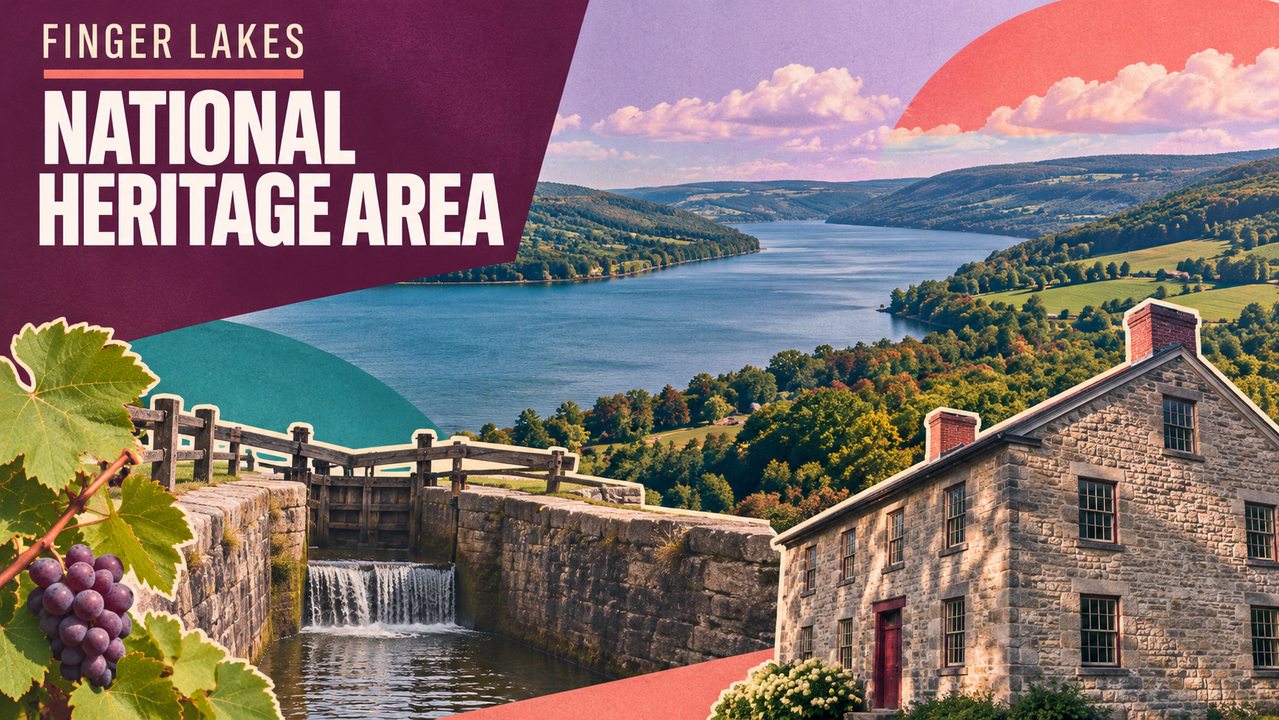
A decade-long effort to secure federal recognition for the Finger Lakes has cleared a major hurdle in Congress, potentially opening the door to new investments in tourism, historic preservation and economic development across 14 New York counties.
The U.S. Senate unanimously approved the Finger Lakes National Heritage Area Act on Thursday. The legislation now heads to the House of Representatives, where Rep. Claudia Tenney has introduced a companion bill.
The measure, sponsored by Democratic U.S. Sen. Kirsten Gillibrand, would establish a federally recognized heritage area stretching from Rochester and Syracuse to the Southern Tier.
While the designation wouldn’t turn the Finger Lakes into a national park, it would establish a framework for federal financial assistance and regional collaboration.
More than a decade in the making
Gillibrand began pursuing the designation in 2015, introducing legislation that called for the National Park Service to study whether the region qualified for national recognition.
Congress authorized that study in 2019. Four years later, the National Park Service released its findings, determining that the Finger Lakes met all 10 criteria used to evaluate potential national heritage areas.
Researchers consulted local governments, businesses, nonprofit organizations, Indigenous nations and residents throughout the process.
The study examined everything from the region’s geological history and agricultural traditions to its role in the women’s rights movement, abolitionism and the development of American democracy.
It also identified opportunities to build upon existing tourism infrastructure rather than create an entirely new system.
What the designation would mean
The proposed Finger Lakes National Heritage Area would encompass Cayuga, Chemung, Cortland, Livingston, Monroe, Onondaga, Ontario, Schuyler, Seneca, Steuben, Tioga, Tompkins, Wayne and Yates counties.
Unlike traditional national parks, National Heritage Areas operate through partnerships between local organizations, governments, businesses and the National Park Service.
The federal government provides financial and technical assistance, while local organizations oversee planning and implementation.
That distinction is particularly important in the Finger Lakes, where historic sites, vineyards, working farms, downtown business districts, parks and other natural resources span dozens of municipalities.
The designation could help connect those assets through coordinated marketing, educational programs, historic preservation initiatives and recreational opportunities.
It could also provide smaller communities with access to resources that might otherwise be difficult to secure independently.

How much federal funding could the region receive?
A September Congressional Budget Office analysis estimates that implementing the legislation would cost the federal government approximately $2 million through 2031.
The estimate reflects existing congressional spending patterns for national heritage areas.
In 2026, Congress appropriated $157,500 for each newly established heritage area and $500,000 for most areas with completed management plans.
Those figures offer a glimpse of what the Finger Lakes could receive, though actual funding would depend on future congressional appropriations.
The Senate-approved legislation authorizes federal assistance for 15 years following enactment.
Who would oversee the effort?
Under the proposed legislation, the Finger Lakes Tourism Alliance would serve as the heritage area’s local coordinating organization.
The alliance would have three years after enactment to develop and submit a management plan to the U.S. Department of the Interior for approval.
That plan would help determine how communities participate, which initiatives receive priority and how federal resources support the region’s long-term goals.
The legislation does not identify specific projects or establish funding allocations for individual counties.
Municipalities, historical societies, tourism organizations and other community partners could play important roles in developing those priorities.
What about private property rights?
The designation would not transfer ownership of private property to the federal government or give the Finger Lakes Tourism Alliance authority over local zoning decisions.
According to the National Park Service, national heritage designations do not establish new federal land-use restrictions, require property owners to provide public access or grant coordinating organizations eminent domain powers.
Existing municipal, state and federal regulations would continue to apply.
Participation by private property owners in heritage area programs would remain voluntary.
What happens next?
The legislation still needs House approval before it can reach the president’s desk.
That leaves a relatively narrow window for Congress to complete work on the measure before the current congressional session ends in January.
If Congress fails to pass the legislation before then, supporters would need to renew the effort in the next Congress.
For now, the Senate’s approval represents significant progress toward a designation that has been more than a decade in the making. If the effort succeeds, the Finger Lakes will gain a new mechanism for bringing federal resources and local organizations together around regional economic development, conservation and historic preservation.
Make FL1 part of your day.
Local reporting. Useful updates. More ways to stay close to your community.
Go ad-free
Support independent local reporting and enjoy FL1 without display ads.
$4.99 / month
Become a member →Cancel anytime. Third-party media players may contain ads.Get the daily briefing
Start your morning with the headlines that matter across the Finger Lakes.
Find more FL1 on Google
Choose FingerLakes1.com as a preferred source to see more of our reporting in your Google news results.

FingerLakes1.com is the region’s leading all-digital news publication. The company was founded in 1998 and has been keeping residents informed for more than two decades. Have a lead? Send it to news@fingerlakes1.com.