

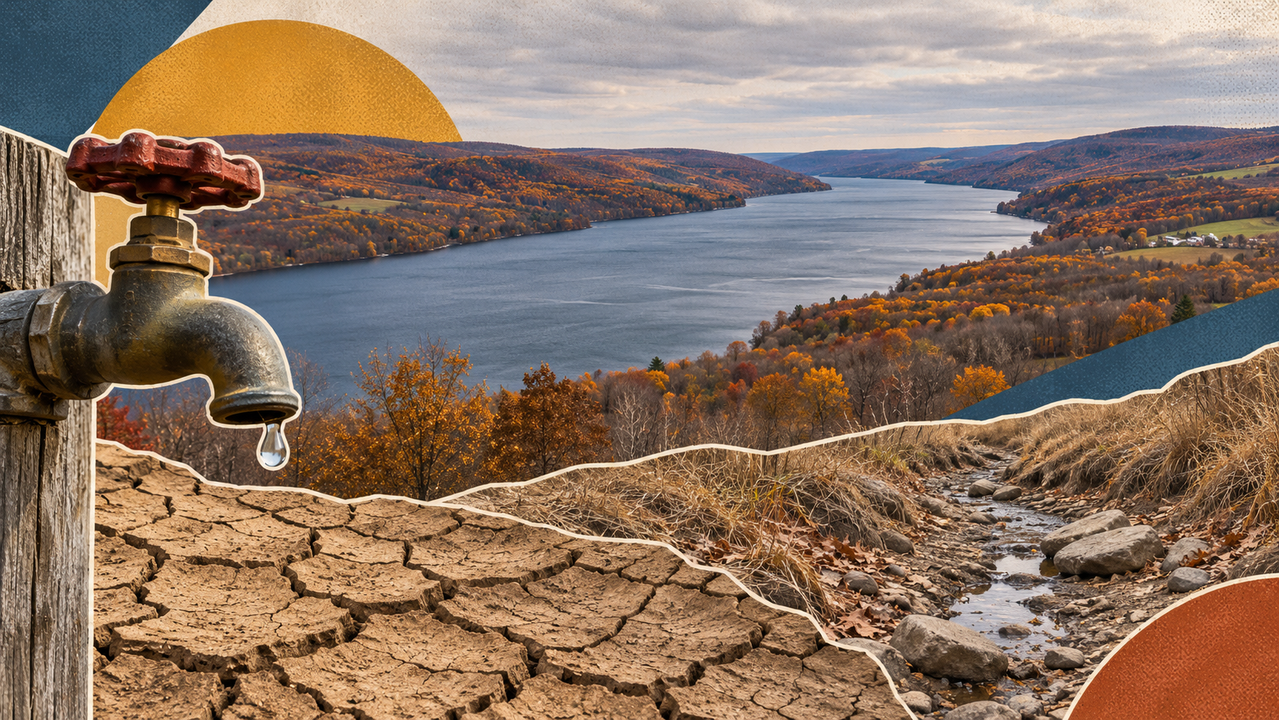
Much of the Finger Lakes is heading into winter with depleted groundwater supplies, declining streamflows and little indication that weather conditions will improve substantially in the coming months.
The New York State Department of Environmental Conservation placed 13 additional counties under a drought watch Friday, following an unusually dry fall across much of upstate New York. The announcement coincides with a federal seasonal outlook that suggests drought conditions could persist across the interior Northeast through February.
For a region heavily dependent on agriculture, private wells and freshwater lakes, the timing raises concerns about water supplies heading into 2027.
How dry has it been?
October precipitation totals illustrate the extent of the problem.
According to the National Weather Service, Syracuse received just 1.25 inches of precipitation in October, compared with a normal total of 3.89 inches. Rochester received 1.47 inches, less than half its monthly average.
Binghamton recorded 1.65 inches against a normal total of 3.76 inches.
The pattern continued into November. The latest Northeast Drought Early Warning System assessment showed moderate drought expanding across western New York as streamflow and groundwater conditions deteriorated.
State officials placed Cayuga, Ontario, Seneca, Schuyler, Tompkins, Yates, Livingston, Onondaga, Chemung, Steuben, Allegany, Cattaraugus and Wyoming counties under the watch.
Nassau and Suffolk counties on Long Island remain under an earlier drought advisory.
Winter may not provide much relief
One of the biggest concerns is what happens between now and spring.
Research from the U.S. Geological Survey shows that fall precipitation plays an important role in replenishing groundwater across upstate New York and northern New England. Groundwater recharge typically peaks in March and April.
Entering that recovery period with an existing precipitation deficit could make replenishing water supplies more challenging.
Meanwhile, the Climate Prediction Center’s latest seasonal drought outlook identifies drought persistence as the most likely outcome across the Great Lakes and interior Northeast through February.
Federal forecasters also expect a strong El Niño weather pattern to influence conditions throughout winter, increasing the likelihood of above-normal temperatures across much of the Northeast.
Those projections don’t rule out significant winter storms or periods of heavy precipitation. They do, however, offer little assurance that the region will receive enough sustained moisture to reverse its current deficits.
Even the immediate forecast offers limited relief. National Weather Service forecasters said Saturday that an approaching storm could largely miss portions of the Finger Lakes before cooler weather arrives Monday.
Private wells face particular risks
Households that depend on private wells could be among the first to experience problems if groundwater levels continue declining.
Unlike municipal water customers, rural homeowners relying on individual wells may have limited alternatives when water supplies diminish.
The DEC recommends that homeowners experiencing water supply problems contact a registered well contractor. Reduced water pressure or interruptions in service may reflect declining groundwater levels, but mechanical problems can cause similar symptoms.
Residents can also report water shortages through the state’s dry well reporting system. Those reports help officials identify localized problems that broader monitoring systems might miss.
What it means for Finger Lakes agriculture
The end of the growing season reduces some immediate agricultural water demands, but it doesn’t eliminate the risks associated with prolonged drought.
Livestock operations require reliable water supplies throughout the year. Farms that depend on wells, ponds or streams could face additional challenges if those sources fail to recover over the winter.
- Upstate growth and winter fuel risks add urgency to New York’s power planning
- Region’s energy future comes down to more than renewable power
- US Dept. of Justice sues NYS over climate change superfund law
- Snow crab season canceled in Alaska for the first time ever- billions of snow crabs have gone missing from the waters around the state
For vineyards, orchards and other agricultural operations, the condition of groundwater and soil moisture entering the spring growing season will be important.
State officials are encouraging farmers to regularly monitor available water supplies and contact county emergency management officials or local soil and water conservation districts if concerns arise.
Could water restrictions become necessary?
A drought watch represents the lowest of New York’s four drought advisory levels. It doesn’t trigger mandatory statewide water restrictions.
However, individual municipalities and water suppliers can impose conservation requirements based on local conditions.
If conditions worsen, New York could elevate affected areas to drought warning status, prompting more aggressive conservation efforts and implementation of local drought response plans.
An escalation to a drought emergency could result in mandatory water restrictions and require communities to identify alternative water supplies.
For now, state officials are asking residents and businesses to voluntarily reduce unnecessary water consumption, repair leaks and avoid waste.
The central question facing the Finger Lakes is whether precipitation over the next several months will be sufficient to replenish reserves before agricultural and residential water demand increases again in the spring.
The region still has time to recover. But the latest forecasts suggest that recovery is far from guaranteed.
Make FL1 part of your day.
Local reporting. Useful updates. More ways to stay close to your community.
Go ad-free
Support independent local reporting and enjoy FL1 without display ads.
$4.99 / month
Become a member →Cancel anytime. Third-party media players may contain ads.Get the daily briefing
Start your morning with the headlines that matter across the Finger Lakes.
Find more FL1 on Google
Choose FingerLakes1.com as a preferred source to see more of our reporting in your Google news results.

FingerLakes1.com is the region’s leading all-digital news publication. The company was founded in 1998 and has been keeping residents informed for more than two decades. Have a lead? Send it to news@fingerlakes1.com.