

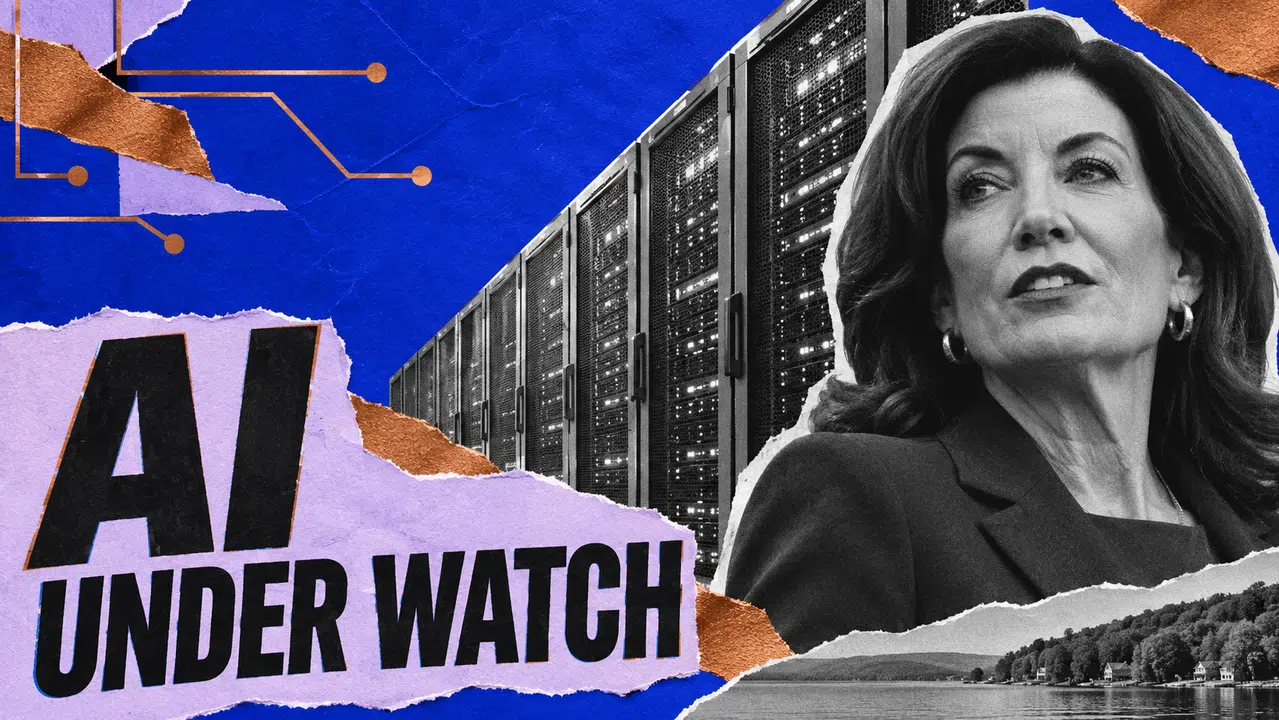
Gov. Kathy Hochul is expanding New York’s oversight of artificial intelligence after an election cycle shaped by concerns about data centers, electricity costs and water use. But her new research institute addresses a different set of risks from those prompting Finger Lakes communities to restrict where large computing facilities can operate.
The New York Center for AI Responsibility and Research, launched Tuesday, Nov. 10, will independently evaluate advanced AI systems and help inform state oversight. Hochul also opened registration for companies covered by New York’s AI safety law.
Neither initiative replaces the state’s temporary data center permitting restrictions or the local zoning decisions underway across the Finger Lakes.
That distinction matters in communities such as Auburn, which adopted its own moratorium to cover projects outside the state’s restrictions, and Lansing, where officials are considering a prohibition as TeraWulf pursues development at the former Milliken power plant.
An election-year promise to regulate while promoting AI
Hochul’s position during the campaign combined support for AI research and investment with promises to protect communities from the infrastructure demands of commercial data centers.
As FingerLakes1 reported after the election, Hochul defended her data center moratorium while Republican challenger Bruce Blakeman promised to repeal it. Their disagreement included competing explanations for rising energy costs and how much authority communities should have over proposed development.
The governor’s position has remained more conditional than an outright rejection of data centers.
In September remarks previously covered by FingerLakes1, she argued that communities choosing to host facilities should receive substantial benefits and that developers should supply power or contribute more toward the grid. She also called for reducing water, land and noise impacts.
Those remarks outlined policy goals rather than establishing all of those conditions as enforceable statewide requirements.
Tuesday’s announcement continued that approach: New York would invest in AI while building the scientific and regulatory capacity to scrutinize it.
What the new institute will do
Based at Binghamton University, the center will bring together more than 80 researchers across New York to study the safety, security and operation of increasingly powerful AI systems.
Greg Morrisett, dean and vice provost of Cornell Tech, and Jeannette Wing, Columbia University’s executive vice president for research, will serve as interim co-directors. Researchers will continue working at their home institutions.
The center will use computing resources from Empire AI, the state’s $500 million public-private research initiative. Its foundation was announced in January with a $30 million philanthropic gift led by Bloomberg LP co-founder Tom Secunda, an initial $25 million SUNY research investment and state operating support.
Its work will include testing advanced models, developing methods to measure risks and training AI safety specialists. At the state’s request, it can provide assessments to help regulators evaluate companies’ safety practices.
Separately, large frontier AI developers must register with the state by Jan. 1, 2027. Requirements beginning in January include published safety frameworks for large developers and critical-incident reporting and model transparency reports for frontier developers.
The Office of Digital Innovation, Governance, Integrity and Trust, housed within the Department of Financial Services, will oversee implementation of the RAISE Act. The center will help review published safety frameworks and recommend improvements.
Those measures address how AI systems function and how their developers disclose risks. They do not establish local zoning rules, water-use limits or project-specific electricity charges for a proposed data center.

The state moratorium has a narrower reach
Hochul’s July 14 executive order covers qualifying facilities capable of consuming at least 50 megawatts.
It directs the Department of Environmental Conservation to hold certain discretionary applications for construction or expansion that had not been deemed complete before the order. The pause continues until the Department of Public Service submits its final environmental review and findings.
The order expressly excludes local government permits. It also exempts facilities primarily used for manufacturing, research, education or medical care, including qualifying university research and Empire AI.
Its practical limits include smaller facilities falling below the threshold, applications already deemed complete and projects whose approvals do not depend on the discretionary DEC permits covered by the order.
The research exemption also explains how New York can expand academic AI computing while restricting some commercial development. The policies distinguish facilities by use and scale.
The governor’s July announcement described a pause lasting up to a year while agencies develop environmental standards, electricity policies and guidance for negotiating community benefits.
That process is intended to establish conditions for future development, rather than permanently prohibit the industry.
Critics question what happens during (and after) the pause
The dispute now extends beyond whether New York has a moratorium to whether the resulting review will produce adequate protections.
As FingerLakes1 reported Nov. 6, a coalition including Earthjustice and Seneca Lake Guardian wants a broader examination of utility costs, water consumption, pollution and community impacts.
In comments filed with the state, Earthjustice argued that framing the review around grid connections could leave other consequences inadequately examined. It sought clearer cost protections, agency responsibilities and consideration of an alternative allowing no new or expanded data centers.
- Data center backlash becomes part of New York’s post-election debate
- Gonzalez renews data center bill push as Rochester discussion brings debate closer to Finger Lakes
- Schumer backs permitting debate, seeks changes to protect water and communities
- Data center regulation tour plans Geneva, Lansing events
The Public Service Commission’s description of the review already identifies water, air quality, public health, agriculture, wildlife, noise and community character among the subjects to be evaluated. The disagreement concerns how comprehensively those issues will be studied and what enforceable requirements will follow.
Another unresolved issue is the Responsible Data Center Development Act, which passed both legislative chambers but is not listed as signed into law.
The bill generally defines large data centers at 20 megawatts, below the executive order’s threshold, and would add requirements involving hearings, energy and community benefits. Its proposed permit moratorium also contains exceptions, including certain existing approvals and projects already beginning construction.
Finger Lakes communities have acted independently
Auburn’s experience shows why local governments have sought additional protection.
The City Council approved a 12-month moratorium Aug. 6, blocking applications for data storage facilities while the city updates its comprehensive plan and considers permanent rules.
Planning Director Stephen Selvek said the measure reaches smaller projects outside the state’s hyperscale threshold. It also covers conversions of existing buildings, rather than only new construction.
In Tompkins County, Newfield adopted a one-year townwide moratorium July 9.
Dryden moved beyond a temporary pause. As FingerLakes1 reported in February, the town approved zoning changes prohibiting data centers and cryptocurrency mines after an earlier 18-month moratorium.
Lansing is weighing a different next step. The town has scheduled a Nov. 17 public meeting on a proposed ban. Its review of TeraWulf’s proposal has raised questions about staff costs, environmental impacts and how local decisions would interact with eventual state standards.
Hochul’s new institute adds expertise to New York’s AI oversight. For Finger Lakes communities confronting development proposals, the remaining decisions concern which facilities can proceed, what conditions they must meet and who pays for their demands on shared resources.

FingerLakes1.com is the region’s leading all-digital news publication. The company was founded in 1998 and has been keeping residents informed for more than two decades. Have a lead? Send it to news@fingerlakes1.com.