

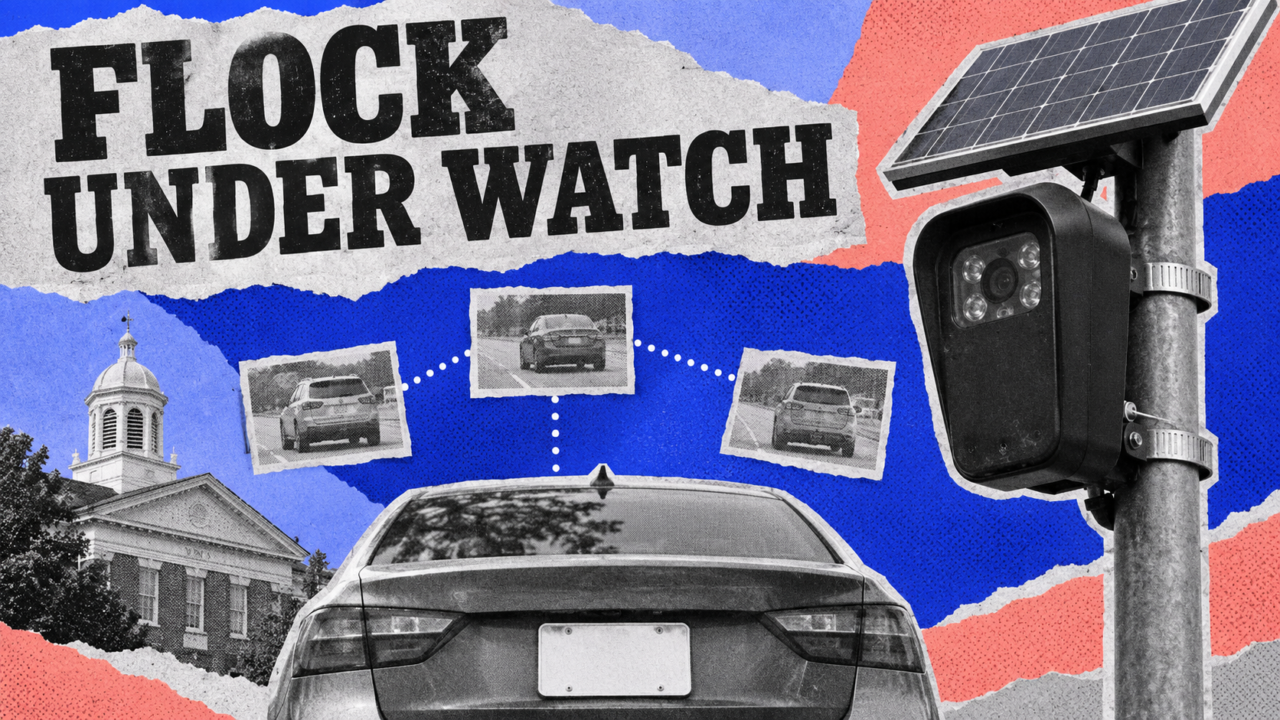
Auburn and Ithaca voted this year to end their relationships with Flock Safety after debates over privacy, data sharing and police oversight. A new Pew Research Center analysis helps explain why those questions have been difficult to resolve: The public’s view of the nationwide license plate camera network remains incomplete.
The analysis released Nov. 9 examines camera locations and information agencies voluntarily disclose about their systems. It finds substantial differences in transparency, retention policies and data sharing.
For Finger Lakes residents, the findings provide context for decisions already made locally — and questions that will follow any future proposal to use similar technology.
What Auburn and Ithaca decided
Auburn City Council voted 5-0 on Aug. 20 to terminate its Flock contract after months of debate.
The resolution directed city departments to stop using Flock cameras, databases and related services once the required termination notice was delivered. It also called for coordinating equipment removal and addressing existing records.
The decision was partly about how Auburn obtained the system. Officials acknowledged that the original agreement had not received formal council authorization.
It did not permanently prohibit automated license plate readers. Council instead required rules addressing access, sharing, security, oversight and retention before another agreement.
Ithaca’s Common Council voted March 4 to end its own Flock contract, citing privacy, civil liberties and governance concerns. The measure directed suspension of the system and removal of equipment following termination.
Those votes establish what each city directed its government to do. They do not provide a complete inventory of cameras operated by other agencies or private customers in the surrounding area.
What the cameras actually collect
Automated license plate readers photograph passing vehicles and turn plate information into searchable records. Combined with the location and time of each detection, those records can help reconstruct a vehicle’s movements across multiple cameras.
The collection is broader than photographing only vehicles already connected to crimes. Vehicles passing a reader can be recorded whether or not their occupants are suspected of wrongdoing.
A detection establishes that a vehicle was photographed at a particular location and time. It does not, by itself, establish who was driving or that a crime occurred.
In our earlier coverage of Ithaca’s debate, local police defended the technology as a source of leads in missing-person, stolen-vehicle and burglary investigations. Officials also emphasized that the license plate system did not use facial recognition.
Identifying a vehicle and identifying a face are different capabilities. A searchable history of vehicle locations can still raise privacy concerns without facial recognition.
We know the network is large, but not its exact size
Pew analyzed 109,577 Flock camera locations recorded on OpenStreetMap as of Sept. 17. Its published state table lists 2,033 mapped cameras in New York.
Those figures are not a verified inventory of every operating camera.
OpenStreetMap relies on volunteer contributions, and Pew cautions that coverage can vary with local mapping activity. Flock does not publish a complete location list.
Other estimates differ. Pew reported that Flock claimed more than 120,000 cameras in 6,000 communities in August, while a separate researcher’s surveillance map identified as many as 175,000.
The uncertainty matters locally. A camera marked on an online map may not have a verified operating status, owner or removal date. Conversely, an unmapped camera may still exist.
A city’s cancellation announcement and a crowdsourced map answer different questions. Neither alone establishes whether every camera nearby is active.
Data sharing can extend far beyond the camera’s location
Pew found 1,517 agencies with public Flock transparency portals as of Sept. 21. Those portals are optional, and participating agencies choose which information to disclose.

About two-thirds disclosed whether they shared data with other organizations. Among agencies reporting sharing information, the median number of partner organizations was 217.
That is a national finding for a subset of agencies. It does not mean Auburn or Ithaca shared their records with 217 organizations.
It does show why residents have asked questions that extend beyond who owns a roadside camera. A locally collected image can potentially become useful to investigators elsewhere when sharing is enabled.
Pew also found that public portals accounted for 39,465 cameras, approximately 36% of those identified in its OpenStreetMap dataset. That gap is not proof of misuse, but it limits what residents can learn through those portals alone.
The relevant questions include which agencies can search records, for what purposes, under whose approval and with what audit trail.
Seven-day retention does not mean every record disappears in a week
Pew found that the median agency with a public portal retained camera data for 30 days. That had been Flock’s default before the company announced a seven-day default in August.
Flock’s published evidence policy now describes seven-day retention but recognizes exceptions for laws and customer agreements.
The company’s safeguards announcement also says existing customers can retain their approved periods and describes an Evidence Mode for preserving specific records connected to active investigations.
Routine deletion and preservation of evidence therefore are separate issues.
That distinction arose in Auburn, where officials discussed records connected to active criminal cases when considering how to end the contract. Removing equipment, ending database access and resolving the treatment of existing evidence require different steps.
- Cornell University ends Flock camera contract amid privacy concerns
- Auburn resident renews questions over Flock decision and police technology oversight (video)
- Schumer asks Flock Safety to explain license plate data access and safeguards
- Auburn ends Flock camera contract, advances Schines Theater talks and changes police grant process (video)
Flock also says it will require misuse-monitoring tools and case codes for law enforcement searches by year’s end, with emergency exceptions flagged for review. Those are company commitments, rather than findings that every customer has fully implemented them.
Investigative leads do not establish how much crime the cameras prevent
Flock estimates that its cameras assisted more than 1 million law enforcement investigations in 2025, Pew reported.
That figure describes the company’s claimed involvement in investigations. It does not establish that the cameras solved 1 million crimes, prevented that many offenses or produced evidence unavailable through other methods.
Pew’s analysis examines deployment and disclosure. It is not a study measuring whether Flock reduces crime in Auburn, Ithaca or nationally.
Likewise, an example of a successful investigation can demonstrate usefulness without establishing the overall value of a camera program.
Assessing local results would require information about searches, verified leads, case outcomes, errors, costs and safeguards. Camera counts and search totals alone cannot answer those questions.
What residents still need to know
Pew found that 90% of agencies with portals disclosed search totals, but only half disclosed information about individual searches.
Even when a reason appeared, it could be broad. Some form of the word “investigation” appeared in 19% of searches that included a reason, offering limited insight into the underlying purpose.
Public disclosure, then, is not the same as a complete explanation of how a system is used.
That issue has continued in Auburn beyond Flock. As FingerLakes1 reported in October, residents questioned oversight of other police technology after the cancellation vote. The discussion highlighted the difference between capabilities a vendor advertises and features a city actually purchases or enables.
For future proposals, the unresolved questions are specific: What equipment is operating? Who can search its records? Which outside organizations receive access? How long are records kept? Who reviews searches and investigates misuse? What results justify the expense?
Pew’s findings explain why those answers require current contracts, policies, inventories and audits from individual agencies. National statistics can illuminate the debate, but they cannot substitute for local accountability.

FingerLakes1.com is the region’s leading all-digital news publication. The company was founded in 1998 and has been keeping residents informed for more than two decades. Have a lead? Send it to news@fingerlakes1.com.