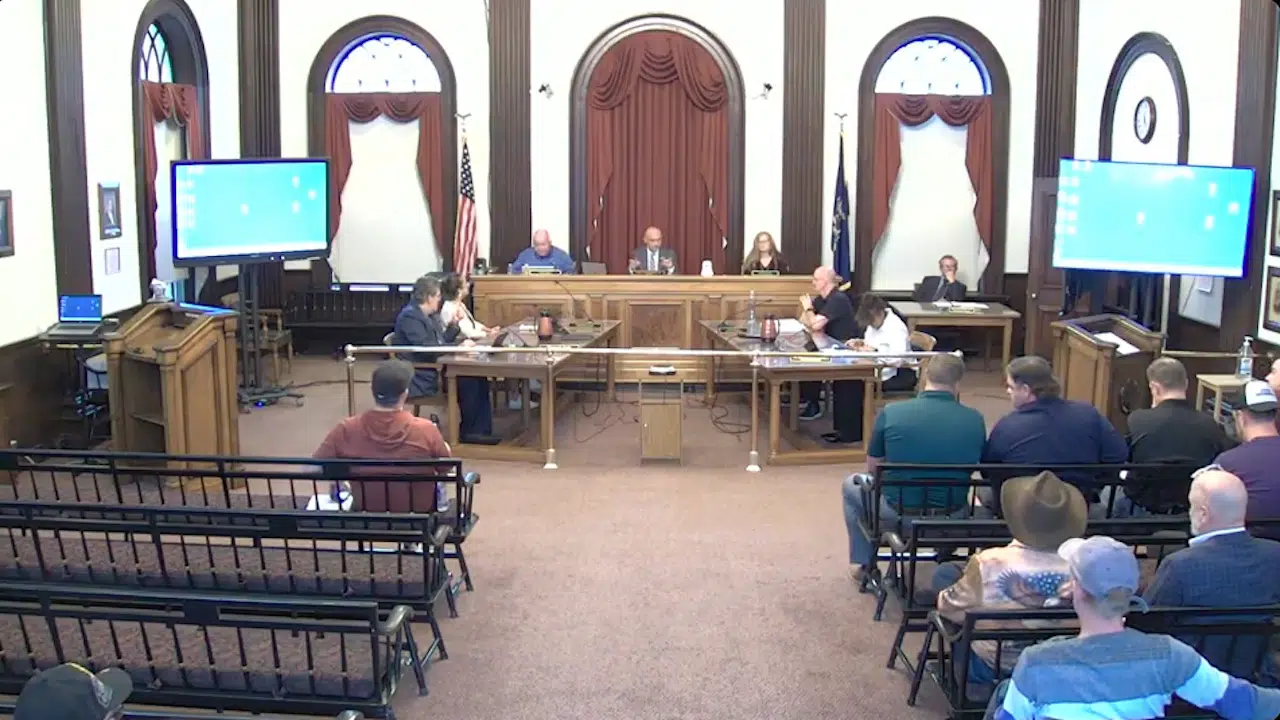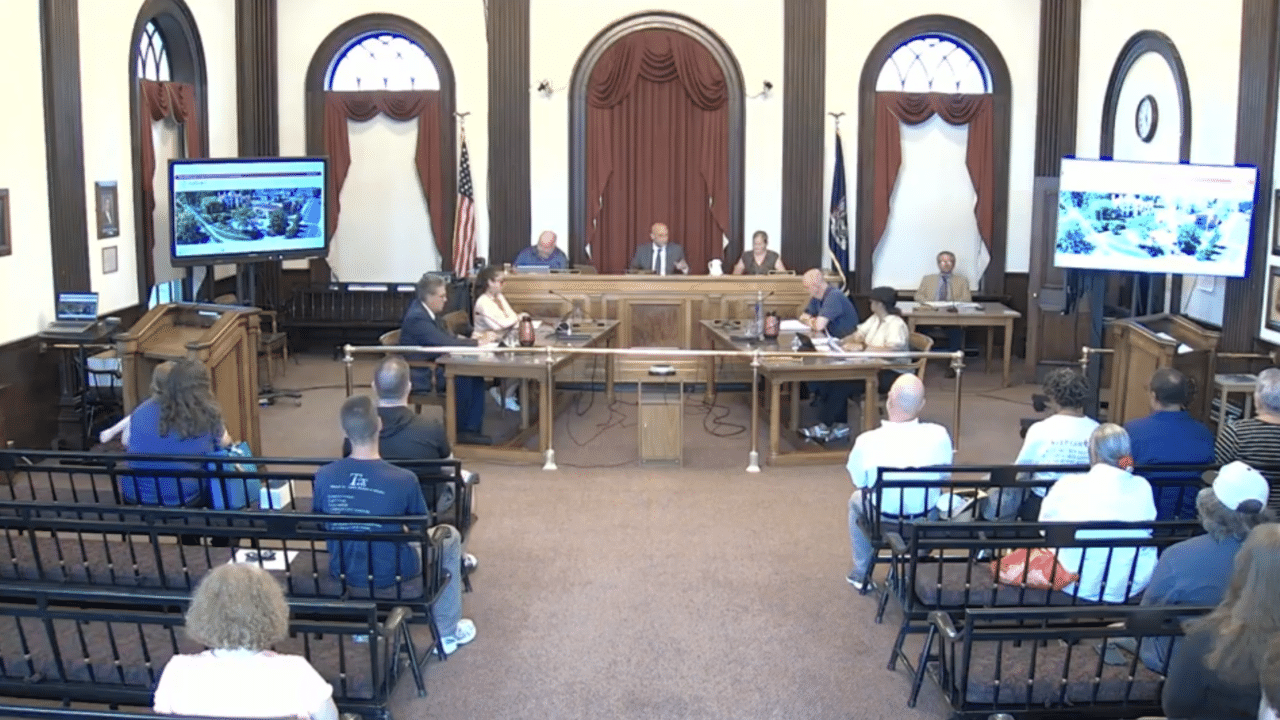
Auburn will terminate its contract with Flock Safety and shut down the city’s automatic license plate reader system after months of debate over privacy, oversight and how the technology was originally acquired.
The City Council voted 5-0 Thursday night to end the agreement, directing city officials to provide the required 30-day termination notice, stop using Flock cameras and databases once that notice is delivered, and begin developing a formal policy governing any future use of automatic license plate reader technology.

The decision was the most consequential action in a meeting that also advanced a potential $70,000 sale of the historic Schines Theater, approved engineering work for replacement of aging municipal geothermal systems and altered a police technology grant resolution to give council another opportunity to review the funding if Auburn receives an award.
Council members repeatedly returned to the same issue throughout the meeting: how much oversight the council should have when departments acquire technology or accept grant funding, particularly after officials acknowledged the Flock agreement had never received formal council authorization.
Flock contract will end, but license plate readers may return

The resolution directs city officials to take all lawful steps available under the contract to terminate Flock Safety’s services.
Once Auburn delivers its required 30-day written notice, city departments are directed to immediately cease using Flock cameras, databases and related services. The contractual relationship would formally end after the notice period expires.
The city must also coordinate removal and deactivation of the equipment and determine how existing data will be retained, transferred, returned or deleted while complying with applicable laws and records-retention requirements.
Police Chief James Slayton told council that existing information can’t simply be erased because some data may be connected to active criminal cases. He also said removing the cameras will vary depending on how individual units are installed, with some hardwired installations requiring electrical and construction work while solar-powered units could be removed more easily.
The resolution doesn’t prohibit Auburn from using license plate readers in the future.
Instead, council must work with city staff to establish a policy covering use, access, data sharing, security, oversight and retention before Auburn enters into another ALPR contract or renews, extends or materially changes one.
Councilor Terrence Cuddy, who sponsored the resolution, said he believes the city can develop an alternative that gives police useful investigative tools while addressing privacy concerns.
Mayor James N. Giannettino Jr. similarly said he supports responsible use of license plate reader technology but believes stronger safeguards and oversight are necessary.
Giannettino said the central issue for him was the process used when Auburn obtained the Flock system.
“We messed up, plain and simple,” he said, describing the failure to obtain council approval as something the city had an obligation to correct.
Councilor Craig T. Diego also voted to terminate the contract despite defending the usefulness of license plate readers during months of debate. Diego said his vote was based on the procurement and approval process rather than opposition to the technology itself.
The financial cost of ending the agreement remains uncertain. City documents say Auburn could face expenses associated with removing the cameras, while officials must also determine whether Flock will reimburse any unused portion of the contract.
Police technology grant gets an extra layer of council review
The Flock debate immediately carried over into another item Thursday: Auburn Police Department’s application for as much as $250,000 through the New York State Division of Criminal Justice Services’ 2026 Law Enforcement Technology grant program.
Police want to use the funding to replace or upgrade equipment including drones, automated external defibrillators, in-vehicle communications equipment, cameras and two-way devices used during hostage or domestic violence situations.
The grant requires no local match.
Slayton told council that replacing aging radio equipment is among the department’s highest priorities. The department is also evaluating in-car cameras, although he said their cost could ultimately put them outside the scope of the grant.
Councilor Rhoda Overstreet-Wilson pressed for more information about exactly what technology the department might purchase, including specific products, prices and capabilities. She said council should avoid approving broad technology spending without understanding how equipment works or what data it collects.
That discussion uncovered an important detail in the resolution before council.
As originally drafted, the measure would have authorized the Police Department to apply for the grant and automatically allowed the city to accept an award if funding was approved.
Council members instead amended the resolution to remove that automatic acceptance.
The amendment passed 3-2, with Overstreet-Wilson, Cuddy and Giannettino supporting the change and Diego and Councilor Christina Calarco opposed.
Council then voted 5-0 to approve the amended resolution.
The result is that Auburn can apply for the funding before the Sept. 2 deadline, but if the state awards the city money, the grant will have to return to council for acceptance.
That will give council another opportunity to review what the Police Department proposes to purchase.
The discussion may also produce a broader change in city policy. Giannettino asked for a council discussion after the Labor Day break on whether all grants should follow a similar two-step process in which council separately authorizes applications and later votes to accept awards.
Several council members said any change should be applied consistently across departments rather than only to police technology grants.
Schines Theater proposal moves into negotiations
Council also authorized city staff to begin negotiating a potential sale of the Schines Theater at 16 South Street to Schine On, a nonprofit organization represented by Bree Kishman.
Schine On has proposed purchasing the city-owned property for $70,000 and redeveloping the historic theater as a cultural venue.
The proposal includes a $2,500 earnest-money deposit, an initial 60-day structural inspection period, 180 days for broader due diligence and feasibility work and the possibility of a 90-day extension.
A proposed closing is targeted for around Jan. 15, 2027.
Thursday’s vote does not sell the theater.
It authorizes city staff to negotiate terms and prepare a formal purchase and sale agreement. Any final agreement, transfer of the property or closing would require another City Council vote.
Kishman told council her team includes theater, architectural, artistic and nonprofit professionals and intends to restore the theater while modernizing it for accessibility and contemporary uses.
She said Schine On would operate as a nonprofit and envision a future schedule including live music, film, community events, internships and educational opportunities.
Diego raised concerns about liability during the potentially lengthy inspection and due diligence period because of the building’s condition.
Corporation Counsel Nate Garland said the property remains covered under the city’s insurance policy, while City Manager Jennifer Haines said Auburn has previously required people entering city buildings to sign hold-harmless agreements.
Kishman said outside professionals entering the building would be licensed and insured inspectors rather than members of the public.
Giannettino encouraged Schine On to communicate regularly with both council and residents, noting the theater has attracted significant public interest for years.
City moves ahead with geothermal system replacement
Council also approved a contract of up to $70,000 with Rochester-based IMEG Consultants Corp. for engineering work associated with replacement of geothermal heating and cooling systems at City Hall, the Auburn Police Department and Auburn City Ambulance buildings.
The systems have been operating for more than 20 years, and city officials say many heat pumps have reached or exceeded their expected service lives.
The initial engineering work will include an assessment of existing conditions, energy modeling, verification of heating and cooling loads, analysis of potential efficiency incentives, code review and preliminary design.
Eight consulting firms submitted proposals. A five-member city committee scored the submissions before interviewing IMEG and IPD Engineering, the two highest-rated firms. IMEG received the highest initial average score at 78.8.
The $70,000 engineering expense is already included within the city’s previously authorized $2.7 million geothermal HVAC capital project.
Giannettino said the work is overdue, particularly at the Police Department, where he said aging heating units have caught fire on multiple occasions.
The city also intends to pursue grants, utility rebates and other outside funding that could reduce the eventual cost of replacing the equipment.
Residents raise concerns about housing, harassment and downtown parking
The lengthy public comment period extended well beyond the Flock debate.
Several residents spoke about harassment directed at LGBTQ residents and institutions.
Lynn Sullivan, an Auburn resident who identified herself as a transgender woman, told council she has had slurs shouted at her from passing vehicles several times this summer and asked officials to consider what kind of community they want Auburn to be.
Other speakers expressed support for Sullivan and raised concerns about repeated vandalism of LGBTQ-themed displays associated with Seymour Library.
Residents also raised housing issues, including the condition of rental properties and difficulty finding safe, accessible housing.
One speaker urged Auburn to create a publicly accessible database that would allow prospective tenants to review information already held by the city about landlords and properties, including nuisance cases, tax problems and other enforcement history.
Another resident described concerns about losing housing assistance after declining an apartment she said wasn’t safe or accessible for her family.
Downtown parking also resurfaced.
A downtown business owner questioned Auburn’s increasing reliance on smartphone applications, QR codes and electronic payments, arguing those systems can create barriers for older residents and people without smartphones or electronic payment methods.
Haines later clarified that parking kiosks remain available in the central downtown area between William and Dill streets and North and South streets, as well as in the parking garage. Daily passes can also be purchased at the Equal Rights Heritage Center.
Summer recreation program draws 576 registrations
Council ended its public session with a recap of Auburn’s 2026 Summer Recreation Program.
City staff said 576 children registered this year, with total attendance reaching 2,759.
Attendance was somewhat lower than last year, but staff said roughly one-third of the program had to be moved indoors because of extreme heat, rain and poor air quality associated with wildfires.
Average attendance was 176 children on outdoor days compared with 106 when activities moved inside.
Programming included sports, arts and crafts, reading, skateboard and tennis lessons, culinary activities, laser tag, visits from local emergency services, theater workshops, STEM activities and events involving community organizations and businesses.
Staff said the final four days produced the strongest closing attendance of any of the program’s past four years.
After the presentation, council entered executive session to discuss two matters related to the sale of real property and one matter involving collective negotiations.

FingerLakes1.com is the region’s leading all-digital news publication. The company was founded in 1998 and has been keeping residents informed for more than two decades. Have a lead? Send it to news@fingerlakes1.com.