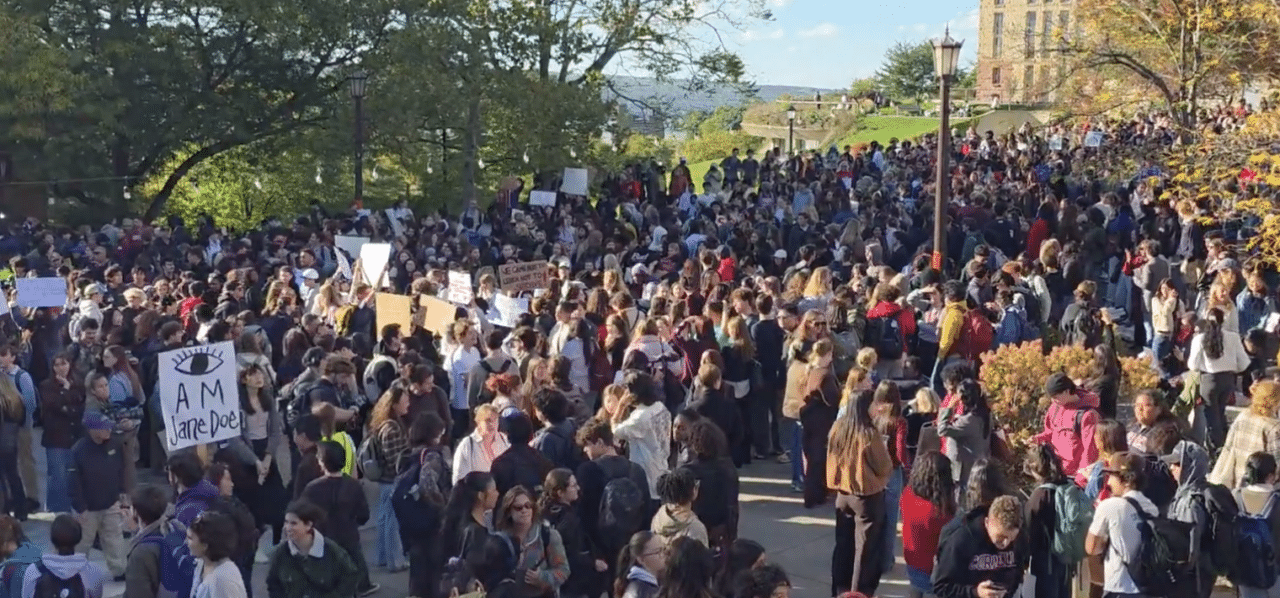
Jane Doe's attorney is urging a judge to reject proposed restrictions on public comments in the Cornell Seven civil case, arguing that limiting his ability to speak would silence his client and benefit the defendants.
Thomas Giuffra made the argument in a letter to State Supreme Court Justice Phaedra Perry-Bond, according to Spectrum News' Thursday report, which described his objection as both a fairness issue and a First Amendment challenge.

The civil lawsuit, filed in September against Cornell University and seven fraternity members, alleges that Doe was drugged and sexually assaulted at the Chi Phi fraternity house in October 2024. The men have denied the allegations, saying the sexual activity was consensual or that they were not involved.
The requested gag order remained a proposal in Thursday's account.
Giuffra's objection follows Cornell's request for clearer limits and exceptions to the proposed order, while faculty members continue debating university leaders' response to the case.
Lawyer says restrictions would silence his client
Giuffra argued that preventing him from addressing the case publicly would deprive Doe of a voice in the public discussion and favor the defendants, Spectrum reported.
“Preventing me from speaking on her behalf effectively stifles Jane Doe,” he wrote.
His letter also argues that the proposed restrictions would violate the First Amendment.
Doe's lawsuit alleges that she was pressured into using ketamine, marijuana and alcohol before the assault.
Cornell seeks clearer limits and witness protections
As FingerLakes1 previously reported, one of the civil defendants requested a gag order Oct. 9, and Cornell subsequently asked that it not be entered without clarifying its scope.
The university said the proposed language could interfere with its institutional and legal obligations or be read to require restrictions on speech by students, employees and community members. Cornell offered to discuss revised wording agreed upon by the parties or determined by the court.
The university also said it did not oppose Doe proceeding under a pseudonym and supported protecting her privacy. It asked that protections extend to nonparty witnesses' identities and sensitive personal information, saying misconduct investigations depend on people's willingness to report, provide information and testify.
An earlier sealing order addressed a different issue: identifying information in court filings. Perry-Bond sealed the complaint and several documents Oct. 9 after threats reached an uninvolved family whose address had been mistakenly included, as our earlier coverage detailed.
The judge directed Doe's lawyers to submit redacted versions. That privacy measure did not impose the separately requested gag order.
Campus response and faculty debate continue
The legal dispute is unfolding alongside Cornell's changes to campus safety and its review of how the university handled Doe's report.
President Michael Kotlikoff announced Oct. 13 that parties and social events in Interfraternity Council houses would be suspended for the rest of the 2026-27 academic year. The directive applies to those houses, not every student gathering.
Cornell also announced plans to add a case manager in its Office of Civil Rights, expand victim-advocate support and prevention programming, and accelerate its sexual-assault task force's work. Those are announced measures, not findings from the university's outside review.
The Faculty Senate began debating a proposed no-confidence resolution Wednesday. Further debate is scheduled Oct. 28, followed by electronic voting so senators can consult their constituents; the resolution has not been adopted.
Our earlier reporting on Cornell's outside review described the university's pledge to examine its response and share more information. Former U.S. Deputy Attorney General Sally Yates is leading the review, which covers prevention, student support, investigations, discipline and oversight.
The city has taken separate action. Ithaca's Common Council voted Oct. 7 to pause certain new event and noise permits for Cornell and affiliated student organizations through Nov. 5, while preserving constitutionally protected activities and permits already issued.

FingerLakes1.com is the region’s leading all-digital news publication. The company was founded in 1998 and has been keeping residents informed for more than two decades. Have a lead? Send it to news@fingerlakes1.com.