Ithaca’s Common Council voted 9-1 late Wednesday to temporarily block certain new permits for Cornell University and affiliated student organizations, escalating pressure on the university over its handling of the sexual assault allegations known as the Cornell Seven case.
The decision came as students staged a dining hall sit-in and faculty members prepared to consider a no-confidence resolution targeting Cornell’s central administration. University trustees have also appointed former U.S. Deputy Attorney General Sally Yates to conduct an outside review.

The developments bring new scrutiny from city government, students and faculty while a renewed criminal investigation proceeds separately under New York Attorney General Letitia James.
City permit restrictions run through Nov. 5

Council approved the moratorium at about 11:25 p.m. Oct. 7 after more than five hours of debate, according to CNY Central.
The measure temporarily prevents Cornell and affiliated student groups from obtaining certain new city permits, including those for assemblies, special events, use of the Ithaca Commons and some noise-related activities.
The restrictions run through Nov. 5 unless council votes to extend them. They do not prohibit every Cornell-related gathering.
Council also added an amendment calling for Cornell to hand off investigations of sex crimes and violent crimes to Ithaca police. Third Ward Alderperson Pat Sewell proposed the addition.
CNY Central reported that the amendment does not specify how the requirement would be enforced or what would happen if Cornell failed to comply. Mayor Robert Cantelmo, who advocated for the permit moratorium, opposed adding the investigative handoff requirement.
Those unresolved details leave questions about how that part of the measure would operate.
Students stage sit-in and spending boycott
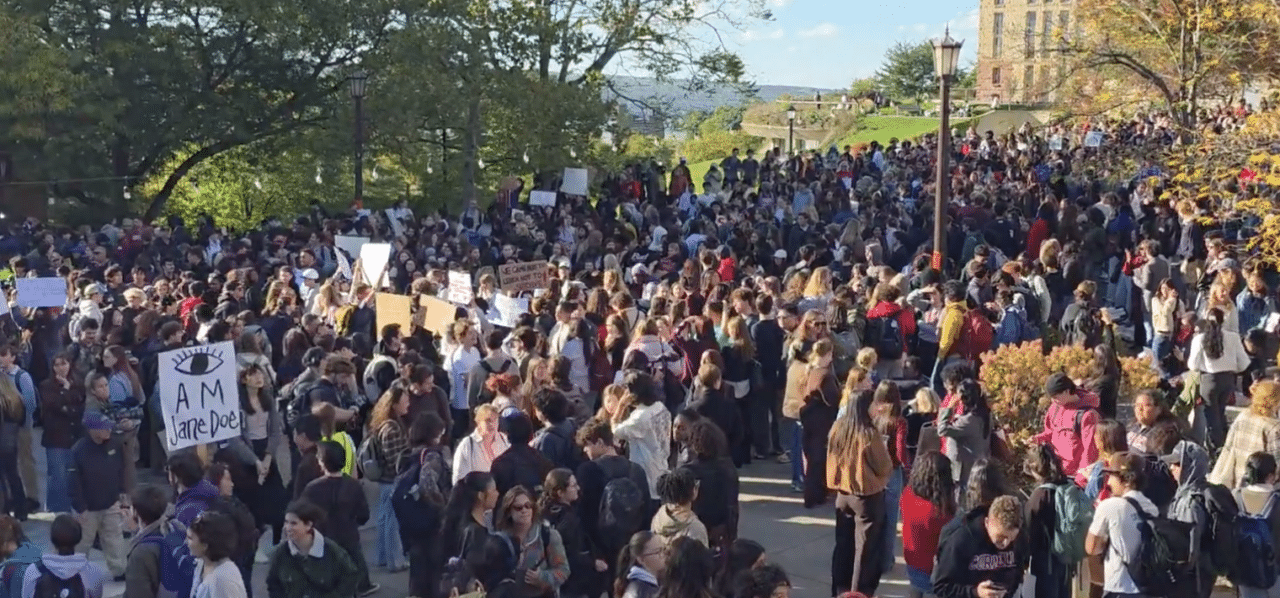
Earlier Wednesday, students occupied a campus dining hall and pledged to avoid spending money on campus to protest Cornell’s response to sexual violence, according to reporting by The Associated Press and Spectrum News.
Some participants sat inside without eating, while another group gathered outside with signs supporting Jane Doe, the name used by the former student who filed the civil lawsuit at the center of the case.
Organizers planned a seven-hour sit-in. Their demands included changes to disciplinary procedures and expulsion or degree revocation for those involved in the alleged assault.
“We’re here to kind of show that students are going to consistently continue to demand change,” student John Hartnett said.
The protest followed Monday’s larger campus rally and march to Day Hall. Wednesday’s action continued students’ push for changes despite Cornell’s commitments to an independent review.
Faculty vote remains ahead
Cornell’s Faculty Senate has not yet adopted a no-confidence resolution.
According to News10 reporting published by MyTwinTiers, the proposal will be introduced at the Senate’s Oct. 14 meeting. Members will then discuss it with colleagues and students before a weeklong vote begins Oct. 28.
The resolution questions the central administration’s ability to address sexual assault at Cornell.
Lead sponsor Professor Paul Ortiz said students had approached faculty members with concerns about their safety and the university’s response to sexual violence.
Government professor Richard Bensel criticized the elimination of Cornell’s independent judicial administrator system in 2021, arguing that the change contributed to the current crisis. Music professor Ariana Kim called for President Michael Kotlikoff to resign.
Those statements represent the views of the individual professors, rather than an adopted Faculty Senate position.
Cornell told News10 that Kotlikoff and administration officials are scheduled to meet with the Faculty Senate next week. The university said it understands community concerns and intends to continue engaging with faculty and others.
Outside review and criminal inquiry proceed separately
Trustees have appointed Yates to examine Cornell’s handling of sexual assault and sexual harassment complaints, student support, disciplinary procedures, campus police responses and oversight of fraternities, sororities and other student organizations.
That assessment is separate from the criminal investigation led by James’ office and Doe’s pending civil lawsuit.
Doe alleges that Chi Phi fraternity members supplied her with alcohol and drugs and that several sexually assaulted her in October 2024. Her lawsuit names Cornell, the fraternity, seven former fraternity members and other defendants.
The allegations have not been proved in court. Lawyers for two of the men have denied their clients participated in a sexual assault, according to the AP. No criminal charges were reported in the accounts of Wednesday’s developments.
Cornell has said it closed the Chi Phi campus chapter in 2024 and imposed expulsions and suspensions following its disciplinary investigation.
The next scheduled campus milestone is the Oct. 14 Faculty Senate meeting. Meanwhile, Ithaca’s permit restrictions are in place, and the university’s outside review and the state criminal inquiry will examine different aspects of the case.

FingerLakes1.com is the region’s leading all-digital news publication. The company was founded in 1998 and has been keeping residents informed for more than two decades. Have a lead? Send it to news@fingerlakes1.com.