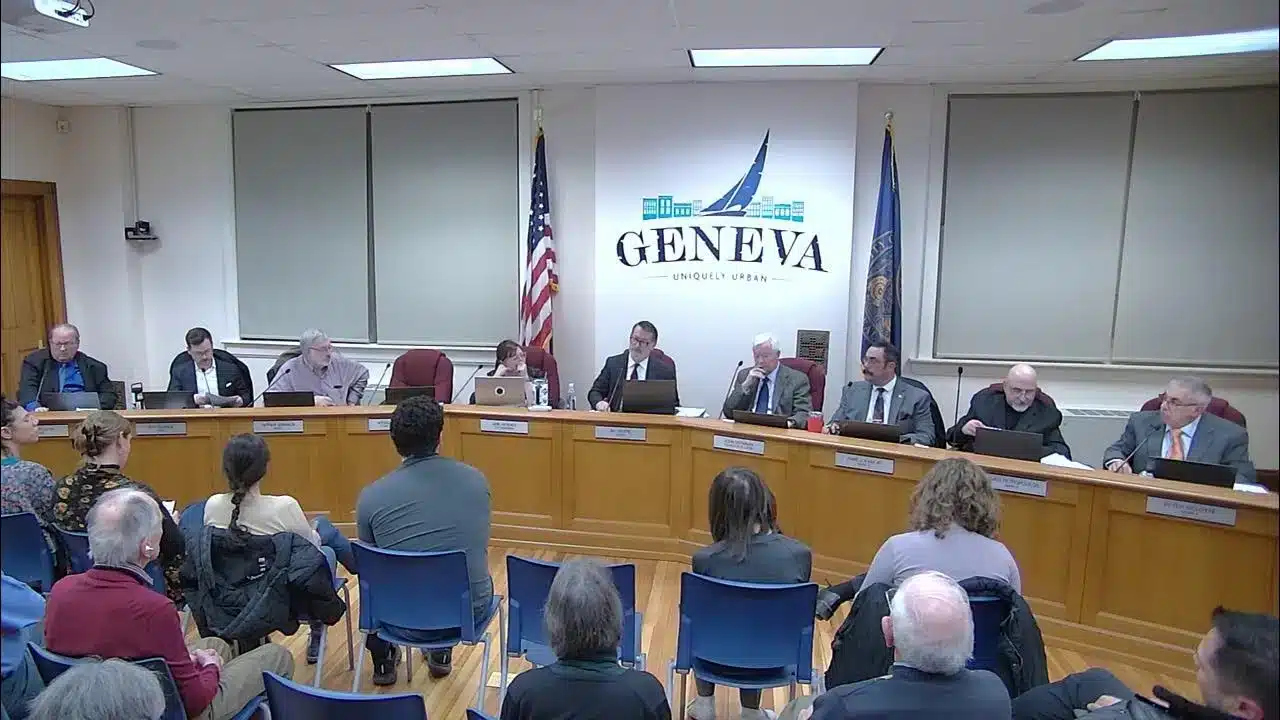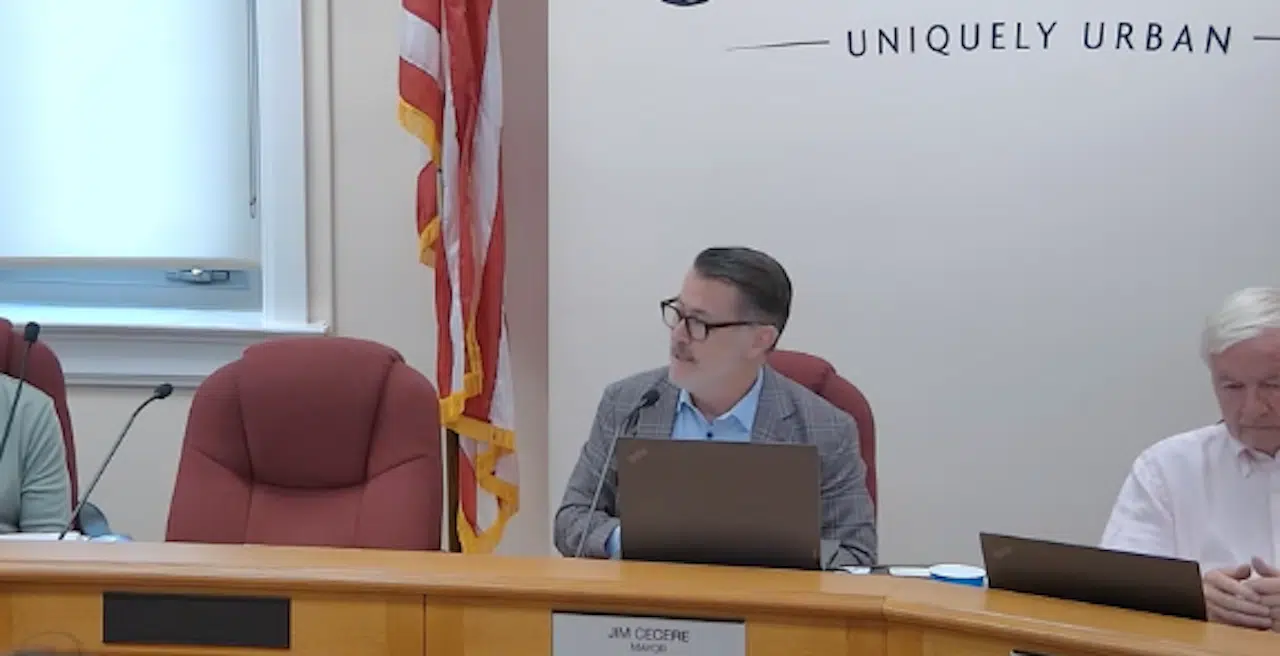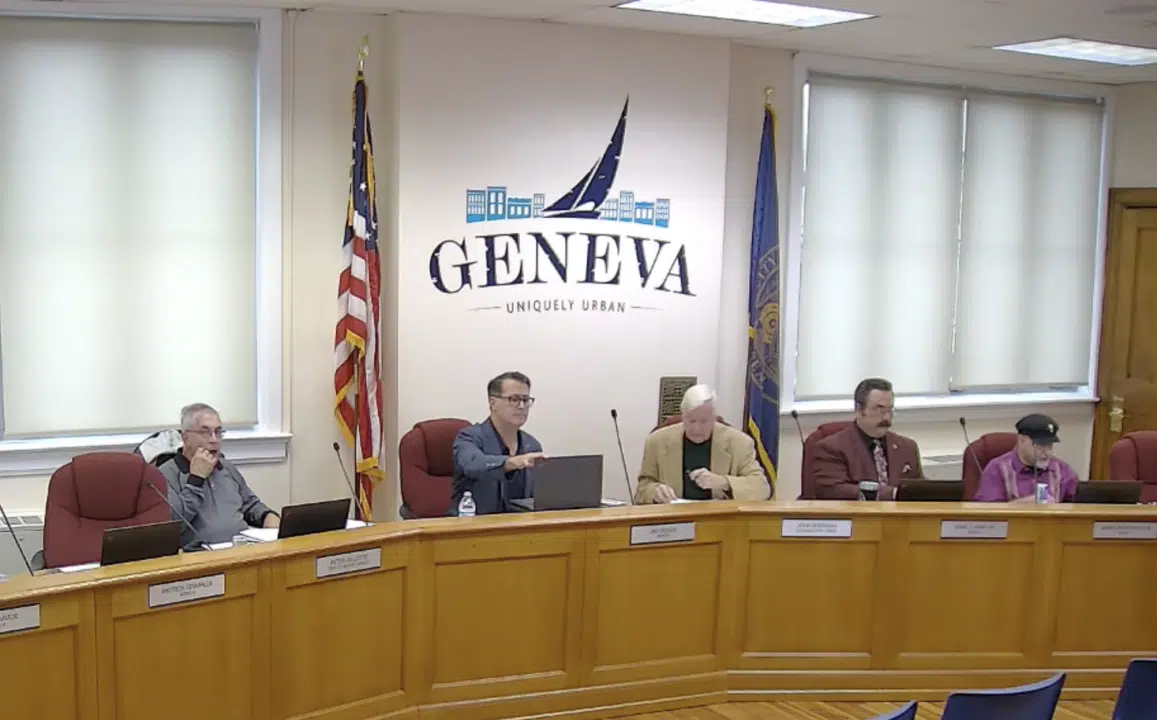
Geneva City Council spent much of its Wednesday meeting wrestling with two familiar tensions in city government: how to turn broad priorities into real action, and how to respond when neighborhood concerns collide with citywide policy.
The meeting featured a lengthy public hearing and eventual adoption of the city’s 2026-27 strategic plan, but some of the sharpest discussion came later over South Main Street safety and a proposal to restore winter parking restrictions. Residents raised concerns about pedestrian danger, parking burdens, board oversight, code enforcement, and whether council’s newest planning document is specific enough to produce measurable results.

The council ultimately approved the strategic plan after amending it to include a commitment to develop public-facing performance metrics and outcome measures. It also approved several administrative items, including an AI use policy, a customer success policy governing responsiveness and conduct, a fair housing officer appointment, and a measure allowing the city to dispose of surplus DPW equipment by auction.
Still, the night’s most animated exchanges centered on what many residents experience day to day: crossing South Main Street safely and finding somewhere to park in winter without creating more problems for plows, emergency vehicles, and neighbors.
Strategic plan draws support, skepticism and criticism

Before council adopted the new strategic plan, residents used the public hearing to question both its substance and its purpose.
Charles King argued the plan does not place enough emphasis on environmental issues, including lake health, invasive plants, tree canopy, and Castle Creek. He also criticized council’s approach to boards and commissions, saying city government has too often handed out appointments without enough regard for training, oversight, and conflicts of interest. He warned that even the strongest planning documents are meaningless if boards and staff are not expected to read and implement them.
Katherine Haynes said she appreciated the effort to focus council’s work, but warned the plan should not become another layer of administration that obscures deeper problems. She questioned council preparedness on new issues, urged stronger code enforcement, and said Geneva has tolerated substandard rental and commercial properties for too long. She also pushed back on suggestions that prior planning efforts lacked community input and said any revived Human Rights Commission must be given real authority and respect.
Jackie Augustine said the plan reads more like a restatement of work already underway than a document with clear deliverables. She questioned what practical gap the plan fills, especially when the city already has a comprehensive plan that is supposed to guide zoning and planning decisions.
Barbara Schrock took a different tack, arguing the city’s top priority should be economic development, not housing. She said Geneva faces stiff competition on housing and should be realistic about where limited city resources can make the biggest difference.
Even with those critiques, the strategic plan moved forward. Mayor Jim Cecere described it as a structured attempt to create a more disciplined and transparent framework for council action, built from council input, staff input, and public engagement. The plan places housing and development at the top of its 2026 priorities, followed by budget and finance process work and downtown and economic development. Before final adoption, council amended the resolution to add a commitment to develop KPIs, metrics, and outcomes and make them publicly accessible.
South Main Street safety concerns remain front and center
South Main Street returned to council’s agenda as both a policy issue and a recurring source of neighborhood frustration.
Councilor Chris Lavin brought forward a discussion item focused on traffic calming and quality-of-life concerns along the corridor. The proposals included pedestrian-activated crossing lights, possible elimination of some parking near the Hobart and William Smith boathouse overlook to improve sightlines, a possible reduction of the speed limit to 25 mph, and evaluation of regular safety inspections for large trucks using Lochland Road and South Main.
Several residents backed at least parts of that approach.
King strongly rejected the idea that responsibility should be placed primarily on pedestrians or students navigating the street, arguing the roadway itself is unsafe and council should address the physical conditions rather than lean on narratives about personal responsibility.
Steve Solomon, who said he has walked South Main for years, urged council to install flashing crossing lights, saying many drivers simply do not seem to realize a crosswalk is coming until too late. He said the lights would both alert drivers and help slow traffic.
Schrock also supported the idea of flashing pedestrian lights, saying the issue is not always reckless driving so much as visibility and reaction time on a busy corridor lined with parked cars.
Augustine focused on the speed limit question, noting that state law has changed in a way that could allow Geneva to lower the speed limit to 25 mph. But she cautioned that the city may want to watch pending state legislation that could ease the engineering requirements before spending money on a new study.
The overall tone of the discussion suggested broad agreement that South Main has a real safety issue, but not yet a final consensus on which tools should come first.
Winter parking proposal runs into strong neighborhood resistance
If South Main traffic calming drew sympathy, the proposed return to old winter parking rules drew resistance.
Jamie Kaim proposed reinstating annual winter parking restrictions from Dec. 1 through April 1, with overnight parking bans from 2 a.m. to 6 a.m. except where otherwise designated. He argued the city’s current announcement-based system, adopted in 2022, has created operational and public safety problems during more typical winters, forcing the DPW to make repeated passes, reducing roadway clearance, and complicating access for buses and emergency vehicles.
Kaim said complaints had come in from across the community, including school bus drivers and people who pay to have snow cleared only to see streets remain partially blocked by parked cars.
But residents from affected areas, especially South Main, said restoring blanket alternate-side rules would create a different set of problems.
One speaker argued the current system should be improved rather than scrapped, saying the real problem is communication. She said visitors and new residents often do not understand Geneva’s signage and suggested clearer signs, more visible alerts, and even QR codes that would allow people to check whether a snow emergency is in effect.
Schrock said she understood the DPW’s frustration but did not think the old system solved the problem. She said finding parking on South Main was a nightmare when alternate-side rules were previously in place and warned that burden would fall hardest on residents in apartments and on older residents with limited mobility.
Augustine echoed that point, saying council seemed to be trying to solve a communications problem with a regulation. In her view, the city would be better served by making snow emergency notices clearer and easier to access rather than imposing months-long overnight restrictions for storms that may never come.
The discussion ended without a vote. Instead, Cecere urged Kaim to work with ward representatives to draft a resolution for a future meeting, incorporating street-by-street accommodations, enforcement facts, and more detailed information about snow emergency frequency and operational impacts.
Finance work and policy changes continue in the background
The meeting also underscored how much of council’s current agenda is tied to management systems and internal structure.
Cecere said the city’s finance ad hoc committee has reached a draft debt strategy that will be released to council at its next meeting. He described it as a significant step toward more transparent and disciplined debt management, including a “traffic light” style system to help council understand the implications of future spending decisions.
The finance and assessor’s office briefing reinforced that broader push. Comptroller Adam Blowers said the department is working toward a five-year financial plan, a citywide timekeeping system, procurement policy updates, and completion of the citywide revaluation process. He also told council that a dip in the tax collection rate was tied in part to changes in foreclosure law that have slowed the city’s ability to finalize tax foreclosures and collect those unpaid taxes in the way it had previously.
In his mayor’s report, Cecere also announced a new housing ad hoc committee that will focus on homeownership, affordability, rental oversight, and possible licensing and suitability standards for rentals, including both short- and long-term units. He said the goal is to build a system that pays for itself and does not create an added cost for the city.
AI, customer response, and fair housing measures approved
Council’s new business included several policy votes that passed with less controversy than the strategic and neighborhood issues, though one of them still sparked notable discussion.
The AI use policy prompted questions about enforcement and why such a policy required council action. City Manager Amie Hendrix said compliance could be monitored through existing tools and work-device controls, and that violations would be handled through the city’s normal discipline process. She said the policy was being brought to council because administrative policies are adopted as part of the city’s policy manual and apply to city representatives broadly.
Council also approved a customer success policy aimed at setting expectations for how city employees and officials respond to residents and treat people interacting with city facilities and staff. Hendrix said the policy is partly a response to rising expectations in an era when technology can generate instant replies but public service still depends on actual people, schedules, and real-world limits.
The council also appointed Assistant City Manager Taylor Youngs as fair housing officer, a move city officials said is necessary to maintain compliance with fair housing and pro-housing requirements that affect Geneva’s eligibility for state funding opportunities.
By the end of the night, Geneva officials had checked several policy boxes. But the meeting’s real message was less about paperwork than pressure: residents want clearer results from city planning, safer streets on South Main, and practical solutions that do not create new burdens in the name of fixing old ones.

FingerLakes1.com is the region’s leading all-digital news publication. The company was founded in 1998 and has been keeping residents informed for more than two decades. Have a lead? Send it to news@fingerlakes1.com.