

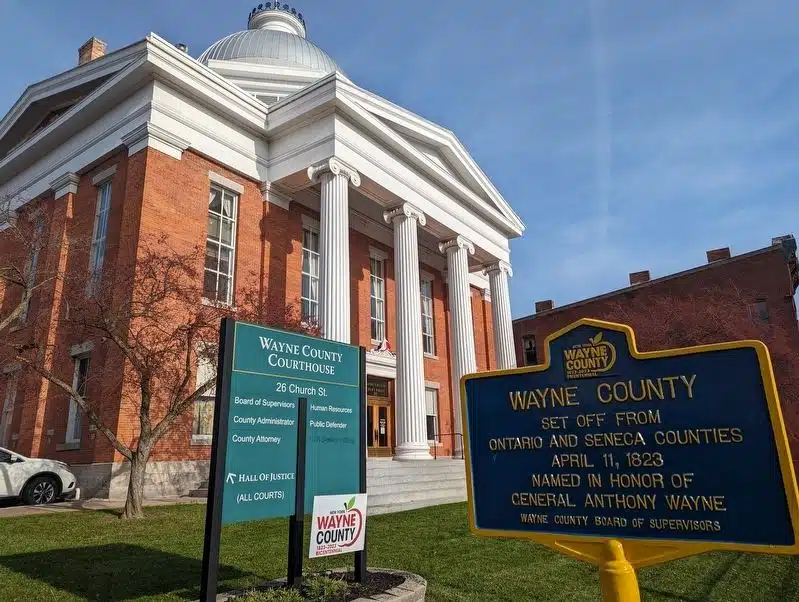
Wayne County’s proposed 2026 budget tops $256.8 million, reflects major year-over-year spending growth, and keeps the property-tax rate flat for another year.
Here are the five biggest takeaways for residents and taxpayers as officials mull over potential changes.
1. Total spending jumps 13% to $256.8 million
The tentative budget increases overall appropriations from 2025 by $28.6 million, bringing the 2026 total to $256,809,468. This includes all funds—general government, highway, social services, enterprise operations, and interfund expenses.
It is one of the largest annual spending increases in recent memory, driven by higher personnel costs, fringe benefits, state-mandated programs, and expanding needs in public safety, health, and human services.

2. Tax levy increases modestly and remains under the state cap
Despite the 13 percent increase in total spending, the county is proposing only a 2.84 percent increase in the property-tax levy.
- Proposed levy: $44,221,000
- 2025 levy: $43,000,000
- Amount below the state tax cap: $742,029
- Allowable levy growth: 4.57 percent
The county’s property-tax rate remains unchanged at $5.09 per $1,000 of assessed value, meaning changes in residents’ tax bills will be more influenced by assessments than county policy.
3. County relies heavily on non-property-tax revenue
The county expects $192.3 million in revenue from sources other than property taxes. They include:
- State and federal aid
- Sales-tax revenue
- Departmental fees and reimbursements
- Interest earnings
- Charges for services
The budget also uses $9.7 million in general-fund surplus and nearly $9.9 million in fund balances across all funds. Strong non-tax revenue growth continues to help the county offset large annual increases in mandated spending.
4. Public safety, social services, and health are the biggest cost drivers
Most of the county’s new spending is concentrated in core service areas.
Public safety spending exceeds $46 million when combining the Sheriff’s Office, District Attorney, Public Defender, 911 communications, corrections, and emergency management. The District Attorney’s Office sees one of the largest single-department increases—more than 45 percent—driven by additional staffing, rising fringe benefits, and software and discovery-reform requirements.

Social Services remains the county’s single largest function at $51.48 million. Most of that is offset by state and federal reimbursement.
Public Health totals $11.18 million, and Mental Health totals $18.47 million. These two categories combine for nearly $30 million in spending, reflecting sustained demand for services across the county.
Highway and infrastructure operations account for major costs as well. The County Road Fund totals $14.31 million, with another $2.56 million budgeted for the machinery fund. The county expects $5 million in state Consolidated Highway Aid.
5. Interfund transfers remain significant as infrastructure investment continues
The proposed budget includes $10.42 million in interfund transfers, the bulk of which comes from the General Fund to support the County Road Fund, the Road Machinery Fund, and Workers’ Compensation. No transfers are planned for the nursing home or special grant funds.
Infrastructure, technology, and public-safety upgrades continue to be priority areas. Highway maintenance, equipment replacement, building improvements, and emergency communications account for a meaningful share of the county’s annual capital and operational spending.

FingerLakes1.com is the region’s leading all-digital news publication. The company was founded in 1998 and has been keeping residents informed for more than two decades. Have a lead? Send it to news@fingerlakes1.com.