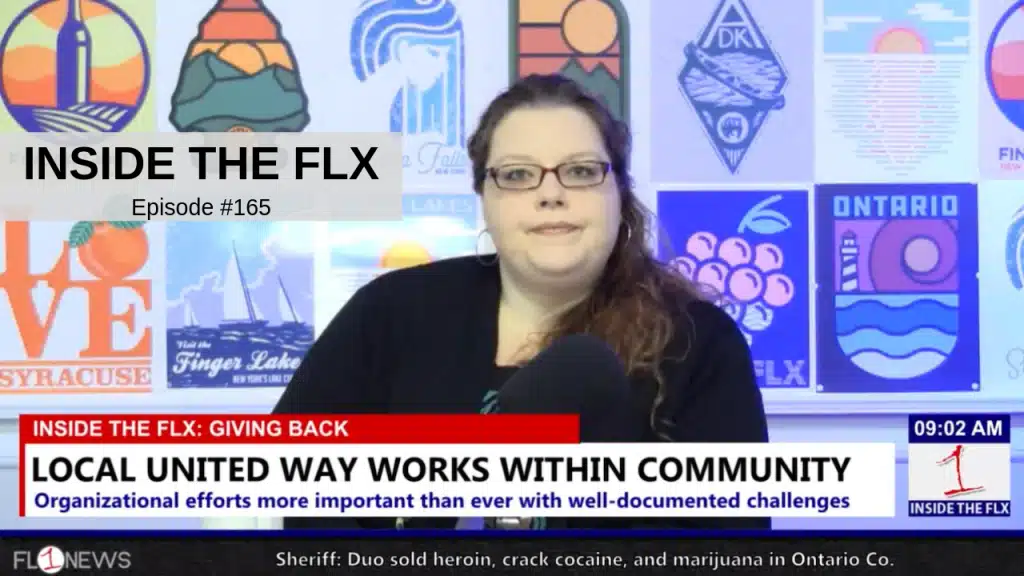
In a candid conversation on FLX Weekly, Seneca County United Way Executive Director Rhonda Jasper described the deepening financial and emotional strain facing local families as federal funding cuts, rising costs, and the recent government shutdown converge.
Jasper said roughly 44% of Seneca County residents are living paycheck to paycheck or less, according to data compiled through the United Way’s ALICE (Asset Limited, Income Constrained, Employed) framework. That means nearly half the county’s households are either below or hovering just above the poverty line, often earning too much to qualify for assistance but too little to meet basic needs.
Grant cancellation and funding challenges

Jasper explained that the United Way lost nearly a third of its operating budget when the federal Drug-Free Communities grant, which it had received for 10 of the past 12 years, was abruptly canceled days before renewal. The funds — previously distributed through the CDC — are now being re-competed under new federal requirements. While the organization avoided layoffs through other contracts and smaller grants, Jasper said the uncertainty has underscored how fragile nonprofit funding can be.
“We had four days’ notice,” she said. “We were able to maintain all of our staff, but it’s a big hit. That’s close to a third of our budget.”
Local impact of SNAP delay
The federal shutdown has also disrupted SNAP (Supplemental Nutrition Assistance Program) benefits, leaving many county residents without expected food assistance since November 1. Jasper said the disruption highlights a widening gap between eligibility standards and real cost of living.
“A single person needs about $24,000 a year to live in Seneca County,” she noted. “Yet the federal poverty level assumes a family of four can live on about the same amount.” She added that many working adults, even those holding multiple part-time jobs, lack benefits and financial stability.

Food pantries stretched thin
The county’s seven food pantries — largely volunteer-run — have already seen their numbers double even before the SNAP suspension took effect. Jasper said donations from grocery stores have dropped, leaving pantries more reliant on local farmers and individual community support. She encouraged residents to donate financially if possible, since pantries can buy what’s needed most.
“Shelf-stable foods are always helpful,” she said, “but things like milk, butter, olive oil, and seasonings — those everyday staples — make a real difference.”
Mental health and youth concerns
Jasper also discussed results from a countywide student survey showing troubling trends among middle and high schoolers: 41% of students said they sometimes feel “no good at all,” and 31% said they sometimes feel life isn’t worth living. “Those are our kids,” Jasper said. “Every child needs at least one adult they know loves them. Sometimes it’s not a parent — it’s a teacher, a coach, a neighbor. That connection matters.”
How to help
Jasper urged residents to research where their donations go, volunteer with local organizations, and use the 211 helpline to find opportunities or services. “If you don’t know where to start, call us or dial 211,” she said. “We’ll connect you.”
She emphasized that all funds donated to the United Way of Seneca County stay local. “Everything we do—all the dollars, all the time and effort — stays right here,” Jasper said. “We’re proud to represent Seneca County and make sure our community doesn’t get left behind.”
Despite the challenges, Jasper said she remains hopeful: “We have amazing people here. Stress like this brings out the best in our community. When you see how hard people work to take care of each other — it gives you hope.”

FingerLakes1.com is the region’s leading all-digital news publication. The company was founded in 1998 and has been keeping residents informed for more than two decades. Have a lead? Send it to news@fingerlakes1.com.