


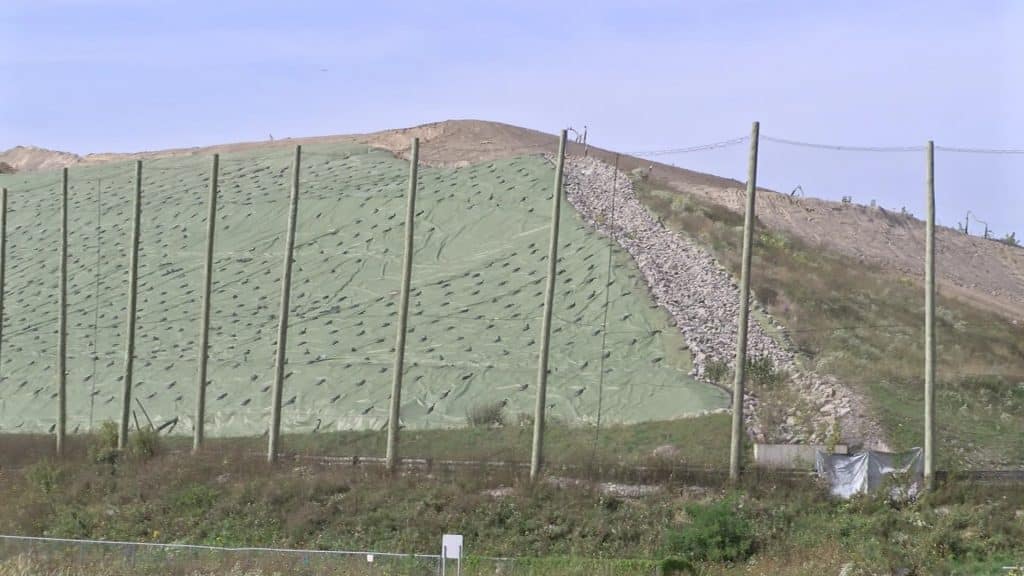
Overturning a landmark trial court decision on the scope of New York’s Green Amendment, an appellate court in Rochester has ruled that citizens lack the authority to obtain a court order to compel state regulators to curtail noxious odors at the High Acres Landfill in Fairport.
The decision deals a potentially crippling blow to a similar lawsuit that targets excessive odors at Seneca Meadows Inc. and seeks to block SMI, the state’s largest landfill, from expanding.
When it took effect in January 2022, the Green Amendment gave New Yorkers a constitutional right to “clean air, clean water and a healthful environment.”
HABs now widespread across Finger Lakes: State rejects proposed rules to protect Owasco Lake
While the new right was enacted by the state Legislature and overwhelmingly approved by voters statewide, the courts were left to decide how apply and enforce it.
The July 26 decision by a panel of judges at the Fourth Judicial Department of the Appellate Division is the state court’s system most definitive answer to that question so far. The panel’s holding could still be appealed to the Court of Appeals, the state’s highest court, which has yet to take a stand on the scope of the constitutional right.
In the High Acres case, a nonprofit group, Fresh Air for the Eastside Inc., sued the landfill’s owner, Waste Management Inc., the State Department of Environmental Conservation and the City of New York, which supplies most of the landfill’s garbage.
Monroe County Supreme Court Judge John Ark had dismissed the cases against the city and Waste Management but had held that the DEC could be sued for failing to use its enforcement powers to prevent annoying and potentially hazardous odors.
“Complying with the Constitution is not optional for a state agency,” Ark wrote in his December 2022 order, which was overturned.
The Fourth Department judges held that enforcement decisions of an administrative agency are generally unsuitable for judicial review.
“Unless the administrative agency has consciously and expressly adopted a general policy that is so extreme as to amount to an abdication of its statutory responsibilities, the responsibility for balancing those factors is lodged in a network of executive officials, administrative agencies and local legislative bodies,” the panel wrote.
That was essentially the argument State Attorney General Letitia James had advanced in defense of the DEC in both the High Acres and Seneca Meadows lawsuits.

The DEC and Seneca Meadows promptly seized on the Fourth Department’s decision in the High Acres case to urge an Albany Supreme Court to dismiss the cases against them.
“The (Fresh Air/High Acres) holding is binding precedent that requires dismissal of the lawsuit against DEC,” James argued in a filing for the agency on Aug. 2. She wrote that because the neither an intermediate appellate court in Albany nor the state Court of Appeals had ruled on the Green Amendment yet, the Albany trial court was bound to apply the Fourth Department’s “precedent.”
Seneca Lake Guardian, a nonprofit environmental group, and others sued SMI and the DEC to compel the agency to enforce odor rules and to block the landfill’s application for a new permit that would allow for a major expansion.
“The determinative issues for plaintiffs’ Green Amendment claims are narrow,” James wrote in the DEC brief, which was also signed by Lucas McNamara. “Can plaintiffs use the Green Amendment to compel DEC enforcement action against a landfill or to challenge DEC’s ongoing review of permit modification applications before DEC has made any decisions that impact plaintiffs? The answer to both questions is ‘no.’”
Seneca Meadows, which is owned by Waste Connections Inc., entered its own filing Aug. 2. It asked the Albany court to dismiss the case, arguing:
“The Fourth Department ruled: A plaintiff cannot bring a Green Amendment claim against the DEC for failing to take enforcement action against a party for its allegedly inadequate operation of a landfill, and a plaintiff does not have a claim directly against a private landfill operator … The Green Amendment cannot be weaponized against a private entity.”
Douglas Zamelis, an attorney representing Seneca Lake Guardian in its suit against SMI, could not be reach for comment.
Linda Shaw, an attorney for Fresh Air for the Eastside, said she was disappointed by the appellate ruling and would appeal.
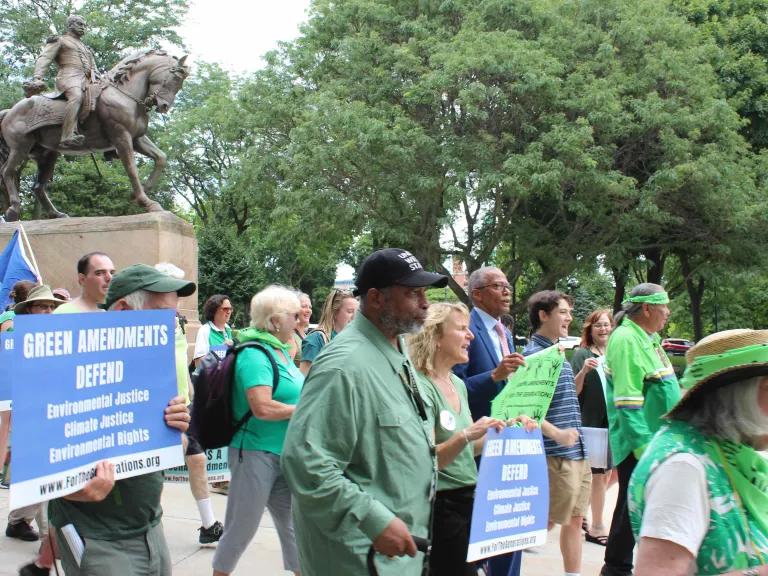
Maya van Rossum, a Pennsylvania attorney who leads a nationwide campaign to enact Green Amendment provisions in states across the country, did not respond to phone and email messages.
Last month, van Rossum led a rally and march at the state Capitol in Albany to encourage state officials, including James and Gov. Kathy Hochul, to take a more active role in applying the Constitutional right as broadly as possible.
“We are here today to tell our New York leaders that our environmental rights are not discretionary. They are mandatory,” van Rossum said at the rally.

Peter is a three-time Pulitzer nominated reporter covering environmental issues through his first-of-its-kind digital publication The Water Front. He’s won an array of Associated Press, UPI, and Society of Professional Journalist awards. His reporting on environmental issues continues to be featured in prominent New York publications and is available on FingerLakes1.com through an exclusive content partnership. Have a question or lead? Send it to peter@fingerlakes1.com.