

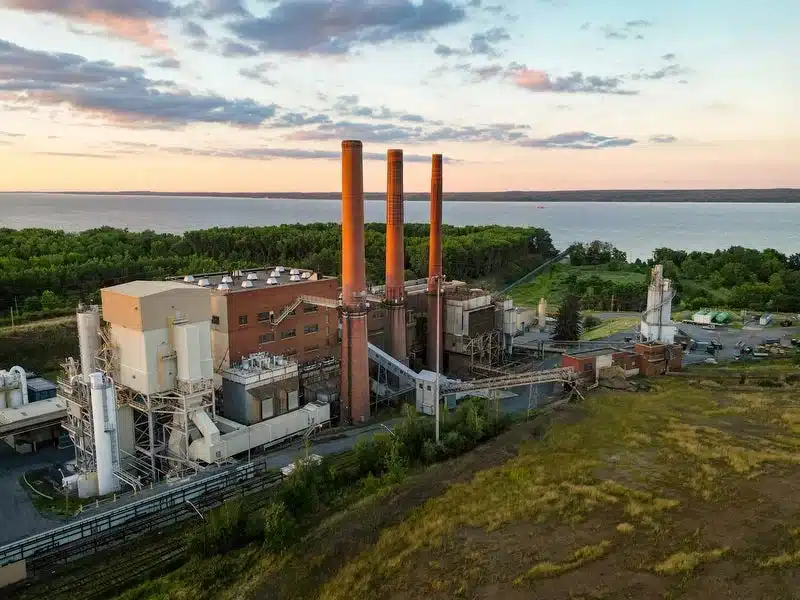
A proposal to shift Dresden’s Greenidge site from cryptocurrency mining to AI computing has raised questions about how the equipment would stay cool, how much noise it would make and who would pay for any power upgrades near Seneca Lake.
More than 200 people signed up for Wednesday’s Seneca Lake Pure Waters Association webinar, where President Bill Roege explained what AI and high-performance computing facilities could mean for the area.
The discussion came the same week Lansing’s Town Board voted 3–2 for a data center prohibition, with its legal effect dependent on a landowner protest. While Lansing’s debate has centered on whether to prohibit the industry, the Seneca Lake discussion examined how different facility designs could affect water, electricity infrastructure and surrounding communities.
Roege said “data center” can describe facilities that put very different demands on a community.
“So the term data center is not really adequate,” he said. “We need to be more specific.”
Vulcan’s latest filing describes a potential 14-megawatt project
Vulcan Infrastructure and Power, formerly Greenidge Generation Holdings, wants to use its sites for AI and high-performance computing.
In its quarterly report filed Nov. 16, the company said it was advancing designs for a potential 14-megawatt AI facility at Dresden using modular infrastructure that would replace existing equipment.
The company said its development projects remained in the preliminary planning stage, without binding construction commitments. Moving forward would depend on securing customers, financing and required approvals.
Roege used earlier investor materials to examine what a much larger expansion might look like. That could take substantially more electricity and land, with the scale and location still to be decided.
Vulcan CEO Jordan Kovler said in the company’s earnings announcement that its immediate focus was advancing preliminary development work and customer discussions while continuing existing operations and supplying electricity to the grid.
Closed-loop cooling still has to release heat
Cooling the computers starts with a basic problem. The heat has to go somewhere.
Roege said liquid cooling around computer equipment can operate in a closed loop, but the facility still needs a way to move the collected heat into the surrounding environment.
He compared it to a car engine: Coolant circulates through a closed system, but a radiator is still necessary to release the heat.
The choice of cooling equipment affects how much water and space the facility needs.

Once-through water cooling withdraws water and returns it warmer. Evaporative cooling can require smaller withdrawals, but consumes water through evaporation and creates wastewater that must be managed. Dry cooling can reduce water demand while requiring more space, fans and attention to noise, Roege explained.
How much that matters in Dresden depends on the equipment, the size of the project and any conditions officials attach to approval.
Roege also distinguished cooling for computing equipment from the existing power plant’s cooling system. He identified the plant’s water withdrawals and heated discharge through the Keuka Outlet as continuing concerns for Pure Waters.
The broader AI transition has already prompted residents and environmental advocates to seek restrictions on new and expanding data centers in Torrey.
Electricity connections could affect neighboring communities
Roege said a much bigger project could require work well beyond the Dresden property.
Additional electricity demand could require transmission and substation improvements, potentially affecting rights of way and infrastructure in multiple municipalities. He emphasized that the necessary work and responsibility for its cost would need to be established through the relevant utility and regulatory processes.
- Gonzalez renews data center bill push as Rochester discussion brings debate closer to Finger Lakes
- Environmental group plans Penn Yan protest, pushes Torrey data center moratorium
- Torrey residents renew call for data center moratorium after Dresden forum
- New York reverses course, grants Greenidge new air permit amid fierce backlash
Which power lines might need work and who would pay for it remain open questions.
Backup power presents another design question. Depending on the facility’s power arrangements, generators, batteries or other systems could introduce requirements involving fuel storage, emissions, noise and emergency response.
Roege urged local governments to evaluate those supporting systems alongside the computer buildings themselves.
Roege also questioned whether local emergency services could handle a much larger facility. He described that as his own assessment of a larger project.
What happens if the facility closes?
Pure Waters argued that reviewing a data center should include its cumulative effects on the lake and regional economy, along with its individual permits.
Roege urged officials to consider noise affecting neighboring properties, demands on public services, potential expansion and what would happen if a facility eventually closed.
He said municipalities should examine financial protections, including insurance and bonds, to address decommissioning and other long-term obligations.
Pure Waters has also submitted comments to the state Public Service Commission seeking greater consideration of water resources, aquatic ecosystems and cumulative environmental effects.
The design, cooling equipment, power arrangements and enforceable operating conditions will give residents a clearer picture as the project moves forward.
The association has made the webinar recording, slides and written presentation online.
Make FL1 part of your day.
Local reporting. Useful updates. More ways to stay close to your community.
Go ad-free
Support independent local reporting and enjoy FL1 without display ads.
$4.99 / month
Become a member →Cancel anytime. Third-party media players may contain ads.Get the daily briefing
Start your morning with the headlines that matter across the Finger Lakes.
Find more FL1 on Google
Choose FingerLakes1.com as a preferred source to see more of our reporting in your Google news results.

FingerLakes1.com is the region’s leading all-digital news publication. The company was founded in 1998 and has been keeping residents informed for more than two decades. Have a lead? Send it to news@fingerlakes1.com.