

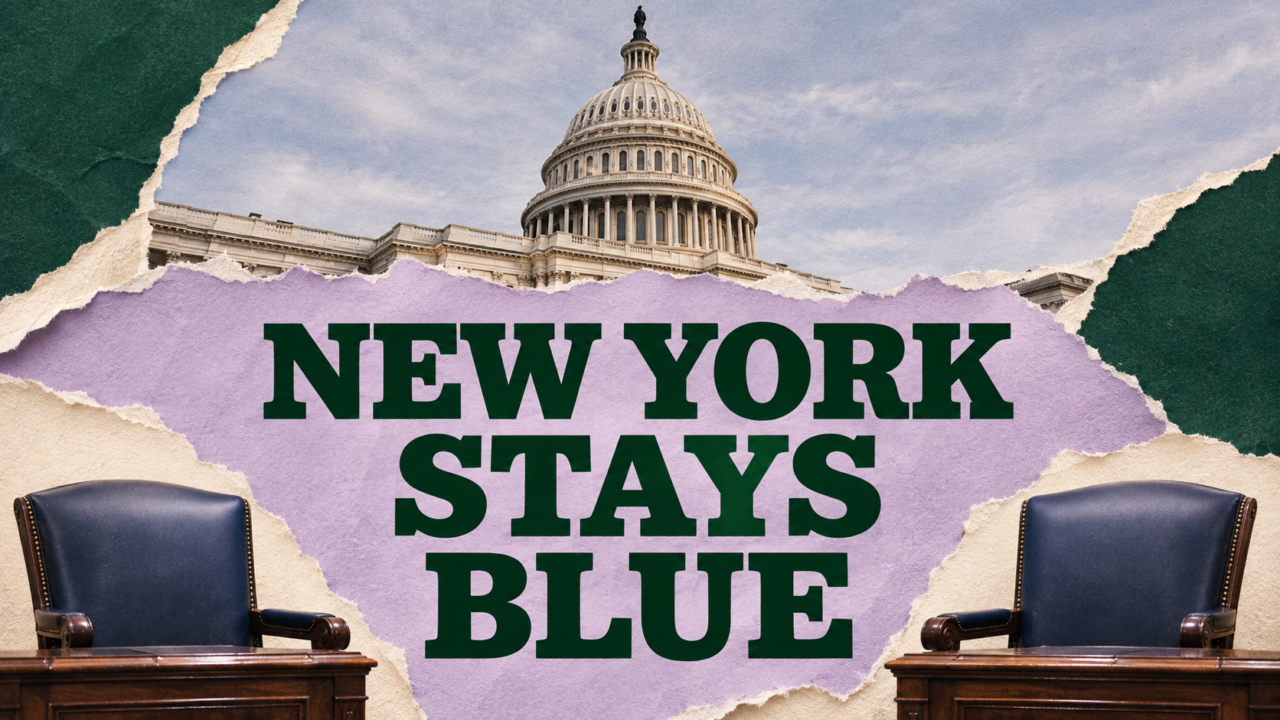
New York will continue sending two Democrats to the U.S. Senate in January, even as more states return to a pattern New Yorkers once knew well: electing a senator from each major party.
A Pew Research Center analysis released Monday finds that 10 states will have split Senate delegations when the new Congress convenes, up from three in the current Congress.
New York remains represented by Chuck Schumer and Kirsten Gillibrand. Its last Republican senator, Alfonse D’Amato, left office in January 1999.
The changing Senate map comes alongside another Pew finding about the midterms: Americans followed the results through sharply different sources depending on their age, and more than a third reported difficulty determining which election information was true.
New York’s bipartisan Senate history is still within living memory
For much of the late 20th century, New York voters sent senators from different parties to Washington.
Republican Jacob Javits served alongside Democrat Robert F. Kennedy in the 1960s and Democrat Daniel Patrick Moynihan beginning in 1977.
D’Amato succeeded Javits in 1981 and served with Moynihan until Schumer took office in 1999, according to the Senate’s historical roster.
Since then, both New York seats have remained Democratic. Hillary Clinton succeeded Moynihan in 2001, and Gillibrand succeeded Clinton in 2009.
That history provides some perspective on the state’s current political identity. A unified Democratic Senate delegation has lasted nearly three decades, but bipartisan representation was familiar to earlier generations of New York voters.
Split delegations rebound after a long decline
Nationally, split delegations were most common during the period Pew examined in 1979-81, when 27 states had senators from different parties.
There were never fewer than 20 split delegations from 1973 through 1994. Their numbers subsequently declined as partisan polarization increased and long-serving senators left office.

The incoming Congress’s 10 split delegations will be the most since the 2017-18 term.
Democratic-aligned delegations will also outnumber Republican-aligned delegations, 23 to 17. Pew groups independent senators with the major party they caucus with.
The analysis does not establish that voters deliberately sought divided representation. Researchers have offered several explanations for split delegations, including candidates’ individual strengths, diverse electorates and broader political realignments.
New York’s two Democratic senators therefore sit within a national map that has become more mixed following Democratic gains, without returning to the much larger number of bipartisan delegations common decades ago.
Americans followed the election through different channels
Pew’s separate election-news survey found that 60% of U.S. adults actively sought information about the results, while 29% happened across it.
- Democratic optimism rebounds as New York’s congressional leaders face a skeptical public
- Schumer, Gillibrand outline affordability agenda as Democrats prepare to take Senate control
- Schumer, Gillibrand put lower costs and Trump oversight atop post-election agenda
- Schumer seeks two-year delay in SNAP cost shift to New York counties
Television was the main source for 58% of adults 65 and older, compared with 7% of adults under 30. Among the youngest adults, social media was the most common source, at 27%.
Half of Americans said they understood the results extremely or very well. But 36% said they generally found it difficult to determine which election information was true.
Those answers describe respondents’ confidence and experiences, rather than a test of their factual knowledge.
The national survey of 10,247 adults was conducted Nov. 9-15 and had a margin of sampling error of plus or minus 1.3 percentage points. Its findings should not be read as New York-specific polling.
For New Yorkers checking results, the state’s election reporting website continues to identify its figures as unofficial. The Board of Elections says certification follows a recanvass and the counting of valid mail, absentee, military, overseas and affidavit ballots.
Make FL1 part of your day.
Local reporting. Useful updates. More ways to stay close to your community.
Go ad-free
Support independent local reporting and enjoy FL1 without display ads.
$4.99 / month
Become a member →Cancel anytime. Third-party media players may contain ads.Get the daily briefing
Start your morning with the headlines that matter across the Finger Lakes.
Find more FL1 on Google
Choose FingerLakes1.com as a preferred source to see more of our reporting in your Google news results.

FingerLakes1.com is the region’s leading all-digital news publication. The company was founded in 1998 and has been keeping residents informed for more than two decades. Have a lead? Send it to news@fingerlakes1.com.