

New York State has approved a new five-year Title V Air Permit for Greenidge Generation in Dresden, ending years of litigation and reopening a fierce political and environmental battle over the future of fossil-fuel-powered cryptocurrency mining on Seneca Lake.
The agreement, announced late Friday, reverses the state’s earlier decision to deny the permit on climate-law grounds. It drew immediate condemnation from Seneca Lake Guardian and praise from the International Brotherhood of Electrical Workers (IBEW), underscoring a deep divide over jobs, emissions, public health, and the state’s climate commitments.
State and company tout emissions cuts, grid reliability
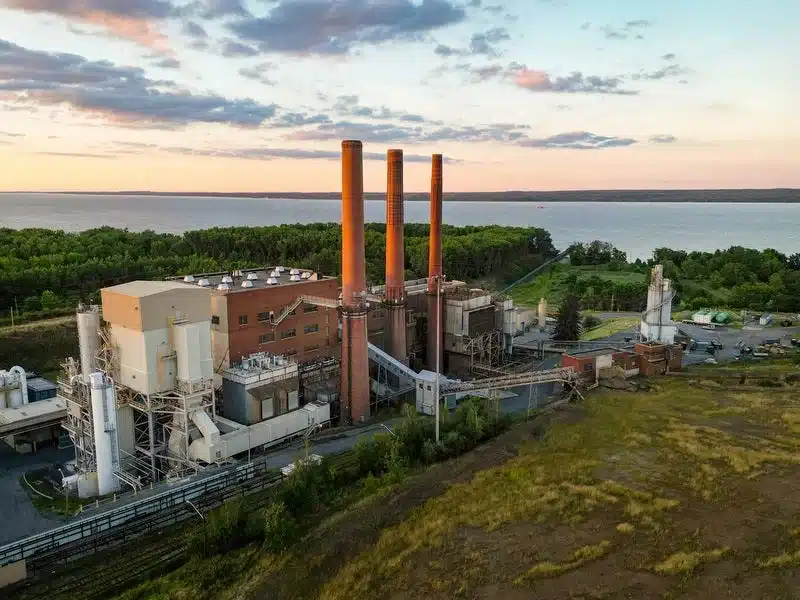
Under the deal, the New York State Department of Environmental Conservation will issue a renewed, modified Title V Air Permit that Greenidge says includes some of the strictest emissions requirements ever placed on a power facility in New York.
The company highlighted several key provisions:
Emissions reductions: The permit requires a 44 percent reduction in permitted greenhouse-gas emissions by 2030, exceeding the Climate Leadership and Community Protection Act’s statewide target of 40 percent. It also mandates a 25 percent reduction from Greenidge’s actual emissions.
Grid support: Greenidge stressed its role as a quick-dispatch power generator that can ramp up electricity to the grid within minutes during high-demand periods. The company said its ability to curtail cryptocurrency mining and redirect power stabilizes the upstate grid and helps reduce local energy costs.
Litigation resolved: The settlement ends all active litigation between the company and the state stemming from the DEC’s 2022 permit denial. Both sides will withdraw their appeals, and the pending administrative hearing will be discontinued.
Greenidge President Dale Irwin called the agreement “a tough, fair new permit” and said it validates their operation as consistent with state climate law. He framed the deal as a balance of environmental limits, economic investment, and grid reliability.
Labor union backs the agreement, calling it a win for jobs
IBEW Local 10 endorsed the permit, citing union employment and economic stability. Business Manager Roman Cefali said the Hochul administration “deserves credit for looking past the campaign of misinformation waged against Greenidge.”
Union representatives argued the Dresden facility provides high-paying jobs in a region with limited economic opportunities and strengthens the upstate grid. They highlighted more than $100 million in private investment since the former coal plant was purchased in 2016.
Environmental advocates condemn “political capitulation”
The reaction from environmental groups was blistering. Seneca Lake Guardian accused Gov. Kathy Hochul of “abandoning the Finger Lakes,” weakening the state’s climate law, and siding with a “fossil-fueled Bitcoin mine.”
Co-founders Yvonne Taylor and Joseph Campbell said they were “shocked and sickened” by the reversal. Their statement framed the permit renewal as a “disgusting betrayal” and “a gift to corporate polluters,” warning that it undermines New York’s Climate Act and exposes the region to continued air and water impacts.
The group said it will meet with its legal team Monday to consider next steps.
A long-running flashpoint in New York’s climate fight
Greenidge transformed the former coal plant into a natural-gas facility in 2017 and added an on-site cryptocurrency datacenter in 2020. Because the datacenter uses power generated onsite, the company says it avoids burdening the local grid and can instead dispatch energy to the NYISO system.
Critics argue the facility’s continued reliance on fossil fuels is incompatible with New York’s climate mandates and sets a precedent for similar operations. Supporters say the hybrid model provides needed electricity and anchors jobs and tax revenue in Yates County, where Greenidge now accounts for roughly 10 percent of the local tax base.
Friday’s decision does not end the broader policy debate. The question now shifts to whether the emissions cuts, reporting requirements, and operational limits in the new permit will satisfy climate-law compliance and community concerns—or further intensify scrutiny of fossil-powered cryptocurrency mining in New York.
Greenidge and DEC will finalize the permit after a public comment period. Environmental groups are signaling continued opposition. Labor groups are urging the state to view the agreement as a model for balancing climate requirements with economic and grid needs.
The Finger Lakes region, once again, finds itself at the center of a statewide fight over energy, climate, and economic development

FingerLakes1.com is the region’s leading all-digital news publication. The company was founded in 1998 and has been keeping residents informed for more than two decades. Have a lead? Send it to news@fingerlakes1.com.