


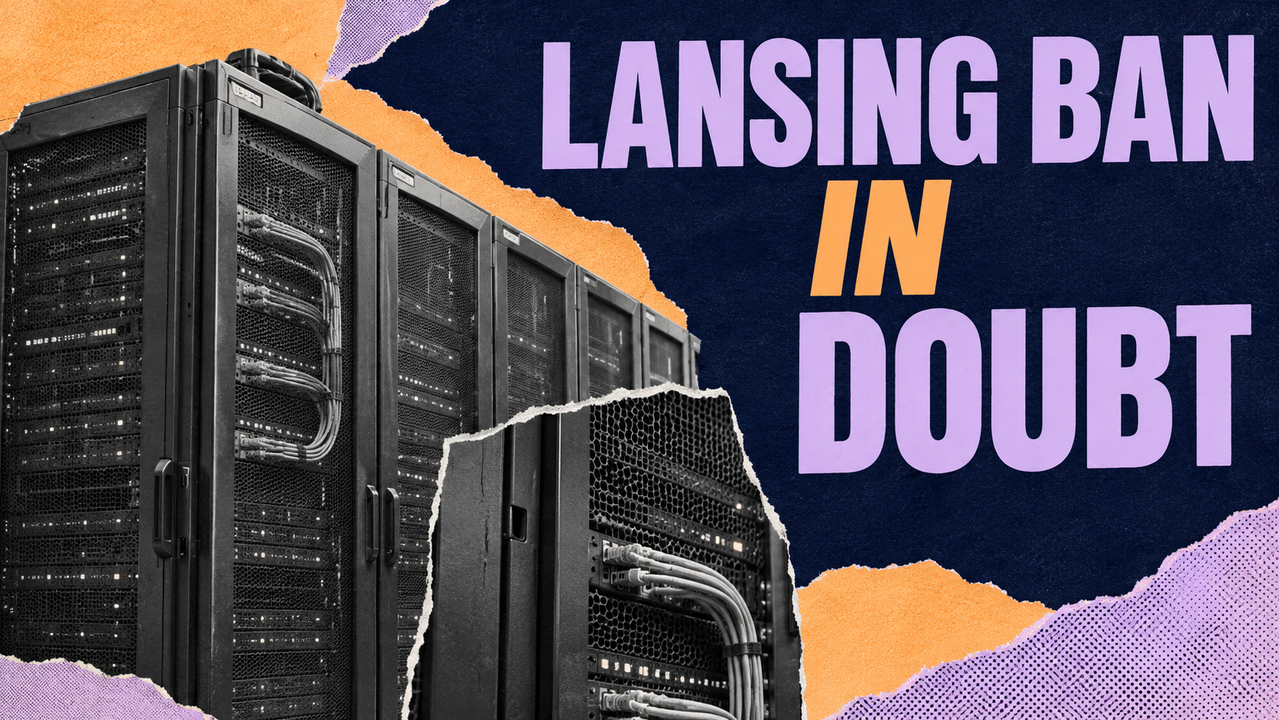
Lansing’s Town Board voted 3–2 Wednesday to prohibit data centers and cryptocurrency mines, but a landowner protest could prevent the zoning change from taking effect by requiring four votes for approval.
Supervisor Ruth Groff, Deputy Supervisor Joseph Wetmore and Councilperson Laurie Hemmings supported the proposal. Councilpersons Judy Drake and Christine Montague opposed it, saying they favored a temporary pause and further regulatory work over an outright ban.
Before the vote, town special counsel warned that officials were reviewing a protest submitted during Tuesday’s public hearing. If that petition meets the requirements of state law, Wednesday’s three affirmative votes would be insufficient to adopt the zoning amendment.
“I think everybody understands that this will be a conditional vote, basically,” Groff said.
The decision followed a crowded hearing over the proposed prohibition and months of debate surrounding TeraWulf’s proposed Lake Hawkeye development at the former Cayuga Power Plant property.
Landowner protest could require four votes
Under New York Town Law Section 265, zoning amendments ordinarily require a simple majority of the Town Board. A qualifying written protest raises that requirement to approval by at least three-fourths of the board — four votes on Lansing’s five-person board.
One way to trigger that requirement is through signatures from owners representing at least 20% of the land area included in the proposed zoning change. The threshold concerns acreage, rather than the number of residents or property owners signing.
At Tuesday’s hearing, TeraWulf community engagement representative Gabby Bryant presented the protest and said its signers owned more than 20% of the affected land. She also said the company had signatures representing nearly one-third of the land in Lansing.
Town counsel said Wednesday that officials were working to validate the petition. The town has posted the submitted protest with its meeting materials.
Wetmore criticized the state-law provision, arguing that a relatively small group of large landowners could change the approval threshold for a decision affecting the wider community.
Board splits over prohibition and regulation
Wetmore said his position had developed as he learned more about the scale and operating demands of large data centers.
He acknowledged the potential for private investment, jobs and tax revenue, but said the town also had to consider electricity demand, noise, fuel storage, emergency services and its ability to enforce operating conditions over time.
“I do not want Lansing to become the test case for these new technologies,” Wetmore said.
He also questioned whether negotiated community benefits could adequately compensate residents for lasting effects on their surroundings.

Hemmings cited uncertainty in the artificial intelligence industry and concerns about neighboring property values. She said the town should wait for more information and state regulations before allowing development to proceed.
Groff said she believed most town residents opposed a data center and that supporting the zoning amendment reflected their wishes.
Montague, however, said the proposed definition was too broad because it lacked distinctions based on a facility’s scale or application. She raised concerns about litigation, economic development and treating industrial uses consistently.
“I would support a temporary moratorium until the state finishes its studies, and we put appropriate, relevant regulations in place, but not a ban,” Montague said.
Drake likewise preferred a moratorium that would allow time for state work and Lansing’s zoning revisions. She argued that professional staff and the Planning Board should have an opportunity to evaluate a development proposal through the established review process.
TeraWulf argues for individual project review
Tuesday’s hearing showed similar divisions among residents and the developer.
- Lansing could ban data centers tonight after packed public hearing
- New York’s data center fight reflects growing concerns over power, costs and local control
- Hochul expands AI oversight, but data center moratorium gaps remain a Finger Lakes concern
- Jail controversy, AI data center concerns and broadband expansion dominate Yates County meeting
Supporters of the prohibition raised concerns about electricity costs, Cayuga Lake, continuous equipment noise and effects on neighboring homes. Opponents argued that the town should evaluate enforceable project conditions and potential financial benefits before excluding the industry.
Bryant said signing the protest did not necessarily mean supporting a particular data center. She described it as support for reviewing projects individually.
TeraWulf project development representative Pace Riley said a community benefits agreement could provide recurring contributions toward local priorities, potentially totaling millions of dollars annually. Those were proposed benefits, rather than an executed agreement.
Riley also said residents deserved measurable commitments addressing electricity rates, water, noise, traffic and other long-term effects.
Zoning proposal extends beyond Lake Hawkeye
The amendment would define data centers and cryptocurrency data mines while leaving them outside Lansing’s schedule of permitted uses, establishing them as prohibited activities under the town’s zoning framework.
It also would narrow “general processing” to distinguish physical treatment or transformation of materials from facilities primarily handling digital information.
That distinction reaches a central issue in the Lake Hawkeye dispute: whether a data center qualifies as general processing under existing zoning. Environmental groups have challenged the zoning interpretation supporting the project, while TeraWulf has separately taken the town to court over records requests and alleged open-meetings violations.
Wednesday’s vote expressed a board majority’s support for prohibition. Whether that majority was legally sufficient depends on the town’s validation of the landowner protest.
Make FL1 part of your day.
Local reporting. Useful updates. More ways to stay close to your community.
Go ad-free
Support independent local reporting and enjoy FL1 without display ads.
$4.99 / month
Become a member →Cancel anytime. Third-party media players may contain ads.Get the daily briefing
Start your morning with the headlines that matter across the Finger Lakes.
Find more FL1 on Google
Choose FingerLakes1.com as a preferred source to see more of our reporting in your Google news results.

FingerLakes1.com is the region’s leading all-digital news publication. The company was founded in 1998 and has been keeping residents informed for more than two decades. Have a lead? Send it to news@fingerlakes1.com.