

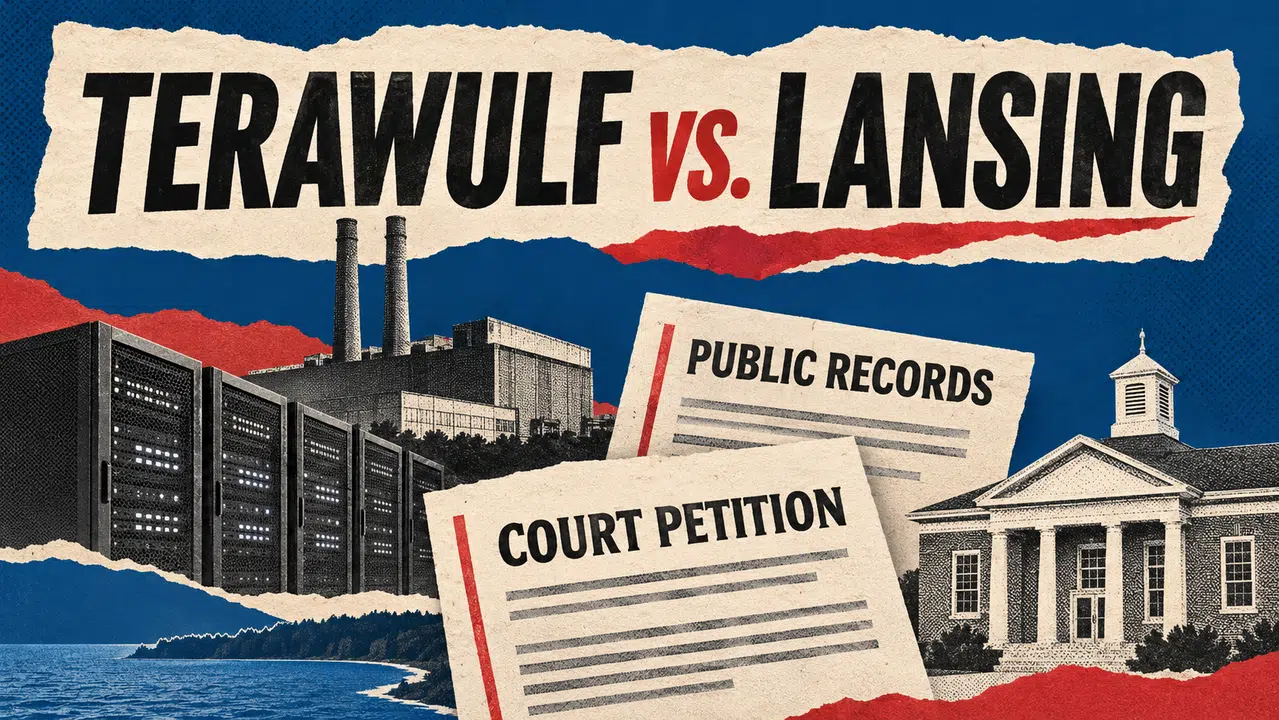
TeraWulf has filed a court challenge accusing the Town of Lansing of withholding public records and violating open-meetings requirements as officials consider zoning changes that would prohibit data centers.
The company filed an Article 78 petition through its Lake Hawkeye LLC subsidiary in Tompkins County Supreme Court on Tuesday, Nov. 3, The Ithaca Voice reported this week.
The petition alleges that Lansing failed to provide legally sufficient responses to at least two Freedom of Information Law requests. It also alleges that communications through a private email listserv violated the state Open Meetings Law.
The filing adds another legal dispute to TeraWulf’s effort to redevelop part of the former Cayuga coal-fired power plant property along Cayuga Lake. The company has separately threatened litigation over the town’s proposed data center ban.
Company challenges town’s records responses
TeraWulf Chief Strategy Officer Kerri Langlais told The Ithaca Voice that the company pursued the records through the town’s administrative process before filing the petition.
“After exhausting the administrative process, we filed an Article 78 petition to obtain information we believe the public is entitled to access,” Langlais said.
Town Supervisor Ruth Groff declined the publication’s request for comment.
An Article 78 proceeding allows a petitioner to seek judicial review of government actions or decisions. TeraWulf’s allegations do not establish that Lansing violated either public-records or open-meetings requirements.
The records dispute comes amid a broader disagreement over whether the proposed Lake Hawkeye data center should continue through the town’s development review process.
In an Oct. 25 letter to Lansing residents, TeraWulf Chairman and CEO Paul Prager argued that the company had invested substantial time and money under existing rules and deserved to have its proposal evaluated on its merits.
Prager criticized what he described as inadequate technical review and misinformation surrounding the project. He also reiterated the company’s willingness to defend its interests if officials changed the rules governing the development.

Public meeting scheduled on proposed ban
Lansing has scheduled a special Town Board meeting for Nov. 17 to receive public comments on a local law intended to prohibit data centers and cryptocurrency data mines.
The meeting will begin at 6:30 p.m. in the Lansing Middle School auditorium, 6 Ludlowville Road.
The proposal would amend the zoning code by defining data centers, cryptocurrency data mines and general processing. It would leave data centers and cryptocurrency mines outside the town’s schedule of permitted uses, establishing them as disallowed activities under the code, according to the town’s notice.
As FingerLakes1 previously reported, the board directed its attorney in September to prepare a prohibition after members questioned whether the industry was compatible with the community.
Officials also raised concerns about the demands that reviewing and regulating a large data center could place on town staff, consultants and legal resources.
- Seneca County to unveil 2027 budget, consider salaries and spending Tuesday
- Auburn residents press council on housing as city advances water projects, delays cybersecurity deal
- Cayuga County sets tax-cap hearing as $201 million budget proposes 3.9% levy increase
- Canandaigua town lists November meetings and Dec. 21 board session
The proposed prohibition remains under consideration. TeraWulf’s latest reported court filing concerns records requests and private communications, while the town’s zoning proposal addresses whether data centers should be allowed.
Separate lawsuit contests zoning interpretation
The development already faces a legal challenge from environmental groups.
FLX Strong and Cayuga Lake Environmental Action Now filed a verified petition in January challenging the Lansing Zoning Board of Appeals’ interpretation of the town code.
That case contests the board’s December 2025 decision treating the proposed data center as general processing. The groups argue that the interpretation improperly allows the development at the former power plant site.
The proceedings address different questions. The environmental groups are challenging the zoning interpretation supporting the project, while TeraWulf’s latest petition challenges the town’s handling of public records and alleged private communications.
The Town Board’s proposed zoning amendment could create another obstacle by expressly establishing data centers as a disallowed use. Residents will have an opportunity to address that proposal at the Nov. 17 meeting.

FingerLakes1.com is the region’s leading all-digital news publication. The company was founded in 1998 and has been keeping residents informed for more than two decades. Have a lead? Send it to news@fingerlakes1.com.