

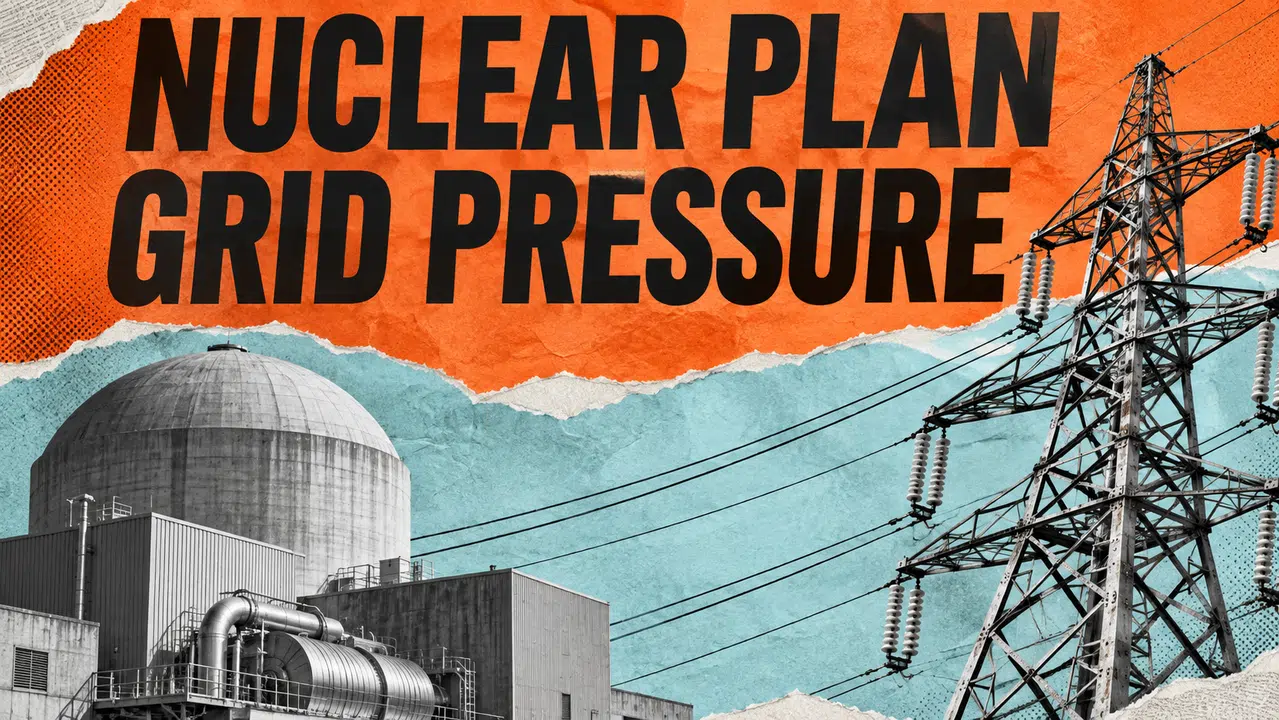
Gov. Kathy Hochul’s new nuclear energy plan could expand the electricity supply supporting Upstate manufacturing and data centers, but the state’s own modeling points to a timing problem: New reactors could arrive years after grid planners say additional power will be needed.
Hochul unveiled the completed Advanced Nuclear Master Plan in Rochester on Wednesday, outlining how New York could add 5 gigawatts of nuclear generating capacity. The roadmap addresses reactor development, financing, workforce training, safety and community involvement.
Its release comes days after warnings that Upstate industrial growth and winter fuel constraints are adding pressure to New York’s electricity system. The expansion offers a potential long-term source of steady electricity, while leaving decisions about construction schedules, public financial support and nearer-term reliability measures ahead.
The electricity need comes first
The New York Independent System Operator warned Wednesday that the state could lack sufficient electricity supply beginning in 2033 as aging generators retire and industrial demand grows, the Times Union reported.
The draft assessment underlying the earlier warning identified a statewide deficiency of approximately 225 megawatts in 2033, increasing to more than 1,850 megawatts by 2036 under its baseline assumptions. Those figures describe a projected failure to meet reliability standards, rather than a schedule of inevitable blackouts.
State nuclear cost modeling, meanwhile, examined deployment pathways with initial reactors entering commercial operation in 2039. That date is an assumption in the analysis, rather than an announced opening date for a selected project. Still, those modeled schedules would leave several years between the projected supply deficiency and the first new nuclear generation. The assumptions appear in NYSERDA’s nuclear policy cost analysis.
That timing matters for communities trying to attract employers whose electricity needs could materialize earlier.
What the nuclear plan advances
New York already has approximately 3.4 gigawatts of nuclear capacity, supplying about one-fifth of its electricity. Adding the proposed 5 gigawatts would bring the total to approximately 8.4 gigawatts, according to NYSERDA.
The new master plan contains 30 recommendations and next steps supported by 12 technical studies and policy documents. Its scope includes selecting sites, developing a workforce and supply chain, managing radioactive waste and involving host communities.
The master plan also examines ways to control construction costs, including using established reactor technologies, repeating designs and developing projects in phases.

A separate New York Power Authority initiative to develop at least 1 gigawatt of advanced nuclear capacity has already attracted industry and community interest. NYPA announced this month that it had qualified 10 potential developers for further consideration.
Those steps advance development, but projects still need financing, site selection, federal licensing and construction before they can supply electricity.
Who carries the financial risk?
The financing debate extends beyond the price of building reactors to who pays if projects run late or exceed their budgets.
A new Department of Public Service staff white paper recommends developing a revenue support mechanism for nuclear projects, along with eligibility requirements and a competitive process involving detailed financial negotiations. An implementation plan would return to the Public Service Commission for consideration.
The paper also examines state equity investment and partial protection against construction cost overruns.
Business and utility commenters raised concerns about transferring those risks to customers. Multiple Intervenors opposed guaranteeing overruns, while National Grid argued that customers should not become the default financial backstop for delays, technology failures or canceled projects.
The state’s illustrative deployment analysis estimated roughly $15 billion to $24 billion in public support, measured in present-value 2025 dollars, depending on the development pathway and assumptions. Those estimates are neither approved subsidies nor the total construction costs.
The master plan also cites modeling showing potential long-term system savings from including new nuclear in New York’s clean-energy transition. Those comparisons do not guarantee a particular reduction in household electricity bills.
Upstate still needs earlier solutions
The earlier grid assessment projected approximately 2,700 megawatts of additional large industrial and data-center demand by 2036.
How those customers operate could affect the amount of new supply required. In one sensitivity analysis, making all planned new data-center demand flexible enough to reduce consumption during peak periods lowered the modeled 2036 statewide deficiency from approximately 1,850 megawatts to 850 megawatts.
That scenario illustrates why demand management matters alongside generation, storage, transmission improvements and energy efficiency. Winter fuel availability also remains a separate reliability concern.
For residents and potential host communities, the nuclear plan’s next public discussion is scheduled for Jan. 13. NYSERDA will hold a public webinar from noon to 1:30 p.m. covering the completed plan and its supporting studies.
Make FL1 part of your day.
Local reporting. Useful updates. More ways to stay close to your community.
Go ad-free
Support independent local reporting and enjoy FL1 without display ads.
$4.99 / month
Become a member →Cancel anytime. Third-party media players may contain ads.Get the daily briefing
Start your morning with the headlines that matter across the Finger Lakes.
Find more FL1 on Google
Choose FingerLakes1.com as a preferred source to see more of our reporting in your Google news results.

FingerLakes1.com is the region’s leading all-digital news publication. The company was founded in 1998 and has been keeping residents informed for more than two decades. Have a lead? Send it to news@fingerlakes1.com.