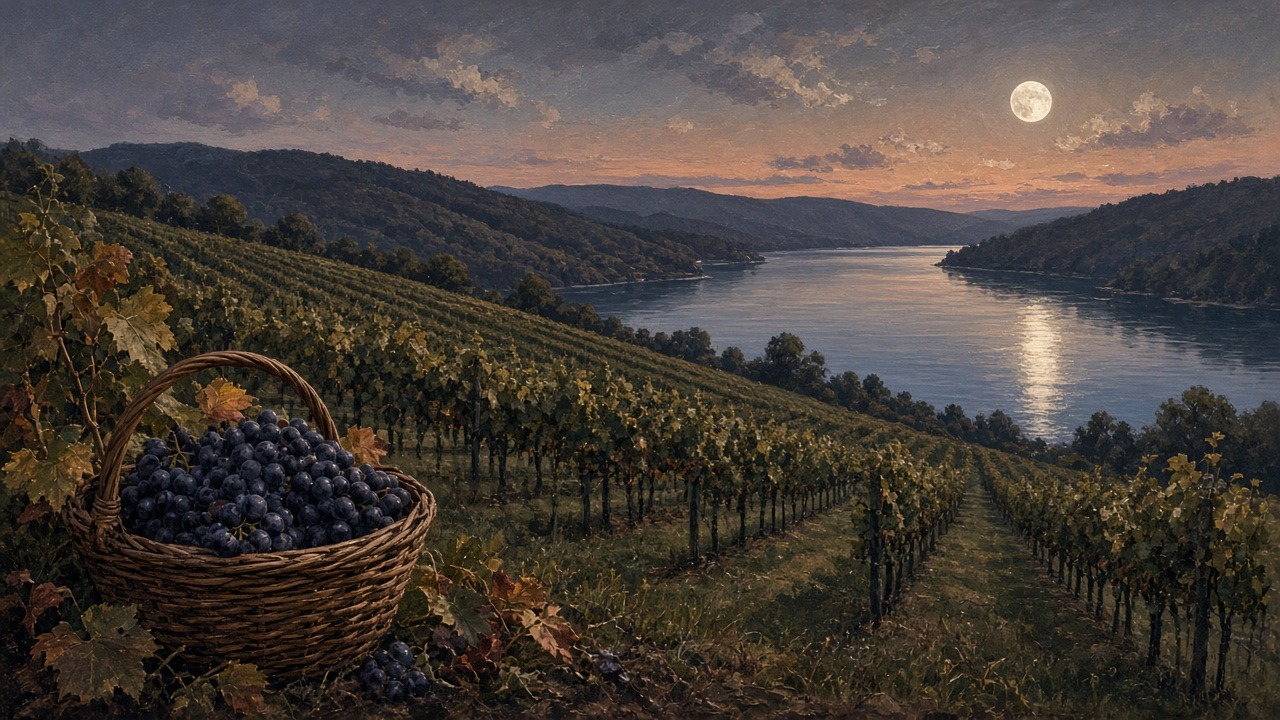
Drive the west shore of Seneca Lake in late September and the rows of vines run almost to the water. The lake is the reason they are there. At roughly 632 feet deep, Seneca rarely freezes, and Cornell University’s viticulture researchers explain that the deep Finger Lakes store heat and soften winter lows on the slopes closest to the shore, which lets growers ripen cold-sensitive European grapes such as Riesling.
Water, slope and soil decide most of what happens in a Finger Lakes vineyard. Yet on some farms around the lakes another rhythm sits quietly in the background: the 29-and-a-half-day cycle of the Moon. For a handful of winemakers it shapes the work calendar, and for many home gardeners it survives as family habit and almanac lore.
Interest in that rhythm is not limited to farmers. An astrology site such as AstriOnLine treats the lunar cycle as a symbolic language rather than a set of commands, and its own calendar is unusually candid on the gardening question. Asked whether it can be used for growing plants, it answers that you can consult it “as a cultural or symbolic reference,” while relying on real conditions, specialist sources and qualified professionals for practical decisions.
That balance, between tradition and observation, is visible at one of the region’s best-known estates. Hermann J. Wiemer Vineyard, founded in 1979 near Dundee on Seneca Lake, began farming 14 acres biodynamically in 2015 and later converted its entire 33-acre HJW site. In 2023 it received Demeter certification, which the winery describes as making it the first Demeter-certified vineyard on the East Coast.
For home gardeners the entry point is simpler. A lunar calendar like the one on AstriOnLine shows the day’s Moon phase, the percentage of the disc that is illuminated, the lunar day and the sign the Moon is passing through, and lets you scroll month by month to find the next new or full Moon. The site adds a sensible caveat: its figures are approximate and intended for editorial reference, not astronomical precision.
Inside a Biodynamic Vineyard
Root days and fruit days
Biodynamic growers do not simply follow phases of the Moon. Many, Wiemer included, use the sowing calendar developed by the German researcher Maria Thun, which assigns days to roots, leaves, flowers or fruit depending on the Moon’s position. According to Thijs Verschuuren, the estate’s biodynamic specialist, root days may be preferred for planting or pruning, fruit days are often favored for harvest, and some periods are avoided for major vineyard work altogether.
A practical, not dogmatic, approach
Verschuuren is careful about the claims. “We don’t approach Biodynamics dogmatically,” he says in an interview published by the winery, adding that some aspects are easier to explain scientifically than others. In his view, the method comes back to paying attention, respecting timing and working with a place instead of against it. Sheep graze between the rows in summer, cutting tractor passes and soil compaction, and geese help with pest control.
When the Calendar Meets a Wet Finger Lakes Season
Picking against the clock
The region’s weather does not wait for a fruit day. Wine Spectator noted that strictly following the biodynamic calendar means grapes can only be harvested on fruit days, a hard rule in a place prone to frequent rain, fungus, occasional hail and deep freezes. Growers who follow the calendar loosely tend to treat it as a tiebreaker: when two days are equally good, the calendar decides.
The 2018 test
Wiemer’s team ran its biodynamic block alongside an organically farmed plot for several seasons. In the difficult 2018 vintage, co-owner Fred Merwarth told Wine Spectator, black rot destroyed about 90% of the fruit in the organic section, while most of the biodynamic block came through unaffected. One season on one farm proves little on its own. Merwarth attributed the outcome to vines that had “gained resilience” over four years of biodynamic farming, and he warned that the method only works with very sound farming and strict fruit selection. Still, the result convinced the owners to expand. The winery has since begun a multi-year transition at Standing Stone, the neighboring historic estate it bought in 2017, starting with compost, cover crops and herbal spray preparations.
Planting by the Moon at Home
Light of the Moon, dark of the Moon
Backyard growers usually work from an older and simpler rule. The Farmers’ Almanac recommends planting crops that bear above ground, such as tomatoes, beans, peppers, lettuce and squash, while the Moon is waxing, from new to full. Root crops go in while it wanes, from full back to new. The almanac itself labels this the folklore rule of planting in the “light” or the “dark” of the Moon, an honest description of where it comes from. Generations of upstate gardeners have passed the rule along with seed packets and hand-me-down tools.
Reading the phase correctly
Anyone trying the method runs into a small practical trap. The illumination figure alone does not tell you whether the Moon is waxing or waning; a 40% Moon appears twice in every cycle. AstriOnLine’s calendar handles this by naming the phase, and it offers a rule of thumb for checking with your own eyes: a waxing Moon is usually easiest to see in the evening, a waning one in the hours before dawn. It also reminds users that the civil date of a phase change can shift with the time zone.
Frost comes first
In practice, the lake decides more than the sky. The same moderating effect that protects vineyards is strongest near the shore and on lower slopes, so a garden a few miles inland can face a later spring and an earlier fall than one by the water. A sensible approach is to choose a planting window based on local frost history and soil temperature, then, if you enjoy the tradition, pick the lunar phase within that window.
Tasting the Tradition
If you visit the Finger Lakes this harvest season, ask at the tasting counter how the vineyard schedules its work. Some will talk about weather forecasts and sugar readings, others about cover crops, a few about root and fruit days. Each answer says something about how that grower balances measurement with tradition. The Moon may not ripen a single grape, but following its cycle can make a grower look more closely at the vines, and that attention ends up in the glass. At home, the same habit of looking closely at the soil, the weather and the sky is a fine reason to keep a lunar calendar on the shed wall.
Make FL1 part of your day.
Local reporting. Useful updates. More ways to stay close to your community.
Go ad-free
Support independent local reporting and enjoy FL1 without display ads.
$4.99 / month
Become a member →Cancel anytime. Third-party media players may contain ads.Get the daily briefing
Start your morning with the headlines that matter across the Finger Lakes.
Find more FL1 on Google
Choose FingerLakes1.com as a preferred source to see more of our reporting in your Google news results.

This content is brought to you by the FingerLakes1.com Team. Support our mission by visiting www.patreon.com/fl1 or learn how you send us your local content here.