

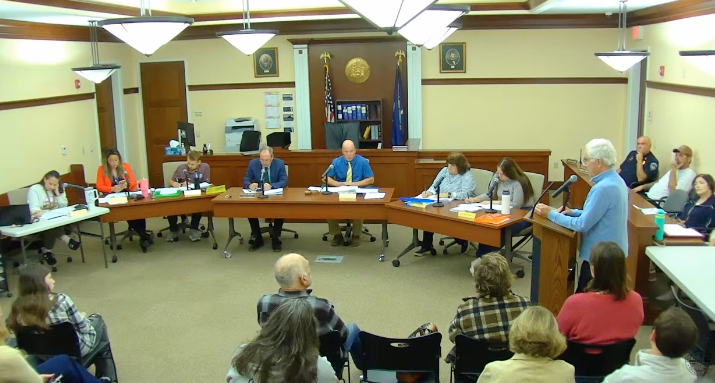
Seneca Falls’ 2027 budget failed to win approval Nov. 12 after objections about missing updated budget documents, the use of accumulated funds and financial help for retirees.
The Town Board had been considering a spending plan built around a 2% property tax levy increase, following weeks of cuts and negotiations. Instead, the special meeting ended with Supervisor Frank Schmitter announcing that the budget had failed and the board agreeing to return Nov. 17.
Councilwoman Wendy Crane said she would not support the proposal without the detailed budget in front of her. She also questioned how the town described its dependence on landfill money and pressed for additional assistance with retirees’ out-of-pocket health costs.
The failed vote follows the Nov. 9 workshop at which the board moved toward a 2% levy increase, down from the previously proposed 4%.
Updated budget details become a sticking point
Schmitter presented figures showing $11,038,386.39 in expenditures outside the water and sewer budgets and a proposed property tax levy of $4,720,405.68.
His funding outline included $1.25 million in landfill revenue, approximately $1.04 million from the tax stabilization account and $4,026,269.48 from the general fund balance.
The discussion paused so Town Clerk Melissa Brown could make copies of the summary.
But the summary did not resolve concerns about whether the board had received a complete budget incorporating its latest changes. Questions continued about the detailed spending lines, updated calculations and proposed tax rate.
Crane said she was uncomfortable approving a budget consisting of roughly 180 pages based on the summary distributed that evening.
Schmitter said financial information had been emailed regularly and that the changes reflected decisions the board had already made during its workshops. Crane responded that she wanted clearer printed information and said she had not received training on the town’s financial software.
When Schmitter moved toward a vote, Crane said she opposed the budget because she did not have it in front of her.
Landfill revenue and accumulated funds divide the board
The funding discussion exposed another disagreement: whether describing the budget as using 25% of landfill revenue adequately explained its reliance on accumulated money.
Crane questioned how much of the general fund balance originated from landfill payments in earlier years. She argued that residents should understand the relationship between those prior payments and the money proposed for current spending.
Schmitter said money remaining after a budget year becomes fund balance, distinguishing accumulated resources from incoming revenue.
“It’s money we’ve had left over for the last couple years,” he said.
The disagreement continues a broader debate over how much landfill income should support services now and how much should be saved for the future.
At the Nov. 3 meeting, the town’s Financial Resilience Committee recommended building reserves to prepare for the eventual loss of landfill payments.
- Seneca Falls moves toward 2% tax increase after budget cuts, landfill revenue debate
- MEETING: Town of Seneca Falls holds a budget workshop Nov. 9 (webcast)
- $8 million cleanup set to begin at former GTE site in Seneca Falls
- Waterloo Container rep challenges councilor, tensions rise at Seneca Falls meeting
That meeting also ended without budget adoption after the board rejected a tax-cap override.
Retiree health assistance remains unresolved
Crane also pushed for approximately $323,400 in additional support for retirees’ out-of-pocket health expenses, describing an arrangement in which money would be replenished as it was used.
The proposal followed requests during the Nov. 9 workshop for greater retiree health assistance. The board had sought information about past reimbursements, actual spending and unused funds before deciding whether to increase support.
Crane argued that additional landfill revenue could help fund those benefits. She also suggested financing comprehensive plan implementation directly with landfill money rather than treating it as part of the limited share available for the operating budget.
Others challenged her contention that comprehensive planning was driven by landfill revenue, noting that communities without landfill income also maintain comprehensive plans.
Schmitter resisted reopening the broader spending plan, saying further changes would require another meeting.
After the vote failed, the board settled on Tuesday, Nov. 17, to resume the discussion. Updated budget copies were requested by email before the next meeting.
Make FL1 part of your day.
Local reporting. Useful updates. More ways to stay close to your community.
Go ad-free
Support independent local reporting and enjoy FL1 without display ads.
$4.99 / month
Become a member →Cancel anytime. Third-party media players may contain ads.Get the daily briefing
Start your morning with the headlines that matter across the Finger Lakes.
Find more FL1 on Google
Choose FingerLakes1.com as a preferred source to see more of our reporting in your Google news results.

FingerLakes1.com is the region’s leading all-digital news publication. The company was founded in 1998 and has been keeping residents informed for more than two decades. Have a lead? Send it to news@fingerlakes1.com.