

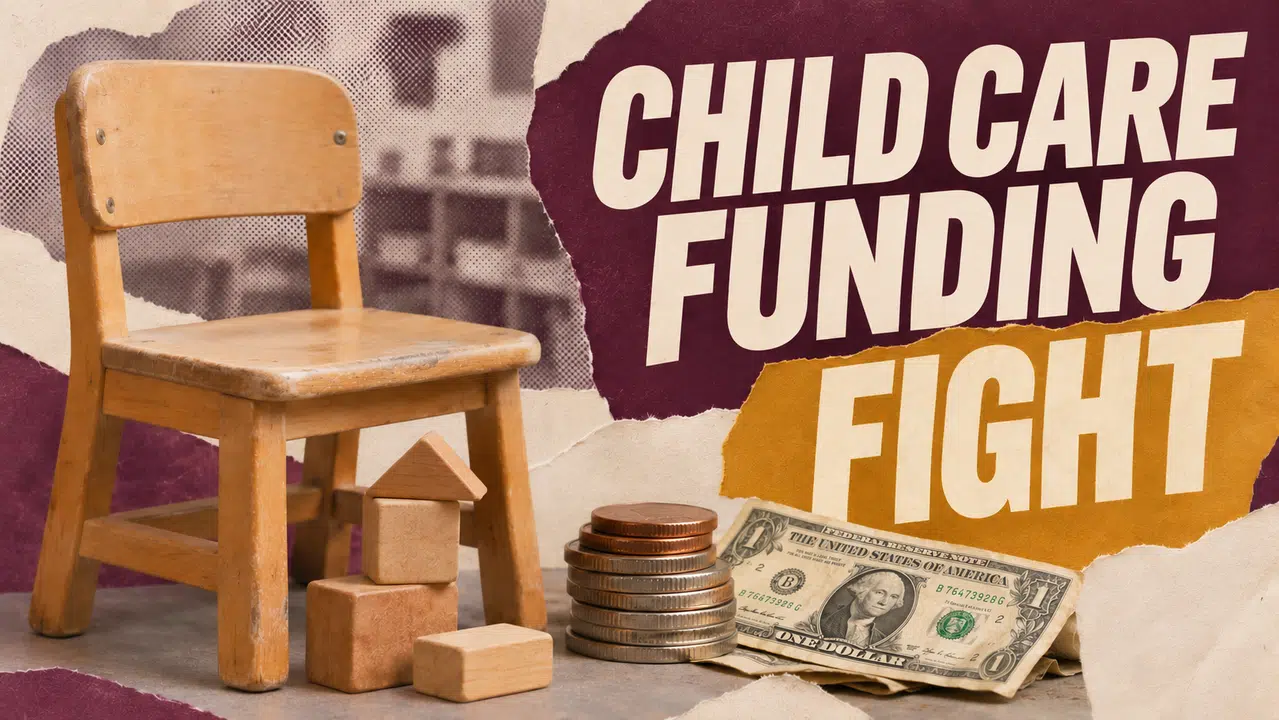
State Sen. Tom O’Mara is warning that New York’s next affordability fight will center on whether expanding government programs saves families money or leaves them facing higher taxes.
In a column for the week of Nov. 16, the Republican senator criticized Democratic leaders’ spending priorities and questioned whether Gov. Kathy Hochul would resist tax increases to finance expanded child care. His criticism comes as stronger tax collections improve the state’s immediate finances, while projected deficits and the long-term cost of new programs remain unresolved.
O’Mara argued that the Finger Lakes and Southern Tier communities he represents need spending restraint, tax relief, lower energy costs and relief from unfunded state mandates.
“The fight will be harder and more urgent than it’s ever been,” he wrote.
Child care puts funding choices in focus
O’Mara singled out Hochul’s recent comments about finding a sustainable funding source for child care, interpreting them as an opening for higher taxes.
Speaking alongside New York City Mayor Zohran Mamdani in November, Hochul said she would try to work within existing resources but would consider other ways to meet the program’s needs. She pointed to previous targeted tax measures as examples of how she has financed priorities.
The governor said the administration had not settled on a long-term funding approach, with more details expected in her 2027 State of the State address.
O’Mara contended that those remarks undermine assurances that Albany can expand programs without asking taxpayers for more.
Hochul has framed child care investment as an affordability measure with benefits beyond individual households. In May, she argued that reliable care helps parents remain employed and gives businesses access to a more dependable workforce. The administration’s child care initiatives include statewide prekindergarten expansion, subsidies and programs outside New York City, alongside the city’s program for 2-year-olds.
The dispute concerns how to sustain those investments and who should pay for them.
Stronger revenue does not erase future gaps
O’Mara also questioned why tax increases were being discussed when state revenue was running roughly $8 billion above expectations.
The state’s midyear financial plan raised its forecast for baseline General Fund tax receipts by $8.1 billion. It attributed the improvement to stronger economic activity and tax collections, including personal income, corporate and sales taxes.
The same plan projected $9 billion in surplus resources for the current fiscal year, with money directed toward replenishing reserves and prepaying debt.
Even with those improvements, the state projected budget gaps of approximately $2.9 billion in fiscal 2028, $5.8 billion in fiscal 2029 and $8.9 billion in fiscal 2030.
Those figures leave Albany facing competing demands: use stronger revenue to support services, reduce future obligations, build financial reserves or provide tax relief.
- Dundee child care center to close Nov. 25, citing financial challenges
- Push for universal child care coverage intensifies ahead of Hochul’s address
- Hochul says universal child care is the end goal in legislative push for more facilities
- NY takes aim at child care crisis: Hochul proposes $110M to build new, expand facilities
State Budget Director Blake Washington said Nov. 9 that serious discussions of potential tax increases were premature, Spectrum News reported. He said the improved revenue outlook would inform the administration’s decisions.
O’Mara presses an upstate affordability agenda
O’Mara’s broader argument is that Democratic control in Albany has failed to address the costs confronting rural communities, small cities and businesses.
He accused state leaders of allowing spending, energy costs and mandates to rise while neglecting waste and abuse in government programs. He also urged upstate Democrats to join Republicans in challenging their party’s direction.
His column outlined priorities rather than a detailed package of spending reductions or legislation. Those priorities include long-term tax relief, a different energy strategy, fewer unfunded mandates and tighter oversight of public spending.
The next concrete test will be Hochul’s proposals for the coming legislative session and state budget. Her administration’s financial plan says the fiscal 2028 executive budget will be presented by Feb. 1, 2027.
Make FL1 part of your day.
Local reporting. Useful updates. More ways to stay close to your community.
Go ad-free
Support independent local reporting and enjoy FL1 without display ads.
$4.99 / month
Become a member →Cancel anytime. Third-party media players may contain ads.Get the daily briefing
Start your morning with the headlines that matter across the Finger Lakes.
Find more FL1 on Google
Choose FingerLakes1.com as a preferred source to see more of our reporting in your Google news results.
Add FL1 on Google ↗Choose FL1 and confirm your selection on Google.
FingerLakes1.com is the region’s leading all-digital news publication. The company was founded in 1998 and has been keeping residents informed for more than two decades. Have a lead? Send it to news@fingerlakes1.com.