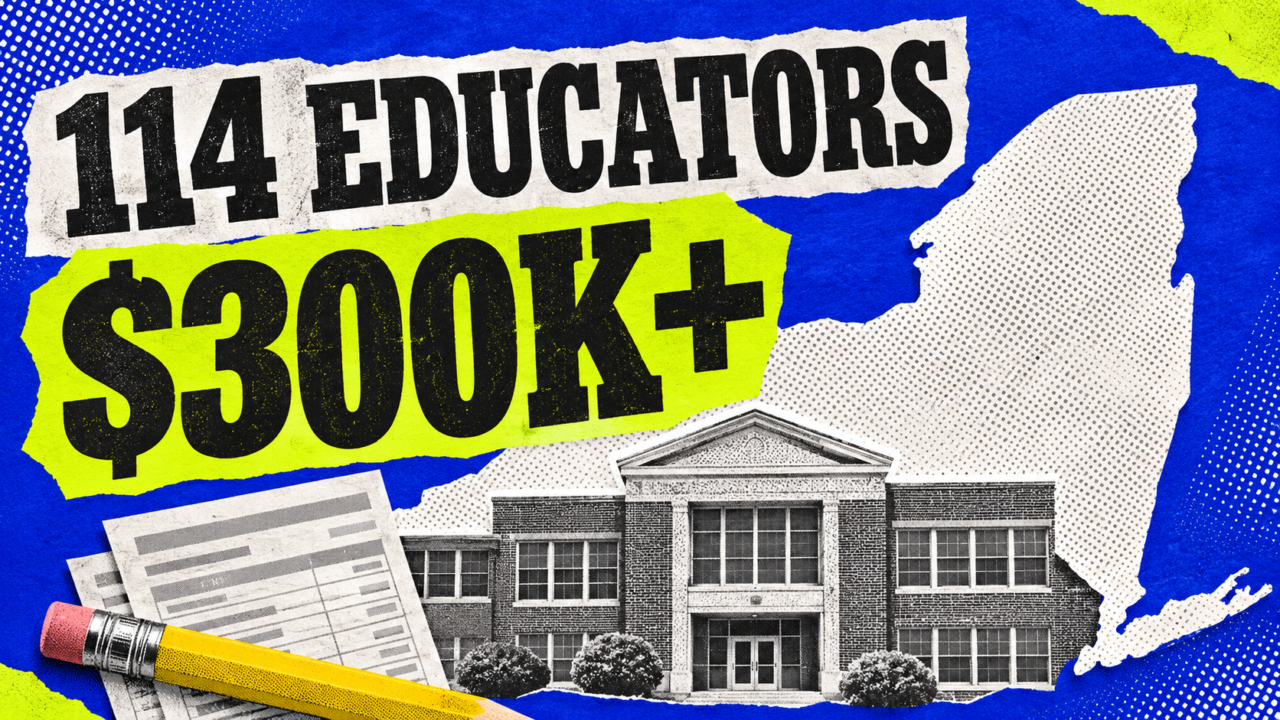
Former Moravia Superintendent John Birmingham received approximately $300,557 in reported pay during the 2025-26 fiscal year, the highest school district educator total across nine counties at the heart of the Finger Lakes.
Ithaca Superintendent Luvelle Brown followed at $292,442, while Palmyra-Macedon Superintendent Robert Ike received $256,409, according to newly released payroll records on SeeThroughNY.
The records accompany the Empire Center’s annual educator pay report, released Nov. 10. They cover the fiscal year ending June 30, 2026.
The payments are gross earnings rather than necessarily an employee’s regular annual salary. They can include extra-duty work, summer school and separation payments, and exclude benefits and employer pension contributions.
The highest reported pay in each county
A review of school district employees classified as educators in the Teachers’ Retirement System identified the following county leaders. Counties follow the district classifications in the Empire Center’s data, rather than employees’ home addresses; some districts serve communities across county lines.
The county links below open the corresponding payroll searches.
| County | Employee | School district | Reported pay |
|---|---|---|---|
| Cayuga | John Birmingham | Moravia | $300,557 |
| Livingston | Jeremy Lonneville | Livonia | $213,101 |
| Ontario | Timothy Terranova | Victor | $233,330 |
| Schuyler | Kristine Somerville | Watkins Glen | $182,118 |
| Seneca | Sarah Cupelli | Waterloo | $198,765 |
| Steuben | Michelle Caulfield | Corning-Painted Post | $239,296 |
| Tompkins | Luvelle Brown | Ithaca | $292,442 |
| Wayne | Robert Ike | Palmyra-Macedon | $256,409 |
| Yates | Gregory Baker | Penn Yan | $182,168 |
The table covers school districts. BOCES and community colleges are separate employers and are not included in these county rankings.
Among neighboring counties, East Syracuse Minoa’s Donna Desiato led Onondaga school districts at $310,881. East Irondequoit’s John Abbott led Monroe at $306,144, while Cortland’s Robert Edwards led Cortland County at $208,723.
Moravia’s figure follows superintendent’s departure
Birmingham’s total comes after his departure from Moravia. As FingerLakes1 previously reported, the school board approved a separation agreement June 30, 2025, following his voluntary leave.
The Empire Center identifies him as a former superintendent in its Central New York findings. The payroll entry reports a combined earnings figure without itemizing its components.
Other Cayuga County totals included Auburn’s Misty Slavic at $205,398 and Weedsport’s Gregory Stone at $202,728.
In Ontario County, Victor’s Terranova narrowly exceeded Geneva’s Lawrence Wright, who received $232,210. Canandaigua’s Jamie Farr followed at $224,773.
Wayne County’s next-highest totals after Ike included Lyons’ Matthew Barr at $233,508 and North Rose-Wolcott’s Michael Pullen at $221,467.
Superintendents do not lead every district
Watkins Glen’s highest-paid educator was Kristine Somerville, whom the district lists as its director of curriculum, instruction and assessment. Her $182,118 exceeded Superintendent Kai D’Alleva’s $180,000.
In Monroe County, Abbott is East Irondequoit’s deputy superintendent. His reported pay exceeded Brighton Superintendent Kevin McGowan’s $293,111 and Rochester Superintendent Eric Rosser’s $292,026.
Those examples illustrate why the data should be read as an educator payroll comparison rather than solely a superintendent salary ranking.
Regional averages remain below the statewide figure
The Empire Center’s Finger Lakes regional analysis found average full-time educator pay of $77,463, compared with $99,652 statewide.
That regional definition differs from the nine-county review above. It includes Genesee, Livingston, Monroe, Ontario, Orleans, Seneca, Wayne, Wyoming and Yates counties. Cayuga falls within the report’s Central New York region, while Tompkins, Schuyler and Steuben fall within the Southern Tier.
The center estimates full-time employment using an earnings threshold because the payroll records do not directly identify full-time status. The averages can therefore include some employees who worked part-time or only part of the year.

FingerLakes1.com is the region’s leading all-digital news publication. The company was founded in 1998 and has been keeping residents informed for more than two decades. Have a lead? Send it to news@fingerlakes1.com.