New York's attorney general will not seek criminal charges against an off-duty New York City police officer who struck and killed a pedestrian in Rockland County, finding that the evidence did not meet the legal standard for criminally negligent homicide.
The Office of Special Investigation's report, released Oct. 21, examined the death of William Huertas, 45, on Dec. 13, 2025, in Orangeburg. It documented an illegally tinted windshield on Officer Justin Belhouji's pickup truck.

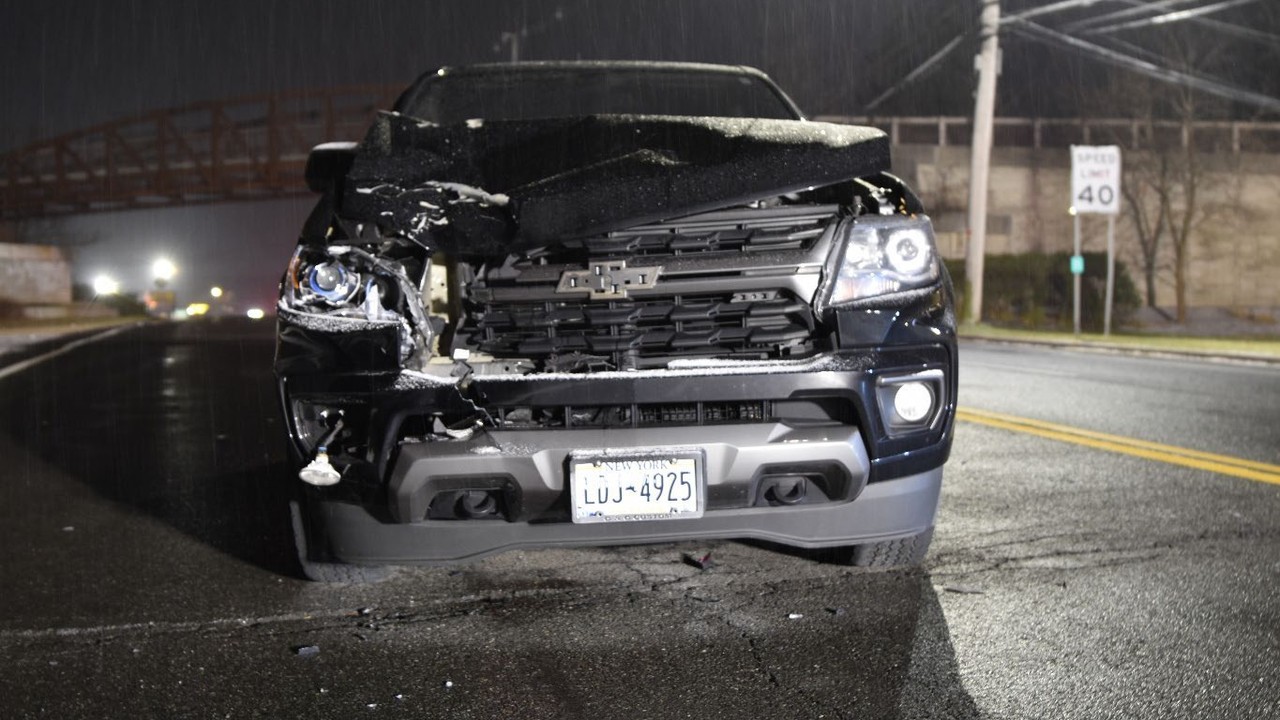
Huertas had finished his shift at Lowe's, at 206 Route 303, and was walking across the four-lane road when Belhouji struck him at about 9:05 p.m. Belhouji was driving north in his personal vehicle after leaving work.
The collision occurred beneath the Joseph B. Clarke Rail Trail pedestrian bridge. The road was dark, and Huertas was outside a marked crosswalk. The posted speed limit was 40 mph.
Lowe's security footage showed Huertas leaving the store at 9:01 p.m., crossing its parking lot and walking over a grassy embankment toward Route 303. Belhouji applied his brakes seconds before the impact, investigators said.
The video did not clearly establish which lane Huertas occupied when he was struck or which lane the truck occupied before the collision. The officer's vehicle had no dashboard camera.
Belhouji called 911 and began chest compressions. A passing nurse stopped and helped until an ambulance crew arrived. Huertas was taken to Montefiore Nyack Hospital and pronounced dead at 9:42 p.m. The medical examiner attributed his death to multiple blunt impact injuries and classified it as an accident.
Witnesses described the area as very dark. One driver following Belhouji said she had been traveling at the speed limit and believed his speed was consistent with hers. Other witnesses described the truck swerving before stopping.
Belhouji told investigators he saw Huertas suddenly near the passenger side, braked and swerved to avoid him. He estimated his speed at 40 to 50 mph but said he did not know how fast he had been traveling.
The officer declined to let investigators download the truck's event data recorder. Such devices can record speed, braking and steering around a crash, although an impact does not always trigger preservation of that information, the report said.
Orangetown police found no indication of alcohol or drug impairment in their tests. Belhouji's preliminary breath test registered a blood-alcohol concentration of 0.00%, and two eye tests were negative for impairment. Phone records showed no calls or text messages at or around the collision.
Using an estimate that Huertas came to rest about 200 feet from the point of impact, a collision investigator calculated his body-throw speed at 52 to 63 mph. That calculation assumed he was thrown the full distance and could overestimate speed if he had been lifted onto the truck before falling. The investigator could not determine the truck's actual speed and, after considering the available evidence, concluded Belhouji had not been traveling at an excessive speed.
The truck's windshield transmitted 28% of light, below the state's 70% minimum. The reconstruction investigator said the tint further reduced the driver's ability to see and react in nighttime conditions.
The attorney general's office reviewed that violation alongside the other evidence. Its legal analysis explained that prosecutors must prove beyond a reasonable doubt that a driver failed to perceive a substantial, unjustifiable risk of death, that this failure grossly departed from reasonable care, and that the driver engaged in seriously blameworthy, risk-creating conduct. The office concluded the illegal windshield tint alone did not elevate the traffic violation to criminally negligent homicide.
The report found insufficient evidence of dangerous speeding or other conduct meeting that standard. It cited the absence of impairment, phone use or a disregarded red light or stop sign, along with the reconstruction findings and witness account of the truck's speed.
The office will not present the case to a grand jury and closed the investigation with the report. State Executive Law requires it to issue a public report when an investigation into a death caused by an officer does not result in charges.

FingerLakes1.com is the region’s leading all-digital news publication. The company was founded in 1998 and has been keeping residents informed for more than two decades. Have a lead? Send it to news@fingerlakes1.com.