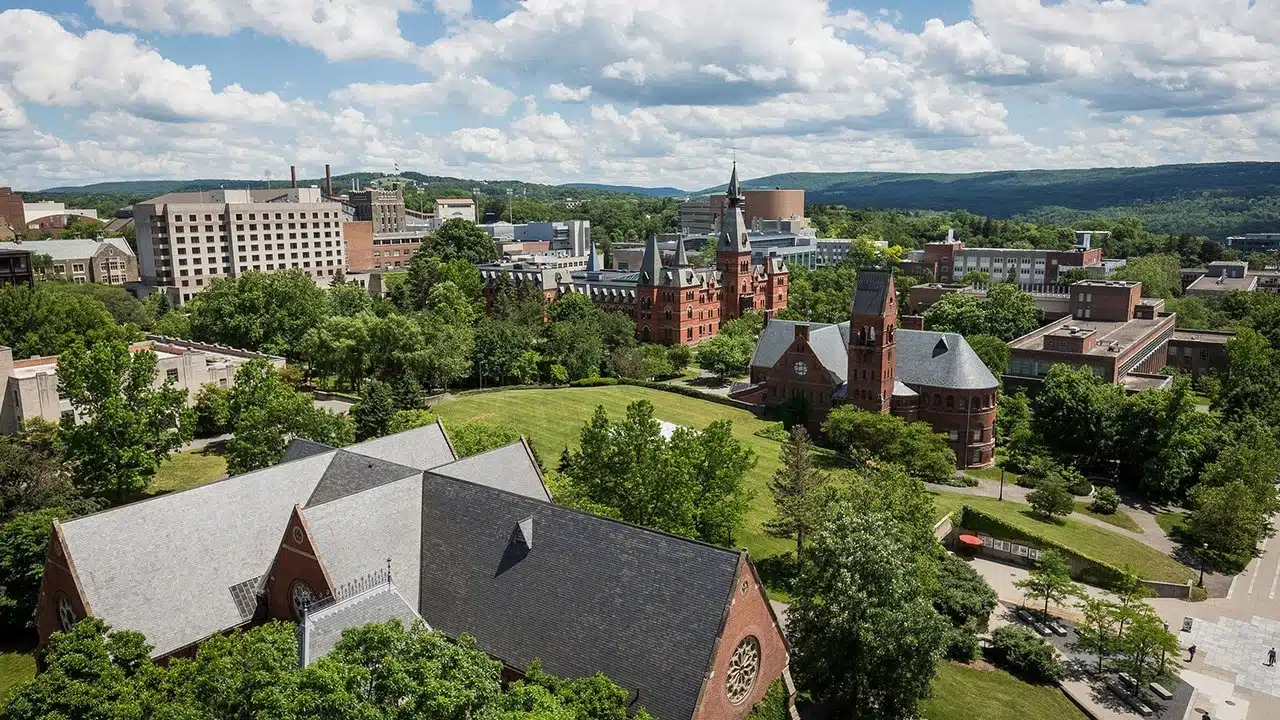
Cornell University will honor art historian Annetta Alexandridis at an Oct. 31 memorial and with a new campus display of four plaster figures she helped curate.
Colleagues and former students will discuss her work in classical art and archaeology from 11 a.m. to 1 p.m. in the Guerlac Room at A.D. White House, according to a Cornell Chronicle announcement. A 2 p.m. concert in Sage Chapel and a reception at the Herbert F. Johnson Museum of Art will follow.

Four figures to be displayed in Goldwin Smith Hall
The four female figures from Cornell’s Plaster Cast Collection will be installed in Goldwin Smith Hall this month in Alexandridis’ memory. Local conservator Kasia Maroney restored them. They show different approaches to depicting draped women at four points in history, said Verity Platt, a Cornell professor of classics and history of art and co-curator of the collection.
Platt said Alexandridis studied depictions of women and textiles in the ancient world. Her doctoral thesis and first book examined portraits of imperial women.
The figures will stand against a photograph of Sardis, Türkiye, where Alexandridis served as an associate director of the Harvard-Cornell Exploration of Ancient Sardis. The image shows the Temple of Artemis and a mountain with an ancient burial ground beyond it, Platt said.
Alexandridis researched Roman funerary culture in Sardis and was working on a survey of the city’s cemeteries with Susanne Ebbinghaus, a curator of ancient art at the Harvard Art Museums, and Leyla Uğurer, a doctoral candidate in history of art.
Concert to reflect her musical life
Alexandridis, who lived from 1968 to 2026, was an associate professor of history of art and visual studies in Cornell’s College of Arts and Sciences. Her research focused on ancient Greek and Roman art, including gender, animals and archaeological media. She also worked across Cornell’s classics, German studies and archaeology programs.
She was a pianist and supported campus music programs, including the Mayfest chamber music festival. Annette Richards, Cornell’s university organist, is organizing the memorial concert, which will include Cornell music faculty.
Roger Moseley, an associate professor of music, composed one of the four-hand piano variations to be performed in Alexandridis’ memory. He will play it with Sezi Seskir, Alexandridis’ former piano teacher and a music professor at Bucknell University.
The reception at the Johnson Museum will feature a Roman brick from the collection. Platt said Alexandridis used the modest object to teach students about Roman buildings, labor and power.
Members of the Cornell community are welcome at the Oct. 31 events. An RSVP is requested, and those joining remotely can request a Zoom link through the College of Arts and Sciences memorial notice.

FingerLakes1.com is the region’s leading all-digital news publication. The company was founded in 1998 and has been keeping residents informed for more than two decades. Have a lead? Send it to news@fingerlakes1.com.