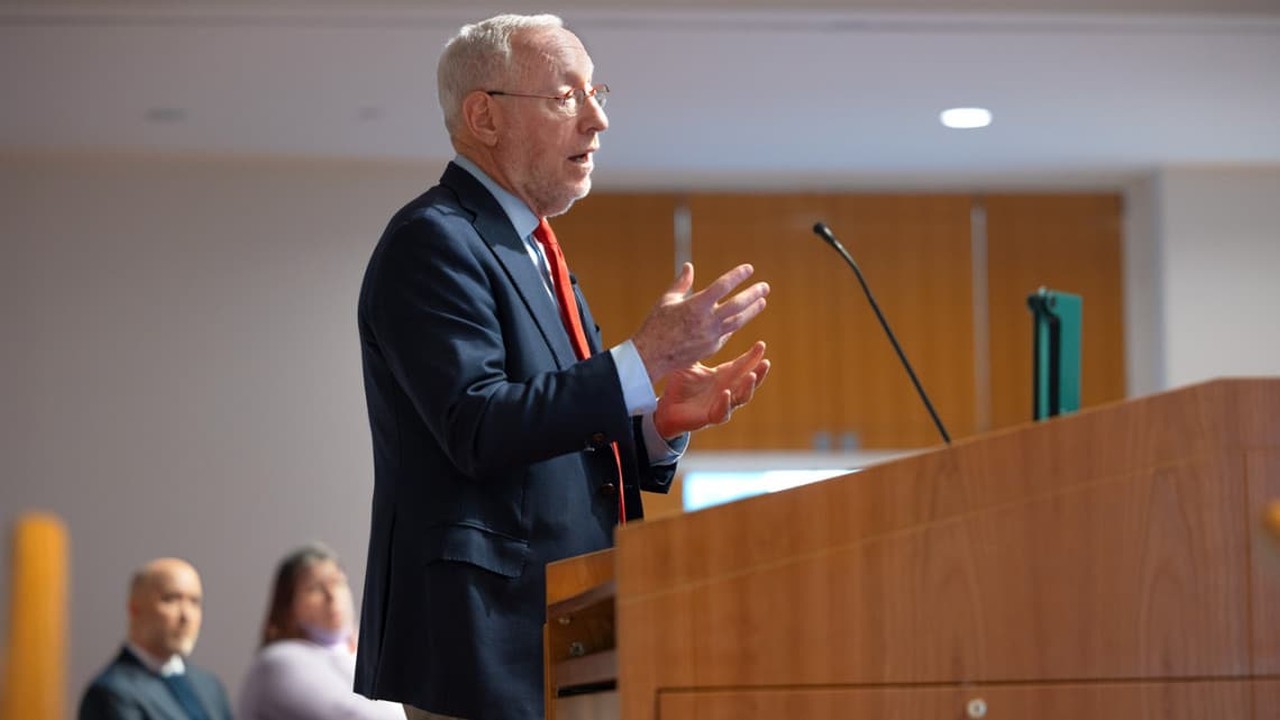
Ithaca College could reorganize its five current schools into three broader schools, moving business programs into an expanded Park School and bringing film and television together with music, theater and visual arts.
The model outlined by Provost Melanie Stein would also replace the standalone School of Humanities and Sciences administration with a structure that places its academic fields across the three schools. Existing degree programs would remain initially as the college works toward an organization intended to make it easier for students to combine interests and for faculty to collaborate.

The three-school proposal is a starting point for a multiyear planning process, rather than an approved reorganization. Trustees endorsed developing a new academic model Oct. 9, and Stein introduced one possible structure to faculty Oct. 13. A final structure would require further academic and operational work and board ratification.
Where would programs go?
The proposed schools have working names and conceptual groupings that remain open to revision.
The School of Health, Technology, and Scientific Discovery would bring together natural sciences, quantitative fields, psychology, public health and allied health programs. The college sees opportunities for shared courses, research and practical experiences linking scientific work with its application to human health.
The Roy H. Park School of Communication, Society, and Enterprise would combine communication, business, social sciences and humanities. Business degree programs would continue within that expanded school, creating closer administrative connections among fields that examine commerce, storytelling, organizations and public life.
The School of Performing, Visual, and Media Arts would include music, theater, visual arts, and cinematic and television arts. That would move cinematic and television arts from their current Park School home into a school organized around creative practice.
The changes would extend across all five current schools. The Park name would remain in the proposed expanded communication school, while the current Humanities and Sciences administrative structure would change. Its degree programs and faculty expertise would carry forward in the new groupings.
The college says liberal arts education would remain foundational for all students, with humanities, social sciences and natural sciences represented throughout the organization. Planning would need to protect the academic strength and identity of individual fields while building relationships among them.
What would change for current students?
The start of planning leaves current degree requirements and the existing school organization in place. A new structure would develop through later planning and approvals.
Students already take courses and pursue interests across school boundaries. Ithaca College says doing so can require navigating different administrative processes, coordinating requirements and working around organizational divisions.
Changing those boundaries could make it easier to develop connected courses, projects and combinations of study, with clearer advising and coordination. The college points to possible connections between health sciences and communication, business and music, and science and technology.
Those are goals for the planning process. The model does not establish a finished set of new majors or course combinations; faculty would develop opportunities as the structure takes shape.
The college has already changed its schedule grid, centralized academic support and introduced a cross-school major as part of its Ithaca Forever strategic plan. The proposed reorganization would take that work into the way schools themselves are arranged and resources are managed.
Stein also described business knowledge as useful across academic fields, saying alumni frequently tell her they wish they had taken business classes. The model would retain business programs while seeking more ways for students elsewhere in the college to use that expertise.

Would programs, jobs or buildings change?
All existing degree programs would remain initially under Stein's model. The college uses that qualification because academic offerings can evolve as faculty develop shared courses, new combinations of study or other approaches. Later curricular changes would require the appropriate academic review and approvals.
The model starts with existing faculty expertise rather than a plan built around faculty layoffs. Administrative leadership and support arrangements would need examination as the college considers moving to fewer schools.
A program's administrative move also would not automatically require students or faculty to move buildings. The model assumes no immediate facilities changes, and any later physical moves would require separate planning and communication.
The college says the discussion is broader than earlier decisions involving its artificial intelligence major or theater programs. Those concerned particular academic offerings; this process examines the organization of Academic Affairs across the institution and announces no additional changes to those programs.
School identities and alumni connections are another planning issue. The college says programs would need to retain their visibility, academic communities and relationships with graduates within the broader schools.
Would three schools save money?
Ithaca College describes enrollment and financial challenges at the institution alongside wider pressures on higher education: fewer traditional college-age students, questions about the value of a degree, political and cultural challenges, and technological change affecting learning and work.
Its academic framework has remained largely unchanged for decades, even as students increasingly seek combinations of liberal arts and professional education, according to the college.
Administrators argue that stronger connections among programs could help attract students and support their continued enrollment. They also say fewer school administrations could reduce expenses and duplication, with the amount depending on the final leadership and support arrangements.
The college presents those potential savings as one part of a broader academic and financial strategy. Reorganization alone would not resolve its enrollment and financial challenges; its value would depend on the educational opportunities and operational improvements that follow.
Who would decide, and when?
Stein, the provost and executive vice president for academic affairs, would lead planning with faculty participation and support from President La Jerne Terry Cornish and the trustees. She is assembling an Organizing for Opportunity Transition Team to help develop the model and create opportunities for broader participation.
Faculty and other participants could examine the proposed groupings, raise operational concerns and suggest refinements or alternatives that meet the same goals. Curriculum, academic rigor, accreditation, workload and support for individual programs are among the questions faculty would help address.
The work is beginning during a presidential transition and interim appointments in several leadership roles. The college says starting now would give the incoming president a foundation of planning and campus discussion to help shape.
In explaining those transitions, the college said former business dean Michael Johnson-Cramer left for another appointment and former Park dean Amy Falkner left to spend more time with her family. It describes Stein's structure as a planning proposal, rather than a model settled by those departures.
The preliminary sequence begins with discussion, refinement and academic and operational planning before trustees consider a final structure. Later phases would establish the organization and its leadership arrangements and develop curricular opportunities. Timing would depend on the model, required approvals and transition work for students and faculty.
The college plans to provide participation opportunities and subsequent steps in the next phase.

FingerLakes1.com is the region’s leading all-digital news publication. The company was founded in 1998 and has been keeping residents informed for more than two decades. Have a lead? Send it to news@fingerlakes1.com.