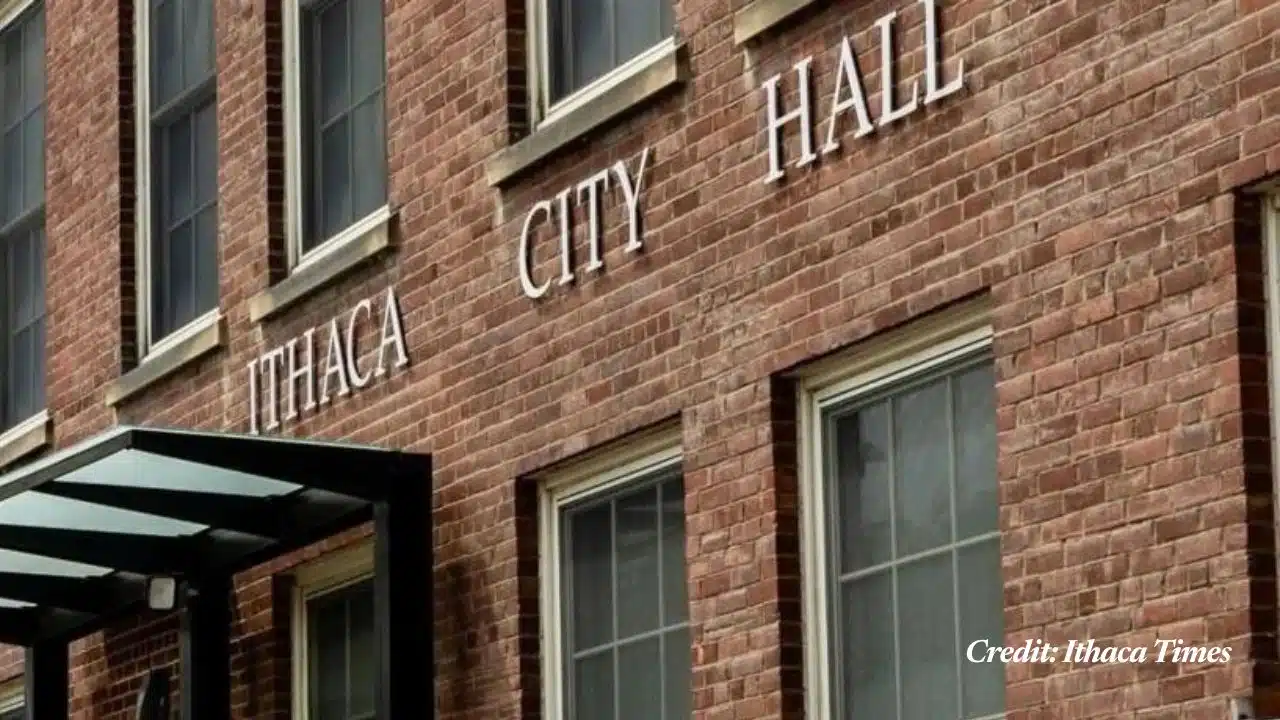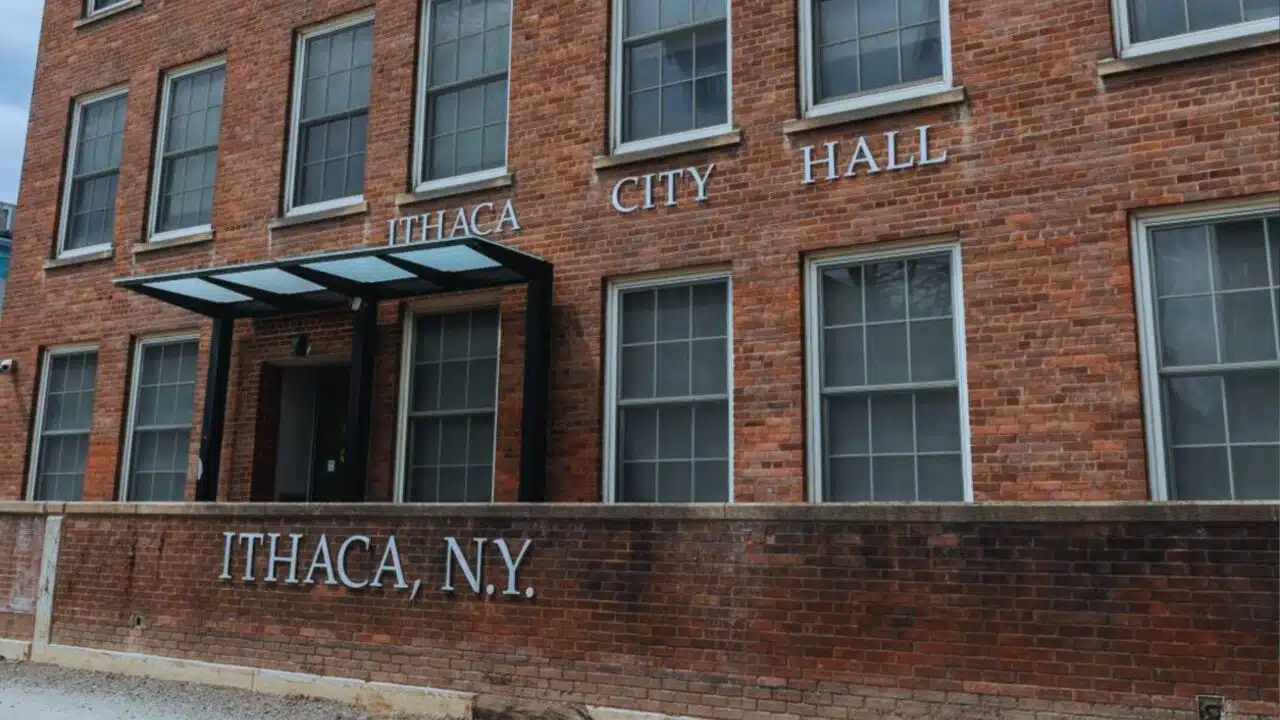
Ithaca’s Common Council approved raises for elected officials, temporarily restricted new permits for Cornell University and affiliated organizations, and authorized public-safety and infrastructure funding during its Oct. 7 meeting.
The actions were detailed in an Oct. 9 city summary. Council also postponed a proposed property tax cap override until Oct. 21 as discussions continue on the recommended 2027 budget.
Mayor and Council salaries will rise in January
Council approved legislation increasing the mayor’s annual salary from $30,000 to $52,166.40 and Council members’ annual salaries from $17,091 to $19,562.40, effective Jan. 1, 2027.
The mayoral compensation measure also requires further study of the position’s pay by Aug. 4, 2027.
Public hearings drew differing views about the increases, according to the city. Supporters argued that the mayor’s responsibilities amount to a full-time job and that compensation should reflect the work. Others questioned the timing, affordability and priority of raises amid the city’s financial challenges.
Council separately appointed Dominick Recckio as permanent city manager. He had served in an acting capacity since Jan. 1.
A new five-member Council committee will examine the roles of the mayor, Council and city manager, including how responsibility for setting policy differs from managing daily operations. Its recommendations are due by June 30, 2027.
Cornell permit restrictions include protected-activity exemption
Council adopted a temporary moratorium on new assembly, parade, special-event, Commons and noise permits for Cornell University and affiliated student organizations, including fraternities and sororities.
The resolution cited concerns about sexual violence, gender-based harassment and public safety at permitted gatherings. Council revised the measure to request that Cornell University Police direct calls involving violent and sexual allegations to Ithaca police.
The moratorium took effect immediately and expires Nov. 5 unless Council acts again. It may be extended through resolutions in 30-day increments.
Constitutionally protected activities are expressly exempt. The city must continue processing and issuing required permits for those activities as provided by law.
According to the city’s summary, supporters described the action as a public-safety measure that allows time for further review. Others questioned its legal authority, effectiveness and effect on organizations unconnected to the reported allegations.
Police and fire grants support prevention, radios and rescue training
Council accepted $176,289 in state Gun Involved Violence Elimination funding for 2026-27.
The money will support violence prevention, crime analysis, community engagement, focused deterrence and a violence interrupter contract. Eligible expenses include overtime, youth engagement, training, software improvements and equipment.
Council also accepted a federal Assistance to Firefighters Grant for P25-compliant portable radios. The city said the equipment will improve communication between the Ithaca Fire Department and partner agencies. Existing department funds will cover the local match.
A separate $43,500 state grant supports confined-space rescue training, including $20,639.20 in firefighter overtime reimbursement. The training resulted in technician-level certifications for department members, according to the city.
Council amended the fire prevention code to establish a $250 minimum fine for general violations. The change removes incarceration as a penalty for failing to comply with an enforcement order but retains possible imprisonment when a violation causes injury.
Wastewater engineering, sidewalks and rink reimbursement advance
Council increased the city’s wastewater treatment capital project authorization by $560,572 for additional engineering services.
The work supports approximately $37.8 million in planned facility improvements addressing aging systems, regulatory requirements, treatment upgrades, equipment replacement and building repairs.
A $15,000 Park Foundation grant will cover the city’s share of City Thread technical assistance for bike lanes, multiuse paths, trails and other Complete Streets planning.
Council also reaccepted a $523,269 Environmental Protection Fund grant for the completed Cass Park Rink enclosure project, allowing the city to seek reimbursement for eligible expenses.

The 2027 Sidewalk Improvement District assessment roll, budget and work schedule were adopted through the sidewalk program’s resolutions and local law. The program covers construction, repairs, accessibility and pedestrian safety.
A separate sidewalk amendment addresses defenses available to property owners cited for uncleared snow or ice. Owners must demonstrate that snowfall began within the previous 24 hours or that frozen conditions prevented safe removal and had been treated to reduce hazards.
The fee for no-parking signs near private driveways will increase from $50 to $150. Council eliminated the five-year renewal requirement and its $25 fee.
Tax cap decision waits as budget review continues
Council held a hearing on legislation that would allow a 2027 budget exceeding the state tax levy limit but tabled the measure until Oct. 21.
An override would permit Council to exceed the limit; it would not itself establish the final levy or require a tax increase beyond the cap.
Recckio delivered his recommended 2027 budget Oct. 2 along with a five-year capital improvement plan. The city said an estimated gap exceeding $8 million during budget development prompted departments to identify spending reductions, efficiencies and revenue opportunities.
The recommended budget and supporting materials are available on the city’s budget page.
Council reauthorized the room occupancy tax for three years to support conference center obligations and related economic development initiatives. It also established a $50 temporary noise permit application fee and a $50 noise variance petition filing fee.
City reports $147.7 million in debt and progress on overdue audits
The controller’s report showed approximately $51.9 million in General Fund revenue through August, about 60% of the annual revenue budget. Property tax collections reached roughly 93% of budgeted expectations.
Revenue associated with Cornell’s memorandum of understanding contributed to gifts, donations and miscellaneous receipts, according to the city.
General Fund spending totaled approximately $49.9 million through August, about 56% of the annual budget. Vacancies kept salary expenses below budget, while health insurance costs were running above expectations.
Combined short- and long-term debt across city funds totaled approximately $147.7 million: $94.5 million in bonds and $53.2 million in bond anticipation notes.
The city attributed increased short-term borrowing partly to capital projects awaiting grant reimbursements. Staff are working to reduce debt through reimbursements and outside funding.
Drescher & Malecki LLP has begun reviewing 2022 financial records and conducting on-site work toward completing overdue audits.
Garage safety, flood planning and staffing remain active
The city said the Seneca Street Garage closed because deteriorating exterior concrete panels posed a danger to pedestrians and transit users below. Public Works crews removed loose concrete and installed protective netting and scaffolding.
The city manager reported that the Cayuga Street Garage has 688 spaces and average daily occupancy of approximately 48%.
City staff and Barton & Loguidice consultants visited Cascadilla Creek and Six Mile Creek as part of flood mitigation planning. Updated documentation seeking revisions to FEMA flood mapping is expected to be resubmitted soon.
Interviews continue for the ROOTS Community Responder Program, with a fall launch anticipated. A public kickoff is planned after staff are hired and onboarded.
The city also hopes to hire a planning and development director before year’s end, allowing an overlap with Lisa Nicholas before her January retirement.
A tracking system is being developed for the 2026-27 Executive Work Plan, with the first formal progress report expected in December. Organizational Development Director Kehar Khan is leading additional work on collaboration and departmental performance.
Council revised its advisory commission framework to allow commissions to be created, changed or discontinued by resolution and reestablished the Sustainability and Climate Justice Commission.
Minor amendments to the municipal health insurance consortium agreement updated its membership list to include the Town of Manlius and Village of Nunda.

FingerLakes1.com is the region’s leading all-digital news publication. The company was founded in 1998 and has been keeping residents informed for more than two decades. Have a lead? Send it to news@fingerlakes1.com.