


Research on sediments uncovered beneath a new Hobart and William Smith science building could help researchers test whether glaciers retreated steadily from the Finger Lakes or returned after an earlier retreat.
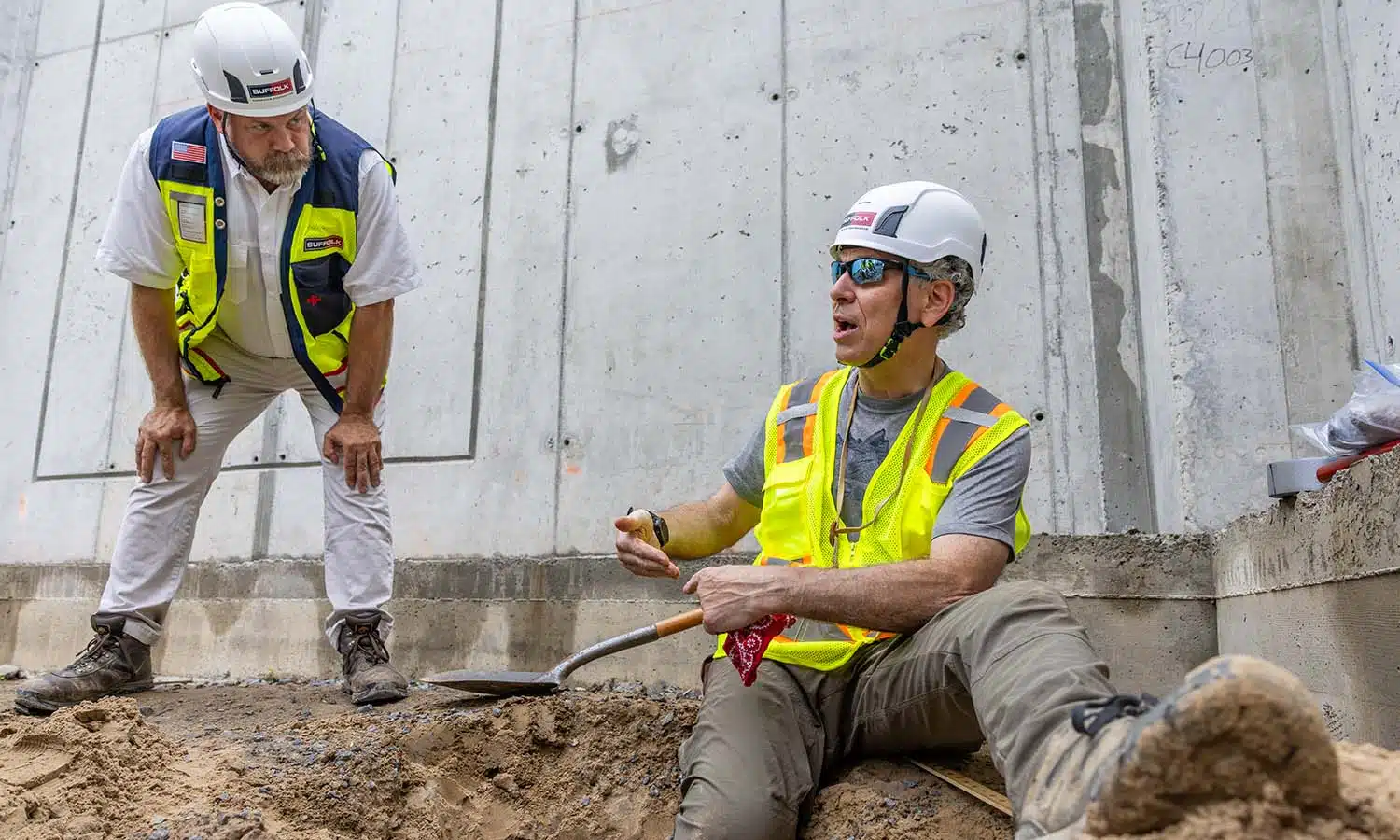
Geoscience professors Tara Curtin and David Finkelstein collected dozens of samples during two weeks this summer before construction crews laid the Fish Center for the Sciences foundation, according to the colleges' account. Some samples will undergo outside laboratory dating, with results expected in 12 to 18 months.

The layers were found eight feet below what had been Eaton Hall's basement. Suffolk Construction senior superintendent Steve Bell first noticed a patch of gray clay that differed from surrounding material in an area about the size of a Volkswagen Beetle.
Bell asked for nearby geoscientists to examine it. Curtin and Finkelstein initially questioned how the clay related to glacial till, but the sequence they saw at the site drew their attention: sand below, till above it and laminated lake sediment on top.
Three layers preserve an incomplete history
Each layer may record a different environment and help establish the chronology of ice movement. When a glacier stops moving and melts, dirt, gravel and boulders can settle gently without being smeared by moving ice or washed away, the colleges explained.
Glaciers may have advanced and retreated repeatedly across the region during the past 2.6 million years, Curtin said. Later ice sheets erased much of the evidence from earlier ones, leaving an incomplete record.
One hypothesis holds that the ice retreated northward. Another suggests it retreated and then advanced again across parts of the Finger Lakes. The deposits beneath the Fish Center may provide evidence to test those alternatives, but researchers have not yet established their ages.
Geologists can follow moraines, ridges of material left along glacier edges, but tracing them across the Finger Lakes is difficult. Finding deposits suitable for dating is harder still, Curtin said.
“It really all comes down to the age,” she said.
Dating will test how old the sand is
Some samples will undergo optically stimulated luminescence dating, which can determine when grains were last exposed to sunlight. Dating the bottom sand layer could be particularly useful for understanding the sequence above it.
Curtin said the sand might be much older than a roughly 15,000-year-old deposit: possibly 40,000 or 80,000 years old. Those are possibilities to investigate, not established dates.
“We've got three layers that are easily explained,” Curtin said. “We can get an idea about when they were deposited and figure out if the ice did advance again or not.”
Students will investigate an unanswered question
Other samples will be used in Curtin's Geomorphology and Sediments and Sedimentary Rocks courses. Students will compare the excavated sand with known wind- and water-deposited samples and investigate how the sand, till and clay formed.
Their questions include what the sand is, its age, how it was deposited and what it reveals about the region's history. A class project will examine the timing of different events to better understand how ice sheets grow and shrink.
Curtin said that work can help students consider what is possible in places such as Greenland and Antarctica. She said she values projects where neither students nor instructors already know the answer.
By the time the Fish Center opens, some excavated material will return to the building as classroom and laboratory samples. The outside dating results will help determine what the layers can establish about the Finger Lakes' glacial history.

FingerLakes1.com is the region’s leading all-digital news publication. The company was founded in 1998 and has been keeping residents informed for more than two decades. Have a lead? Send it to news@fingerlakes1.com.